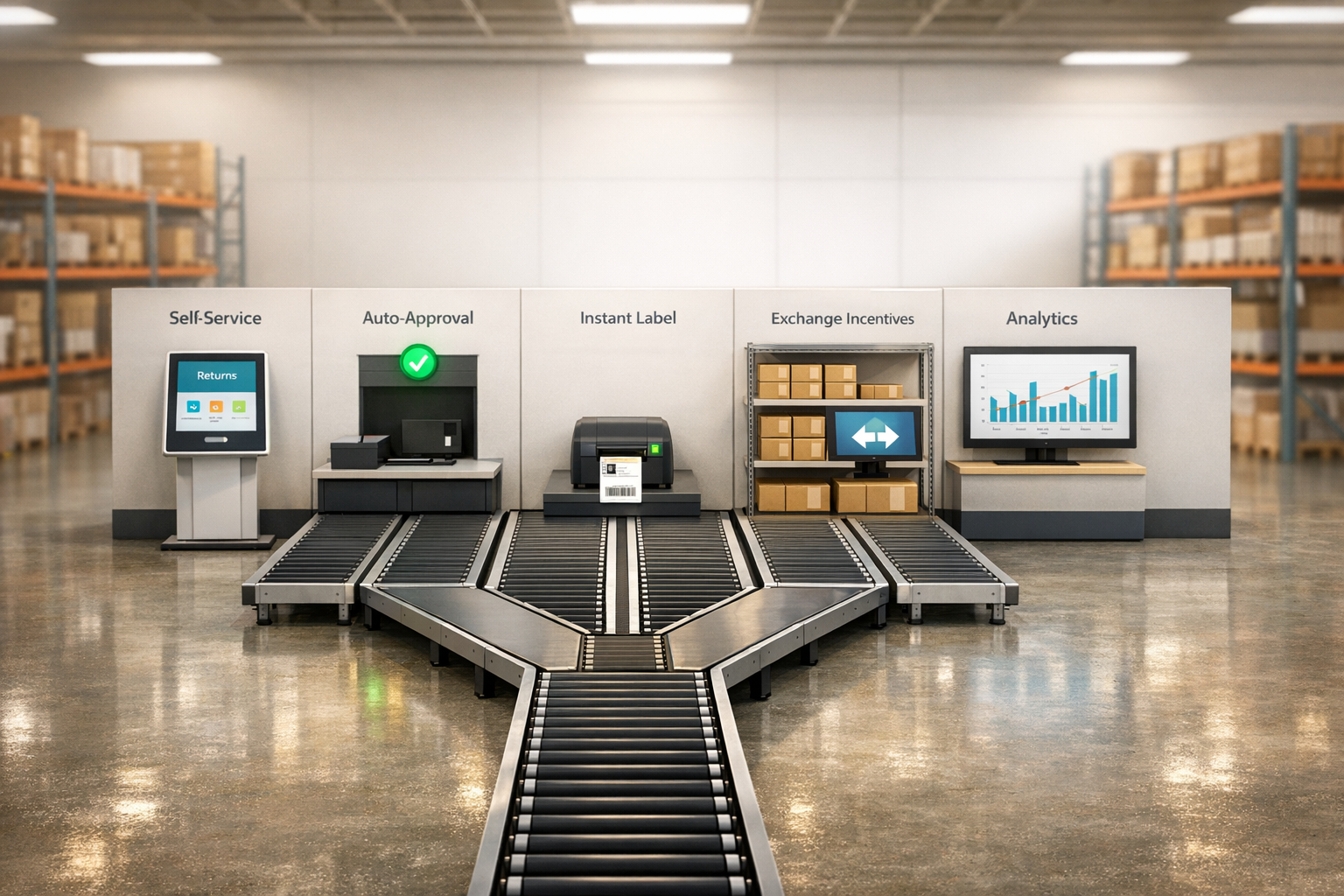
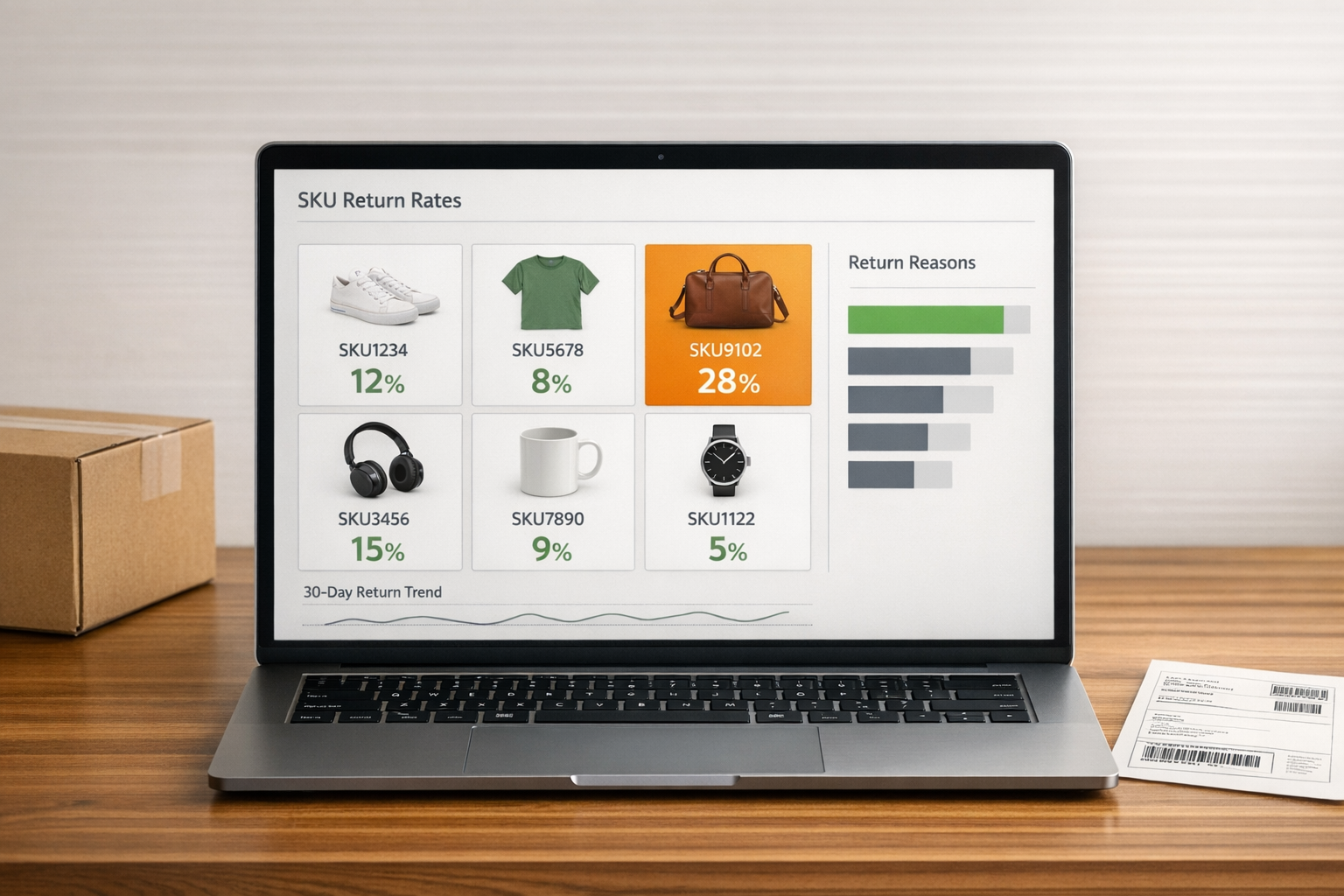
Return fraud is costing U.S. retailers over $103 billion annually, with schemes like wardrobing, item switching, and AI-generated false claims becoming more common. Traditional fraud prevention methods can't keep up with this growing problem, especially for Shopify merchants who face tight margins.
AI-powered tools are now key to tackling these scams. They analyze patterns, detect anomalies, and flag suspicious behavior instantly, protecting businesses while ensuring a smooth experience for honest customers. From identifying fake product damage to spotting bracketing trends, AI helps reduce losses and streamline returns.
Key Points:
- $103 billion lost to return fraud annually (15% of all returns).
- Common scams: wardrobing, bracketing, counterfeit swaps, and shallowfake claims.
- AI detects fraud using image analysis, behavioral tracking, and risk scoring.
- Tools like Forthroute automate fraud detection and promote exchanges to minimize revenue loss.
AI isn't just a solution - it's a necessity for e-commerce businesses to stay ahead of increasingly sophisticated fraud tactics.
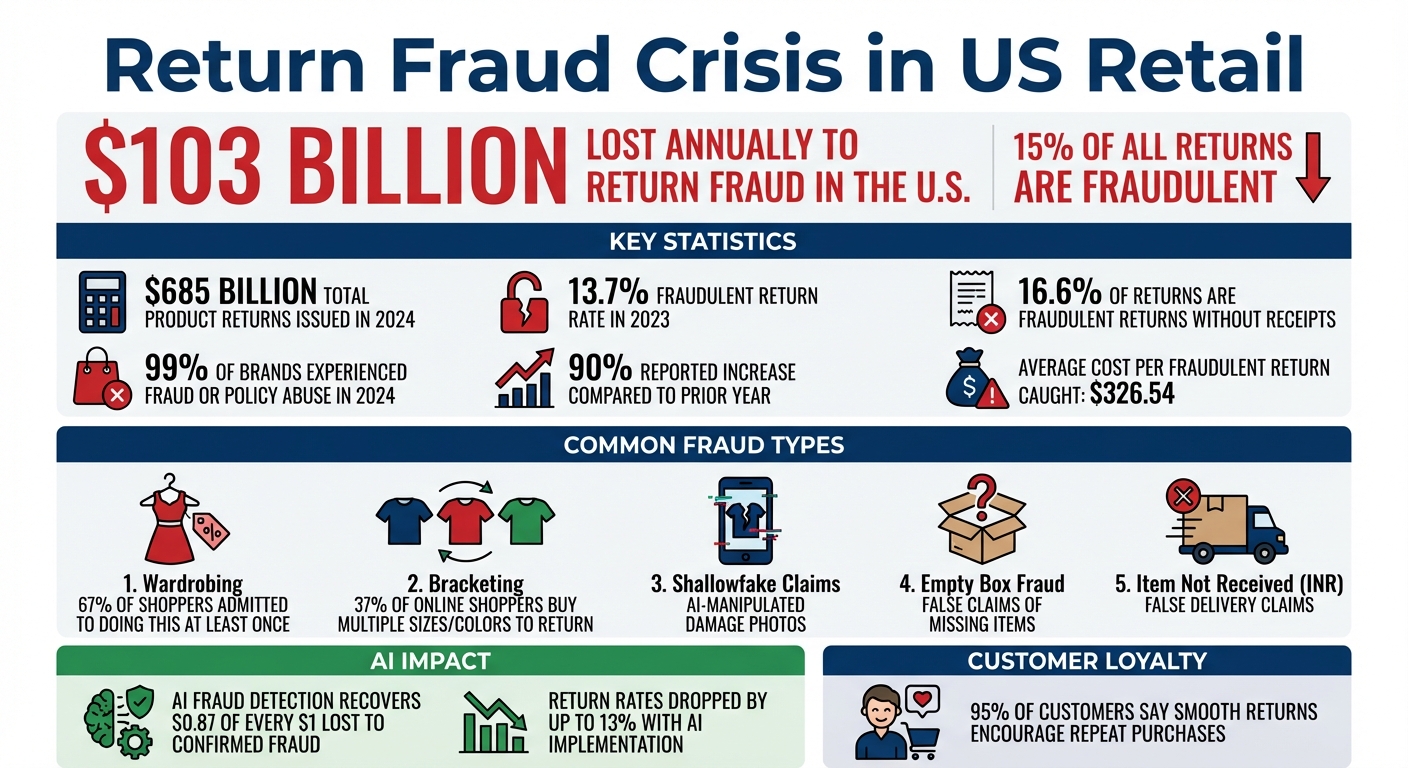
Return Fraud Statistics and Impact on US Retailers 2024
How UPS Is Using AI to Fight Return Fraud at Scale | Logistics AI Explained
Common Types of Return Fraud in Ecommerce
To use AI effectively in combating return fraud, merchants must first understand the various tactics fraudsters use. These schemes are no small problem - U.S. retailers are projected to lose between $101 billion and $103 billion in 2024, which accounts for about 15% of all returns. Below are some of the most common types of fraudulent returns.
Wardrobing and Item Switching
A late 2024 study revealed that over two-thirds of shoppers admitted to engaging in wardrobing at least once. This practice often involves buying clothing or accessories, using them briefly - like influencers who purchase outfits for social media photos - and then returning 85% of their haul after their photoshoots.
"Wardrobing is frequently regarded as harmless by people who do it, yet it is still a fraud." - Steve Pogson, Founder and Ecommerce Strategy Lead, FirstPier
Item switching, on the other hand, involves more deliberate deception. For example, bricking occurs when fraudsters strip valuable internal components - like processors from computers or circuit boards from phones - and return the hollowed-out item for a full refund. Another tactic, price arbitrage, involves buying a new version of a product and returning an older, used version in the new packaging. High-end brands are also vulnerable to counterfeit swaps, where authentic items are replaced with convincing fakes before being returned.
These swapping schemes often pave the way for other types of fraud, such as receipt manipulation and exploiting return policies.
Receipt Fraud and Policy Exploitation
Receipt fraud involves using fake, stolen, or even AI-generated receipts to return items that were never purchased - or, in some cases, items that were shoplifted. Fraudulent returns without receipts alone make up an estimated 16.6% of all returns.
Another widespread tactic is bracketing, where 37% of online shoppers admit to buying multiple sizes or variations of a product, intending to return the ones that don’t work for them.
While receipt fraud manipulates documentation, refund fraud relies on outright false claims to secure refunds.
Refund Fraud and False Return Claims
This category includes some of the boldest schemes. For instance, empty box fraud involves claiming a package arrived empty - or returning a box filled with rocks or weights - to trigger a refund before the item can be inspected. Each fraudulent return caught by automated systems costs an average of $326.54, making these incidents especially damaging.
Shallowfake damage claims are another growing concern. Fraudsters use AI to manipulate images, creating fake evidence of product damage. These altered photos often bypass basic visual checks in automated systems, allowing scammers to collect refunds without returning the actual item. Additionally, Item Not Received (INR) claims, where customers falsely state that a package never arrived despite proof of delivery, are quickly becoming a major issue. When merchants successfully block return fraud, scammers frequently shift to filing chargebacks, leading to extra dispute fees and increased risks for the merchant’s account.
| Fraud Type | Primary Tactic | Common Target Industries |
|---|---|---|
| Wardrobing | Purchase, use, and return | Fashion, Luxury, Electronics |
| Bricking | Strip valuable internal components | Consumer Electronics, Hardware |
| Bracketing | Buy multiple variants to try on | Apparel, Footwear |
| Shallowfakes | AI-manipulated damage photos | Electronics, Luxury Handbags |
| Empty Box | Claiming item was missing from delivery | Local Delivery, High-value Goods |
How AI Detects Return Fraud
AI technology has become a powerful tool for spotting fraudulent returns, using a mix of advanced techniques. By analyzing product images, customer behavior, and historical data, AI can uncover inconsistencies that might escape human reviewers. These methods work together seamlessly to catch fraud early.
Image Recognition and Photo Verification
The first line of defense against visual fraud is AI-driven image analysis. When customers submit photos of damaged products, AI tools step in to verify their authenticity. These systems can identify signs of tampering, like Photoshop edits, by creating heatmaps to spot cloned scratches or fake dents. They also examine metadata to confirm when and where an image was captured. If metadata doesn’t match up, it raises an alert. For high-value returns, some systems even require real-time video or multi-angle photos to ensure accuracy. Additionally, AI uses duplicate fingerprinting to compare new images with historical records, helping flag repeat offenders.
"United States merchants issued an estimated $685 billion USD in product returns in 2024 and roughly $103 billion USD of that mountain was fraudulent." - Team VAARHAFT
Pattern Recognition and Anomaly Detection
Once images pass verification, AI digs into historical data to identify unusual patterns of behavior. These systems can flag suspicious activities like multiple shipping addresses tied to one account, frequent returns of entire orders, or mismatches between a shipping destination and a return’s origin. Predictive AI also identifies behaviors like bracketing - when customers buy multiple sizes or colors intending to return most - or wardrobing, where items are used and then returned.
AI further tracks digital red flags, such as the use of VPNs, temporary email addresses, or disposable phone numbers. Retailers using these models have seen return rates drop by up to 13%. They’ve also detected emerging scams like Fake Tracking ID fraud, where shipping labels are altered to falsely show a delivered status, triggering refunds.
"Predictive AI is essential in helping retailers analyze transactions, such as reviewing a shopper's historical data and looking for anomalies in a transaction, such as a purchase with multiple addresses or repeated returns of all purchased items from an order." - Dean Abbott, Chief Data Scientist, Appriss Retail
Behavioral Analysis and Risk Scoring
AI doesn’t just stop at visuals and patterns - it also evaluates customer behavior to assign risk scores for return requests. Every return is analyzed based on factors like device metadata, IP addresses, refund amounts, and the specific items being returned. High-risk returns are flagged for further review, giving merchants insight into the reasons behind the alert, such as frequent returns or a history of confirmed fraud.
"Loop's Fraud Model uses machine learning to evaluate fraud risk on returns in real time as they are submitted... enhancing accuracy and minimizing false positives to ensure higher trust and confidence." - Loop Returns
This approach allows low-risk returns to be processed automatically, while high-risk cases are sent for manual review. In 2023, fraudulent returns accounted for 13.7% of all returns, leading to a staggering $101 billion loss.
sbb-itb-a3e286c
AI-Powered Fraud Detection with Forthroute
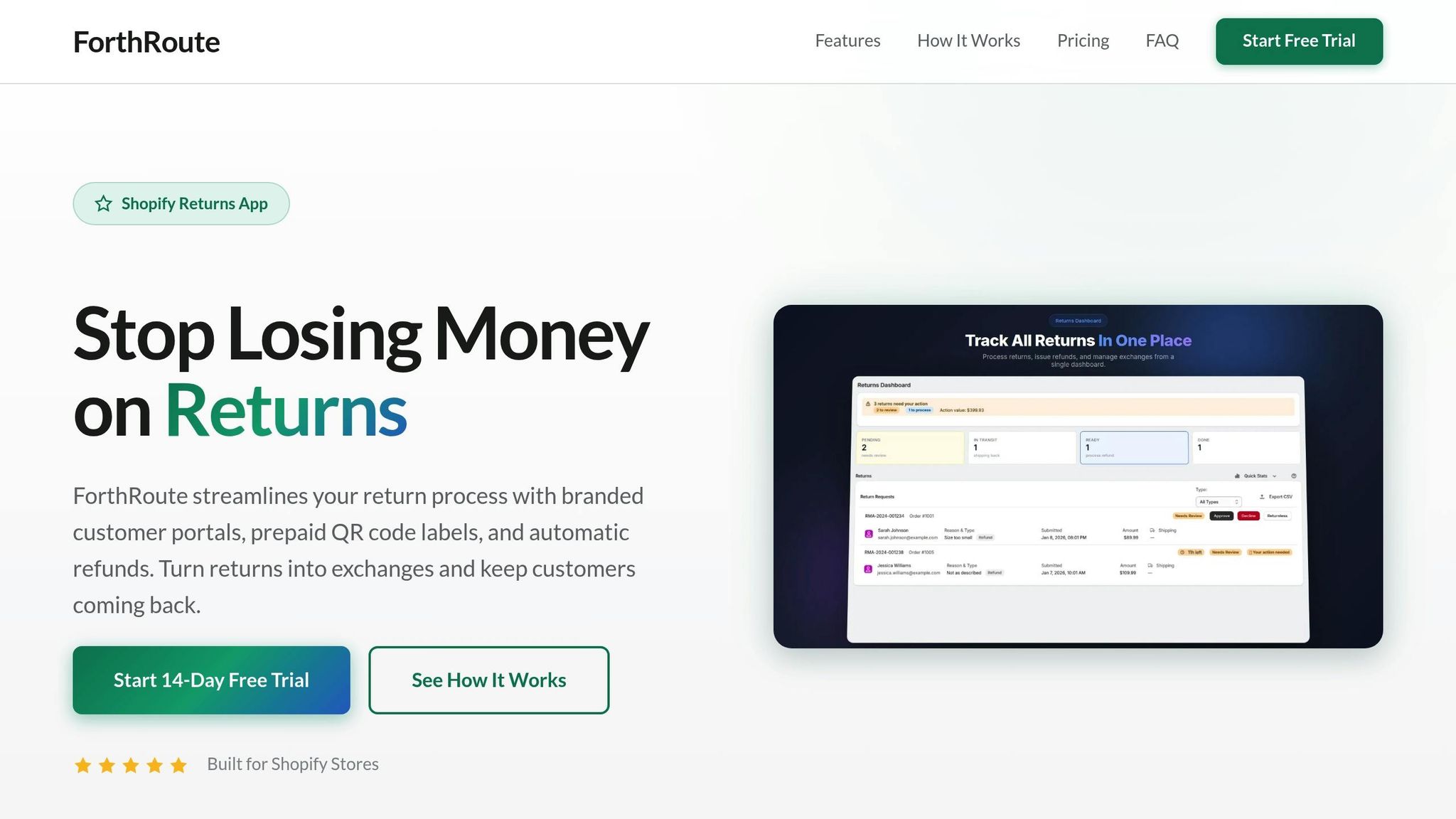
Building on the latest advancements in AI detection, Forthroute takes fraud prevention to the next level by seamlessly integrating it into the Shopify returns process. The platform combines machine learning with smart automation to identify fraudulent activity while ensuring a hassle-free experience for genuine customers. Instead of manually sifting through every return request, Forthroute allows you to set up intelligent safeguards that streamline the process and protect your revenue.
Automating Fraud Detection with Smart Rules
Forthroute enables you to create custom rules that automatically filter return requests based on criteria you set. For example, you can auto-approve returns under $50, flag higher-value requests for review, or block returns for "final sale" items or those outside the return window.
For high-risk returns, the platform offers flexible options like routing them for manual inspection, disabling "Keep Item" refunds for suspicious cases, or delaying processing to "after inspection" instead of "on scan" to combat empty box fraud. Best of all, setup takes just five minutes and requires no coding skills.
Exchange-First Approach to Keep Revenue
Beyond fraud detection, Forthroute helps transform standard returns into revenue-saving exchanges. By prioritizing exchanges and store credit over refunds, the platform ensures that customers can apply credit immediately while refunds are deferred until items are inspected. The "Instant Exchanges" feature allows customers to use their credit to purchase new items right away, keeping revenue within your business.
"95% of customers indicate that a smooth returns process encourages them to purchase from a merchant again".
By making exchanges the easiest option, Forthroute not only minimizes revenue loss but also strengthens customer loyalty.
AI-Powered Product Suggestions
Forthroute doesn’t stop at fraud prevention and exchanges - it also leverages AI to turn return reasons into actionable opportunities. When a customer selects a reason like "Too small" or "Wrong color", the system suggests alternative products, such as a larger size or a different style. These recommendations appear during the return process, engaging customers at the perfect moment to convert a refund request into an exchange. This smart approach helps retain revenue while improving the customer experience.
Best Practices for Implementing AI in Returns Automation
Set Clear Return Policies and Automation Rules
Establishing clear return policies is essential. For instance, you might set a 30-day limit for refunds, extend store credit options to 45 days, and limit cash refunds to a 15-day window to help deter fraudulent activity.
With tools like Forthroute, you can implement layered automation rules to streamline the process. For example: automatically approve returns under $50, flag high-value requests for review, and reject returns for final sale items. To combat schemes like empty box fraud, you can delay processing high-risk cases until after a thorough inspection.
"Robust record-keeping is key to staying ahead of scammers."
- Brian Case, Director of Ecommerce and Retail, Selkirk
These well-defined policies not only protect your business but also provide a foundation for leveraging return data more effectively.
Use Data Insights to Improve Your Process
Return analytics can uncover patterns that manual reviews often miss. For example, if multiple customers cite "Too small" as a reason for returning an item, the issue may be related to product sizing rather than fraud. Additionally, serial returners are a growing concern - 42% of U.S. retailers in 2024 reported an increase in habitual returners. Use this data to create blocklists that redirect repeat offenders to customer service for manual handling instead of automated processing.
Keep an eye on geographic inconsistencies, such as mismatched shipping and return addresses, which can indicate fraud. Monitoring device and identity data is also critical, as fraudsters often attempt to hide their digital footprints. In 2024, 99% of brands reported experiencing fraud or policy abuse, with 90% noting an increase compared to the prior year. Regularly reviewing your Forthroute dashboard can help you detect sudden spikes in return rates or unusual patterns before they negatively affect your bottom line.
By consistently analyzing return data, you can ensure that your AI remains agile and responsive to new fraud tactics.
Monitor and Update AI Systems Regularly
AI systems require regular updates to stay effective. Using built-in feedback loops, you can train your AI to recognize emerging fraud patterns. This kind of continuous learning sets dynamic AI systems apart from static, rule-based models.
Schedule quarterly reviews of your automation rules to ensure they align with the latest fraud trends. AI fraud detection tools, when properly maintained, can recover $0.87 of every $1 lost to confirmed fraudulent transactions. To maximize this potential, set reminders to audit return reasons, identify new fraud tactics, and adjust your processing workflows based on updated data.
This ongoing maintenance not only strengthens your fraud prevention efforts but also ensures your AI system adapts to the ever-changing landscape of returns management.
Conclusion
AI-powered fraud detection is reshaping the way returns are managed by analyzing transactions in real time, flagging suspicious cases before refunds are issued, and allowing your team to focus on the 95% of customers who are honest. This highlights the importance of solutions that not only catch fraud quickly but also maintain a smooth shopping experience for legitimate buyers.
These advanced systems can uncover complex schemes like Fake Tracking ID (FTID) fraud, wardrobing, and altered images that might slip past manual checks. By using tiered processing - such as providing instant store credit for low-risk returns and reserving inspections for high-value items - you can safeguard your profits while keeping the process hassle-free for honest customers.
For Shopify merchants, tools like Forthroute simplify returns by automating approvals, prioritizing exchanges, and using AI to suggest products that retain revenue. As discussed earlier, combining straightforward return policies with automation can significantly reduce fraud-related losses.
Fraud tactics are constantly evolving, and your defenses need to keep pace. Regularly monitoring return analytics, updating automation rules, and refining AI models ensure your system stays ahead of new threats. With 99% of brands facing return fraud or policy abuse in 2024, adopting AI-powered tools is no longer optional if you want to protect your margins and grow sustainably.
Start by establishing clear return policies, setting up automation, and leveraging data to spot trends. Merchants who embrace AI today will be better equipped to navigate the growing complexity of ecommerce returns and stay ahead of increasingly sophisticated fraudsters.
FAQs
How does AI identify fraudulent return claims?
AI helps tackle fraudulent return claims by digging into various data points to spot unusual patterns or behaviors. It examines things like a customer's return history, the condition of the returned items, and transaction details.
With the power of advanced algorithms, AI can highlight red flags - frequent returns from the same customer or discrepancies between the reported and actual condition of a product, for instance. This allows businesses to separate legitimate returns from suspicious ones, cutting down on fraud while maintaining a hassle-free process for honest customers.
What are the key benefits of using AI for detecting return fraud?
AI helps improve return fraud detection by spotting intricate patterns and subtle irregularities that traditional methods might overlook. Unlike manual checks or simple rule-based systems, AI can analyze massive amounts of data quickly and keep up with changing fraud strategies.
For Shopify merchants, using AI means fewer false positives, a smoother review process, and better protection of revenue - all while ensuring customers enjoy a hassle-free experience.
How can businesses use AI tools like Forthroute to improve their return process?
Businesses can improve their return processes using AI tools by automating tasks, simplifying customer interactions, and providing smart suggestions. For instance, a branded self-service portal can enable customers to initiate returns, print shipping labels, or select exchanges with ease - reducing the workload for support teams. Automation rules, like automatically approving returns below a certain dollar threshold or rejecting returns for final sale items, can make operations smoother and faster.
AI tools also help retain revenue by offering personalized suggestions during the return process. For example, if a customer is returning an item due to sizing issues, the system can recommend a better fit, potentially converting a refund into an exchange. Features like printerless returns using QR codes add another layer of convenience, making the process easier for customers while saving time and resources for the business.