Automating return eligibility saves time, reduces errors, and improves customer satisfaction. With ecommerce return rates reaching nearly 30%, manual processes are inefficient and costly. By implementing automated workflows, businesses can verify requests instantly, enforce policies consistently, and reduce reliance on support teams. Here’s what you need to know:
- Why Automate? Faster approvals, fewer errors, and better customer experiences. For example, Travelpro cut return processing time from 20 minutes to 90 seconds after automation.
- Key Benefits: Lower labor costs, real-time data insights, and increased revenue retention through exchanges or store credit. Senita Athletics retained 61.7% of revenue with smart return rules.
- How It Works: Use a Trigger > Condition > Action framework. For instance, approve returns automatically if they meet your 30-day window, or flag high-value items for review.
- Customer Experience: Self-service portals simplify returns with instant eligibility checks, pre-paid labels, and printerless QR code options.
- Revenue Retention: Offer store credit, AI-driven product recommendations, and instant exchanges to minimize refunds.
- Continuous Improvement: Track return patterns, costs, and customer behavior to refine policies and automation rules.
Automation isn’t just about efficiency - it’s about creating a frictionless experience that keeps customers coming back. Tools like Forthroute make it easy to implement these practices for just $19/month, helping businesses of all sizes streamline their return processes.
Ecommerce Returns Best Practices to Save Time and Money
Define Clear Return Policies
Having clear return policies isn't just a good idea - it's a necessity. They act as the foundation for automating your return process while ensuring both businesses and customers are on the same page.
Set Return Timeframes and Conditions
Different products call for different return windows. For example:
- Apparel: 14 to 21 days
- Standard goods: 30 days
- High-ticket electronics: 60 to 90 days
Interestingly, research from the University of Texas-Dallas revealed that longer return windows can actually reduce return rates. This happens because of the "endowment effect", where customers grow more attached to items the longer they keep them.
To automate returns effectively, establish clear conditions at multiple levels:
- Order-level: Include timeframes based on delivery dates, payment methods (e.g., store credit vs. credit card), and even customer location.
- Item-level: Account for product-specific rules, such as non-returnable categories like swimwear or undergarments, price thresholds for manual reviews, or items that have already been exchanged.
- Customer-level: Flag accounts based on tags like VIP status or frequent returners to prevent fraud. This is crucial since 93% of retailers report return fraud as a major challenge.
- RMA-level: Set limits on how many items can be returned in one request or apply weight restrictions for automated label generation.
Make sure non-returnable items are clearly labeled. These might include final sale items, custom-made products, or opened hygiene-related goods. For low-value items (typically $15-$40), offering returnless refunds can save time and money - especially when shipping costs outweigh the product’s resale value.
When these rules are well-defined, they not only streamline the process but also improve how you communicate with customers.
Communicate Policies to Customers
Once your return policies are set, it’s critical to make them easy for customers to find and understand. This is more important than you might think: 82% of online shoppers review return policies before making a purchase, and clear communication can directly impact your conversion rates.
Here’s how to make your policies stand out:
- Highlight key details: Include return windows, condition requirements, and any fees directly on product pages. Avoid burying this information in hard-to-find sections.
- Use scannable formats: Since 79% of web users skim content rather than reading it word-for-word, rely on headings, bullet points, and straightforward language to convey your points.
- Leverage multiple touchpoints: Add return policy links to transactional emails, include QR codes in package inserts for mobile-friendly returns, and display policies prominently on your website and packaging.
Configure Automation Rules for Return Approvals
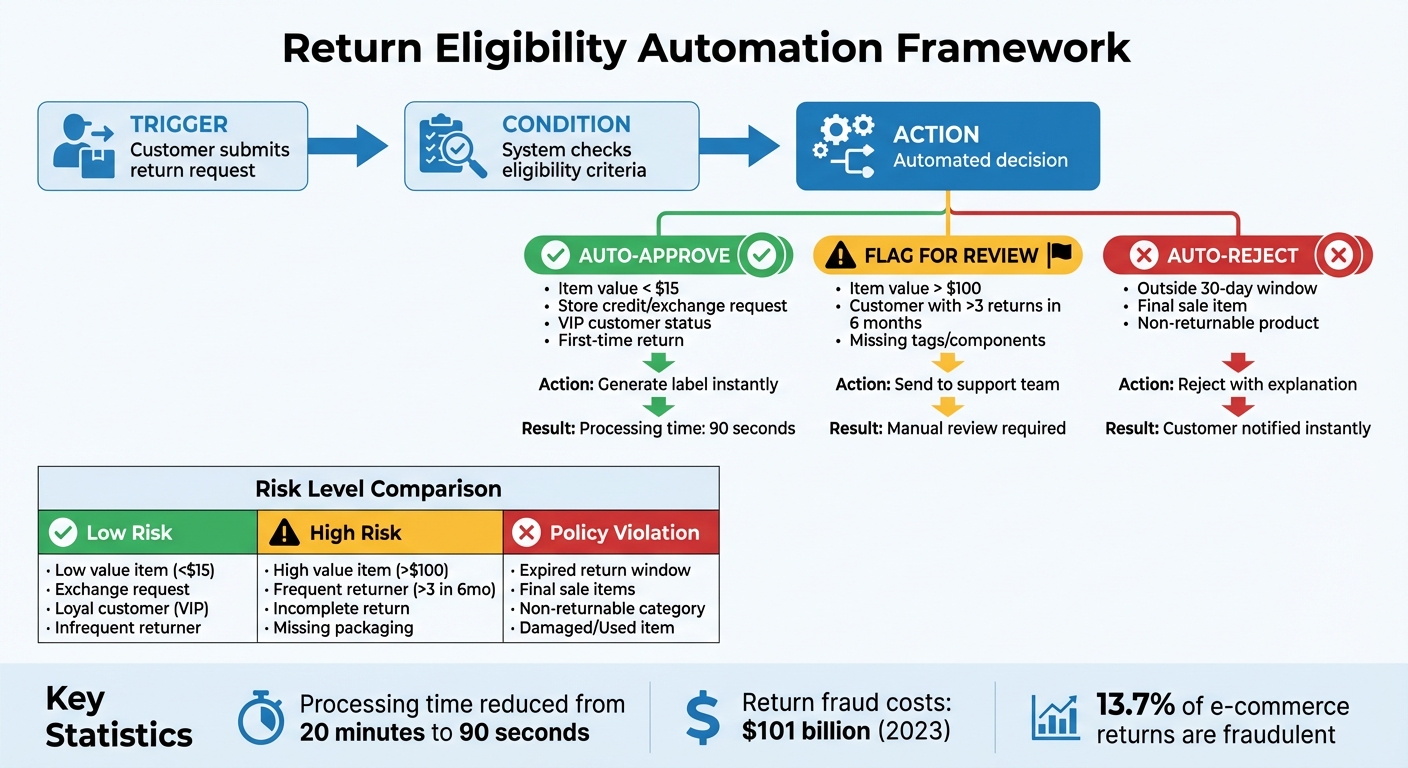
Return Eligibility Automation Framework: Trigger-Condition-Action Workflow
Once you've established clear return policies, the next step is to set up automation that handles return requests efficiently, minimizing the need for manual intervention. This process typically follows a Trigger-Condition-Action framework: a return request triggers the system to check specific criteria, which then determines whether to approve it instantly or send it for further review. By automating this process, you can reduce return processing times dramatically - from 20 minutes to just 90 seconds per request.
Auto-Approve Low-Risk Returns
Start by identifying low-risk returns. These might include:
- Items with a low value (e.g., under $15)
- Requests for store credit or exchanges
- Orders from verified or VIP customers
For example, Travelpro uses automation to instantly generate return labels when specific conditions are met, making the process quick and easy for customers.
In cases where return shipping costs more than the item's resale value, you can implement "Keep Item" rules. These rules allow customers to receive a refund while keeping - or even donating - the item, saving both time and money. You can also design tiered approval systems based on customer loyalty. For instance, VIP customers might enjoy instant approvals, while new or guest customers go through standard processing.
While automation works well for low-risk cases, some returns require closer scrutiny.
Flag High-Risk Returns for Review
Not all returns are suitable for auto-approval. High-risk returns should be flagged for manual review. These might include:
- High-value items (e.g., over $100)
- Customers with more than three returns within six months
- Products missing tags or other key components
Fraud prevention is a critical part of this process. In 2023, return fraud cost retailers over $101 billion, with approximately 13.7% of e-commerce returns deemed fraudulent. To combat this, set up rules to detect patterns of abuse, such as serial returners who send back over 50% of their orders or multiple returns originating from the same address.
For instance, a fragrance brand in Riyadh tackled a spike in fraudulent returns by analyzing address-level data. They shortened return windows for certain zip codes and flagged high-value returns for manual review, ultimately cutting return fraud by 37% in just two months.
Your system should also automatically flag policy violations. If a customer tries to return a final sale item, a non-returnable product, or an order outside the allowed return window, the system should either reject the request outright or forward it to your support team for review.
| Risk Level | Example Criteria | Automated Action |
|---|---|---|
| Low Risk | Item under $15; first-time return | Auto-approve & generate label |
| High Risk | Item over $100; customer with >3 returns in 6 months | Flag for review |
| Policy Violation | Order outside 30-day window; final sale item | Auto-reject with explanation |
The key is to strike a balance between speed and risk management. By doing so, you can protect your revenue while maintaining customer trust and loyalty.
Deploy Branded Self-Service Portals
Set up a self-service portal to allow customers to check eligibility, submit returns, and generate shipping labels automatically - anytime, day or night.
Customer Experience with Self-Service Portals
A thoughtfully designed self-service portal simplifies the returns process, making it easy and hassle-free for customers. By entering their order number and email address, customers can quickly see which items are eligible for return. The system uses pre-set rules - like purchase date, item type, or customer status - to provide instant feedback. If the return is approved, they receive a pre-paid shipping label or a QR code for easy processing.
Customizing the portal's design to match your brand not only strengthens brand recognition but also builds trust. Automated email notifications keep customers informed about their return status, shipping updates, and refund timelines. This transparency helps ease post-purchase concerns and enhances the overall shopping experience. These portals play a key role in maintaining a seamless, automated approach to returns.
Reduce Support Team Workload
Beyond improving customer satisfaction, self-service portals also make life easier for your internal teams. By enabling customers to handle routine tasks like initiating RMAs, generating labels, and tracking updates, these portals free up your support team to focus on more complex issues.
Take the case of One Project, a global fashion platform that automated its return process in April 2025 by integrating a self-service portal with its ERP and logistics systems. Shmulik Konforty, CTO at One Project, explained:
"The process is fully automated, from the customer request to the refund".
This approach allowed the support team to concentrate solely on exceptions, such as items not returned, while standard return requests were handled automatically. Considering ecommerce return rates can climb as high as 30% and reverse logistics can account for up to 66% of the item's original cost, automating routine returns leads to substantial savings in both time and resources.
sbb-itb-a3e286c
Increase Revenue Retention Through Smart Suggestions
Every refund represents lost revenue. By adding smart suggestions to automated return approvals, you can shift the focus from refunds to exchanges or store credit, keeping more revenue in your business. This approach works hand-in-hand with automated approval rules, turning potential refunds into ongoing sales. When customers choose a return reason, your system should immediately offer solutions that address their concerns while maintaining the sale.
AI-Driven Product Recommendations
Automation can use return reasons to generate precise product suggestions. For example, if a customer states that an item is too large, the system can recommend a smaller size. If the issue is style-related, AI can present trending alternatives to encourage an exchange.
The system can also handle price differences automatically, applying credits or additional charges without requiring manual input. These personalized recommendations make store credit or exchange options more appealing to customers.
One effective tactic is offering "instant exchanges", where the replacement item is shipped as soon as the return package is scanned by the carrier. This minimizes the waiting period that often pushes customers toward refunds. For low-cost items where shipping expenses outweigh the product's value, automation can suggest store credit while letting the customer keep the item - a cost-saving "green return" solution.
Promote Store Credit Options
Store credit helps retain revenue within your business and gives customers an incentive to return. Unlike refunds, which often take 5–10 business days to process, store credit is issued instantly and can be used right away. Highlighting this speed advantage in your return portal can encourage more customers to choose credit over refunds.
You can also set up rules to auto-approve store credit, possibly enhanced with bonus credit, while flagging refund requests for additional review. This creates a smoother, more attractive path for customers to follow - one that benefits both them and your business.
"Store credit is more beneficial to your Shopify store than a straight refund because it requires the shopper to revisit your business and potentially spend more than the value of the credit."
Customers who use store credit often spend beyond the credit amount, turning a return into an upsell opportunity. For returns that fall slightly outside your policy or lack tags, automation can offer partial store credit as a middle ground, helping you recover revenue that might otherwise be lost.
| Strategy | Revenue Impact | Automation Trigger |
|---|---|---|
| Bonus Credit | High; encourages customers to choose credit | Selection of "Store Credit" resolution |
| Instant Exchanges | Medium; reduces refunds and retains customers | Return shipment "In Transit" status |
| Size Recommendations | High; resolves fit-related issues | Return reason: "Too big" or "Too small" |
| Green Returns | High; cuts costs while retaining customers | Item value < Shipping cost + Processing fee |
Automate Label Generation and Return Logistics
Once a return is approved, the next hurdle is getting the item back to your warehouse. Manually creating shipping labels slows things down and frustrates customers. But when you automate this step, prepaid shipping labels are generated instantly after approval, cutting processing time from 20 minutes to just 90 seconds per return. This not only speeds up the process but also ensures the return journey stays smooth and hassle-free for customers.
Automated Label Creation
When a customer submits a return request through a self-service portal, the system can automatically generate a prepaid shipping label. This is made possible by integrating directly with shipping carriers, which also provide real-time tracking updates for both you and your customers. The label is sent immediately, ready for printing or mobile use.
For example, one major retailer managed to drastically reduce processing times by implementing automated label generation.
Real-time tracking also helps you stay ahead with inventory management. As soon as the carrier scans the return package, your system gets an update, allowing your team to prepare for restocking even before the package arrives at the warehouse. This level of visibility eliminates the guesswork often associated with manual returns, where packages can go untracked for days.
By offering both printed and digital label options, you make the process even more convenient for customers.
Support Printerless Returns
Taking automation a step further, printerless returns simplify things for customers who don’t have easy access to a printer. Instead of a traditional label, the system generates a QR code. Customers can then take their return package to designated drop-off locations - like UPS, USPS, or FedEx - where the QR code is scanned, making the process faster and more convenient.
Providing both print-at-home and printerless options gives customers the flexibility to choose what works best for them. While some may prefer the ease of printing a label at home, others find the QR code option more practical. Forthroute, for example, supports printerless returns through its EasyPost integration, allowing customers to drop off packages without needing a printer. This added convenience not only improves customer satisfaction but also speeds up the overall return process.
| Return Method | Customer Requirement | Merchant Benefit |
|---|---|---|
| Print-at-Home | Printer and packaging needed | Lower cost if the customer provides packaging |
| Printerless (QR Code) | Digital device; drop-off required | Higher customer satisfaction; faster turnaround |
| In-Store Drop-off | Visit to physical location | Eliminates shipping costs; increases foot traffic |
| Returnless Refund | No action; customer keeps item | Saves on shipping and labor for low-value items |
Use Analytics for Continuous Improvement
Automation thrives on consistent data tracking. By leveraging this data-driven approach, you can fine-tune your automated return processes. Monitoring return patterns allows you to identify problems early - whether it's a product frequently returned or a policy draining resources - and transform your return process into a continuous feedback system.
Track Return Patterns and Trends
Understanding why items are returned can uncover product or policy issues. For example, if a specific product often comes back marked "too small", consider updating the product page with a "size up" recommendation. Similarly, frequent "damaged" returns for certain SKUs might signal a need to reevaluate your packaging or shipping methods.
Beyond individual products, analyzing overall customer behavior is just as important. Online return rates are often much higher than those for physical stores. Monitoring individual return patterns can help you detect trends or even cases of policy abuse.
Regional data can also reveal valuable insights. Higher return rates in specific areas could point to problems like unreliable local carriers or regional sizing preferences that need addressing.
These observations guide adjustments that help you manage costs more effectively.
Monitor Costs and Processes
Returns are expensive. Reverse logistics for online returns can cost as much as 66% of the original item's price. Tracking metrics like lost revenue, shipping costs, and labor expenses can help you refine your processes.
For instance, if shipping a $5 item back to your warehouse costs $8, consider automating refunds for low-cost returns where shipping exceeds the item's value. This not only reduces costs but also minimizes environmental impact - around 9.5 billion pounds of returned products ended up in landfills in a single year.
Keep an eye on your exchange versus refund ratios as well. If most customers choose refunds over exchanges, it could mean your automation isn't effectively encouraging revenue retention. Adjust your system to promote store credit or suggest alternative products during the return process.
Analytics ensure that your automation rules remain efficient and effective.
| Metric Category | Key Data Points to Track | Purpose for Automation |
|---|---|---|
| Product Performance | Return reasons by SKU, quality feedback | Improve product descriptions and quality control |
| Financials | Shipping costs, processing fees, lost revenue | Optimize "Green Return" thresholds and shipping costs |
| Customer Loyalty | Exchange rates, store credit usage | Enhance incentives for retaining revenue |
| Risk Management | Return frequency per customer, policy abuse | Automate fraud detection and block-listing |
| Logistics | Transit times, warehouse processing times | Refine auto-refund and auto-exchange triggers |
Conclusion
Tips for Successful Automation
Getting automation right begins with clear return policies and smart, well-thought-out rules. Start by defining specific return windows - whether it's 30, 60, or 90 days - and make sure these policies are communicated clearly upfront. This way, customers know exactly what to expect. Use automation to streamline the process by setting rules to automatically approve low-risk returns, flag higher-risk cases for review, and reject returns on final-sale items.
Offering 24/7 self-service options can significantly reduce friction. When customers can initiate returns on their own, without waiting for email responses or support tickets, it leads to a smoother experience. In fact, 65% of shoppers say the speed and simplicity of refunds influence their choice of retailer. Combine this with automated label generation - complete with printerless QR code options - and you’ll create a hassle-free process that builds customer loyalty.
Don’t overlook revenue retention strategies. Offer instant store credit with added incentives or use AI tools to suggest alternative sizes or products. With 95% of shoppers stating that a poor returns experience makes them less likely to shop with a retailer again, nailing these details is key to driving growth.
These practices are exactly what Forthroute’s solution delivers.
How Forthroute Simplifies Return Automation
Forthroute takes these principles and puts them into action with a branded self-service portal and intelligent automation. Customers simply enter their order number to instantly view which items qualify for returns. The platform’s smart approval rules handle the rest - whether it’s auto-approving returns under $50 or rejecting items marked as final sale - saving you time and effort.
Revenue retention is built into the system. By prioritizing exchanges and store credits in the return process, Forthroute helps keep money in your business. AI-powered recommendations suggest alternative products based on the customer’s return reasons - like offering a size up for fit-related returns - turning refunds into potential exchanges. Plus, with printerless QR codes and instant label generation, the process is seamless for customers while allowing you to recover inventory faster.
All of this comes at just $19/month (plus carrier rates), with a 14-day trial that doesn’t even require a credit card. Forthroute offers enterprise-level automation at a fraction of the cost, making it an accessible solution for businesses of all sizes.
FAQs
How does automating the return process benefit businesses and customers?
Automation takes the hassle out of the return process by replacing slow, manual tasks with quick, rule-driven workflows. For businesses, this means faster processing, fewer mistakes, and lower costs. For example, rules like automatically approving returns under $50 or declining returns on final-sale items eliminate the need for constant manual oversight, freeing up teams to focus on higher-priority tasks. Plus, automation can help retain revenue by promoting exchanges or store credit instead of issuing refunds.
For customers, it’s all about convenience. They can start a return in just a few clicks, instantly receive shipping labels or QR codes for printer-free returns, and track their return status in real time. This streamlined experience not only makes returns less of a hassle but also builds trust and loyalty, increasing the chances that customers will shop with the brand again.
What are the advantages of using a self-service portal for managing returns?
A self-service returns portal empowers customers to handle returns independently, cutting down processing times from roughly 20 minutes per request to an impressive 90 seconds. By automating approval rules and instantly creating shipping labels, merchants save both time and money - typically around $2,500 for every 1,000 returns. These portals also help retain revenue by turning potential refunds into exchanges or store credit.
For customers, the process couldn’t be simpler. They input their order number and email, pick the items they want to return, select a reason, and choose a resolution - whether it’s a refund, exchange, or store credit. Within moments, they receive a shipping label or a QR code for printer-free returns. This streamlined experience not only reduces hassle but also increases satisfaction. In fact, research shows that 92% of shoppers are more likely to make repeat purchases when the returns process is easy.
Merchants using solutions like Forthroute gain extra advantages, including automated approval workflows, AI-driven exchange suggestions, and real-time analytics. These features minimize manual effort, strengthen customer loyalty, and transform refunds into additional sales opportunities.
How can businesses use AI to retain revenue during the returns process?
Businesses can use AI to minimize refunds and maintain revenue by suggesting exchanges or store credit during the return process. By analyzing factors like a customer’s purchase history, product details, and current inventory, AI can recommend alternatives - like a different size or a complementary product - that better align with the customer’s needs. These instant suggestions can encourage customers to opt for exchanges instead of refunds, preserving more of the original sale value.
AI also simplifies return operations by automating approval processes. For example, it can automatically approve straightforward, low-risk returns (such as items under $50 or purchased within 14 days) while flagging more complicated cases for manual review. This approach speeds up processing, cuts labor costs, and improves the customer experience with quicker, hassle-free resolutions. By blending tailored recommendations with smart automation, businesses can transform returns into opportunities to retain revenue and strengthen customer loyalty.