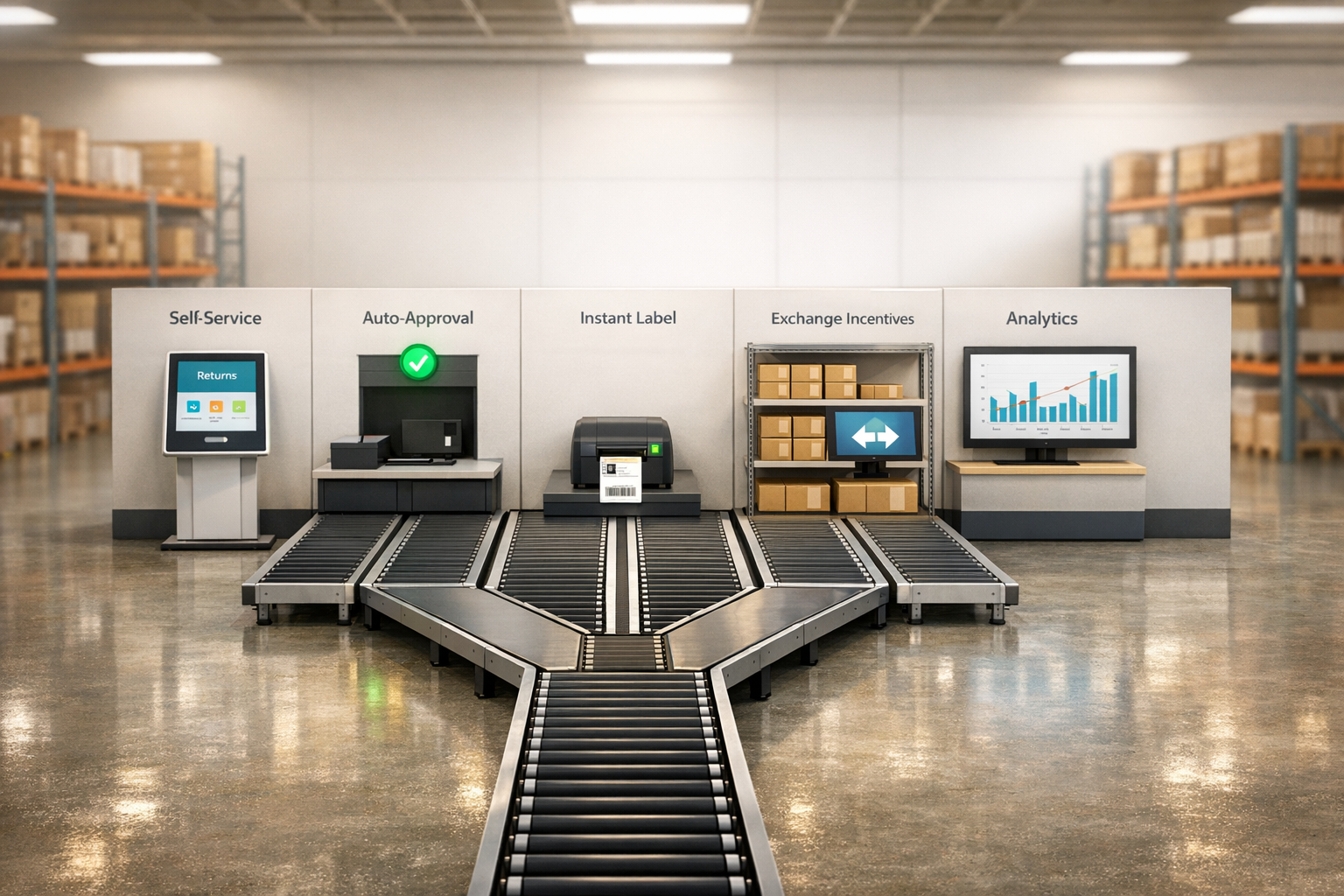
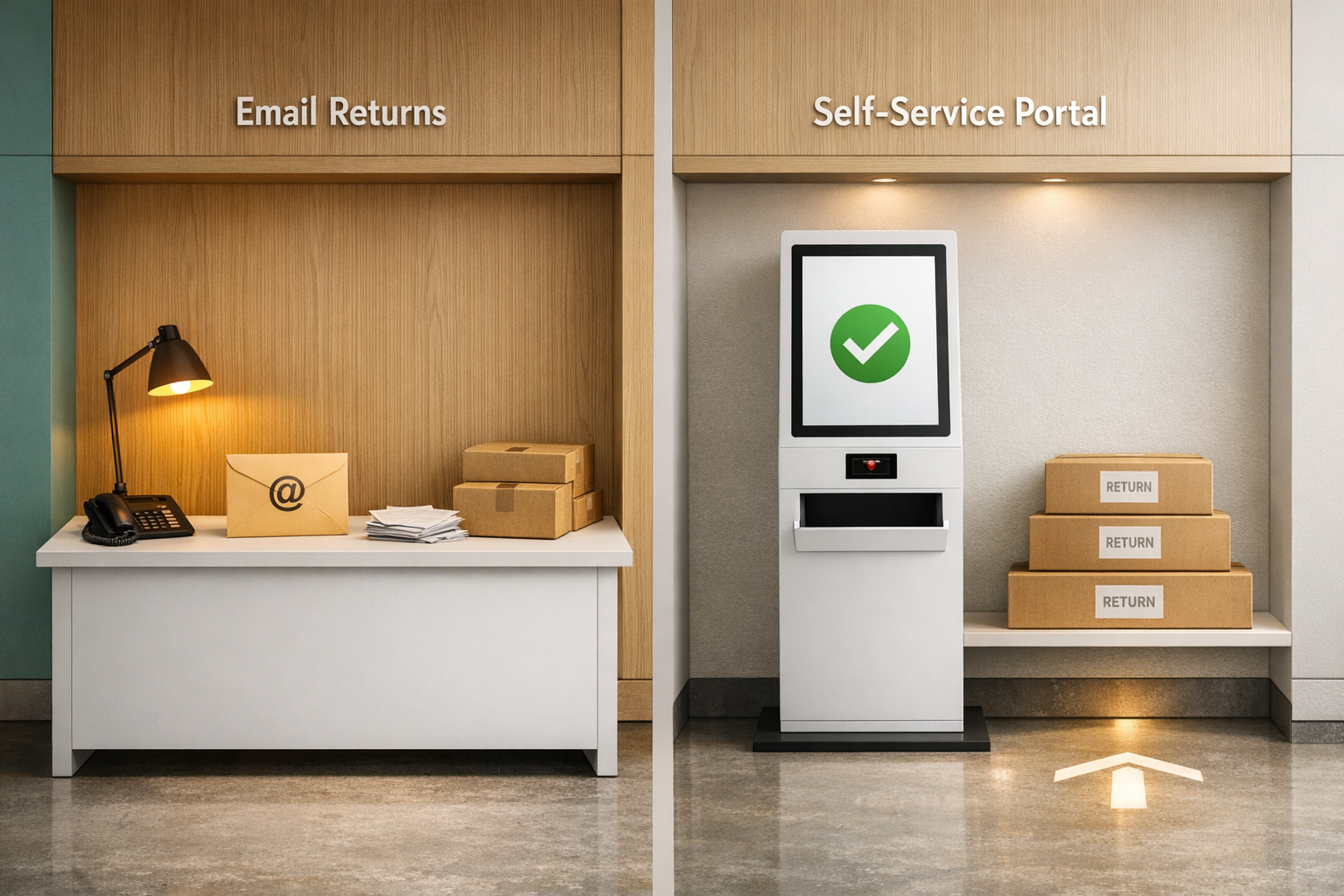
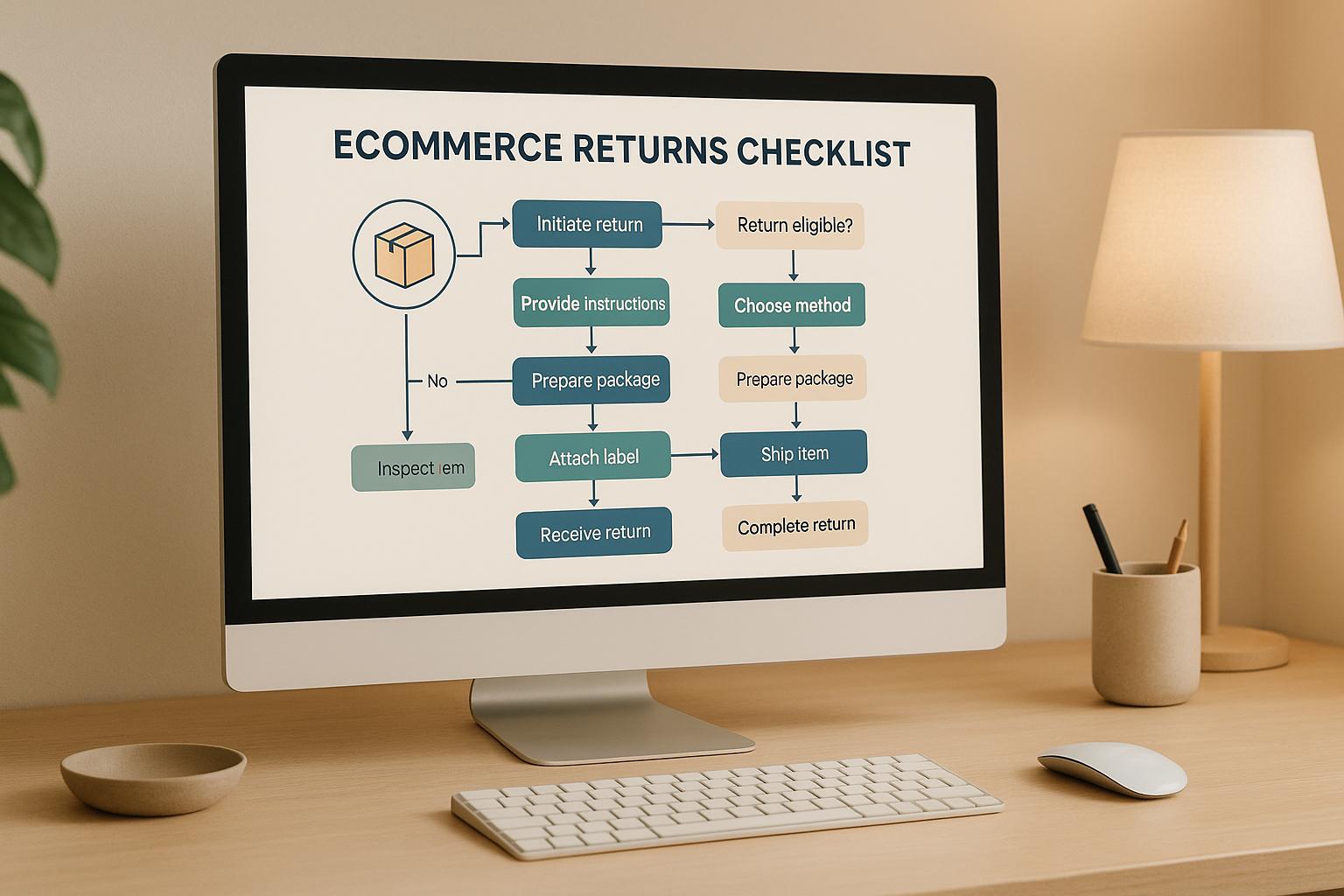
Handling returns manually wastes time, costs money, and frustrates customers. Automating your return process can save up to 90% of processing time, reduce fraud, and improve customer satisfaction. Here’s how:
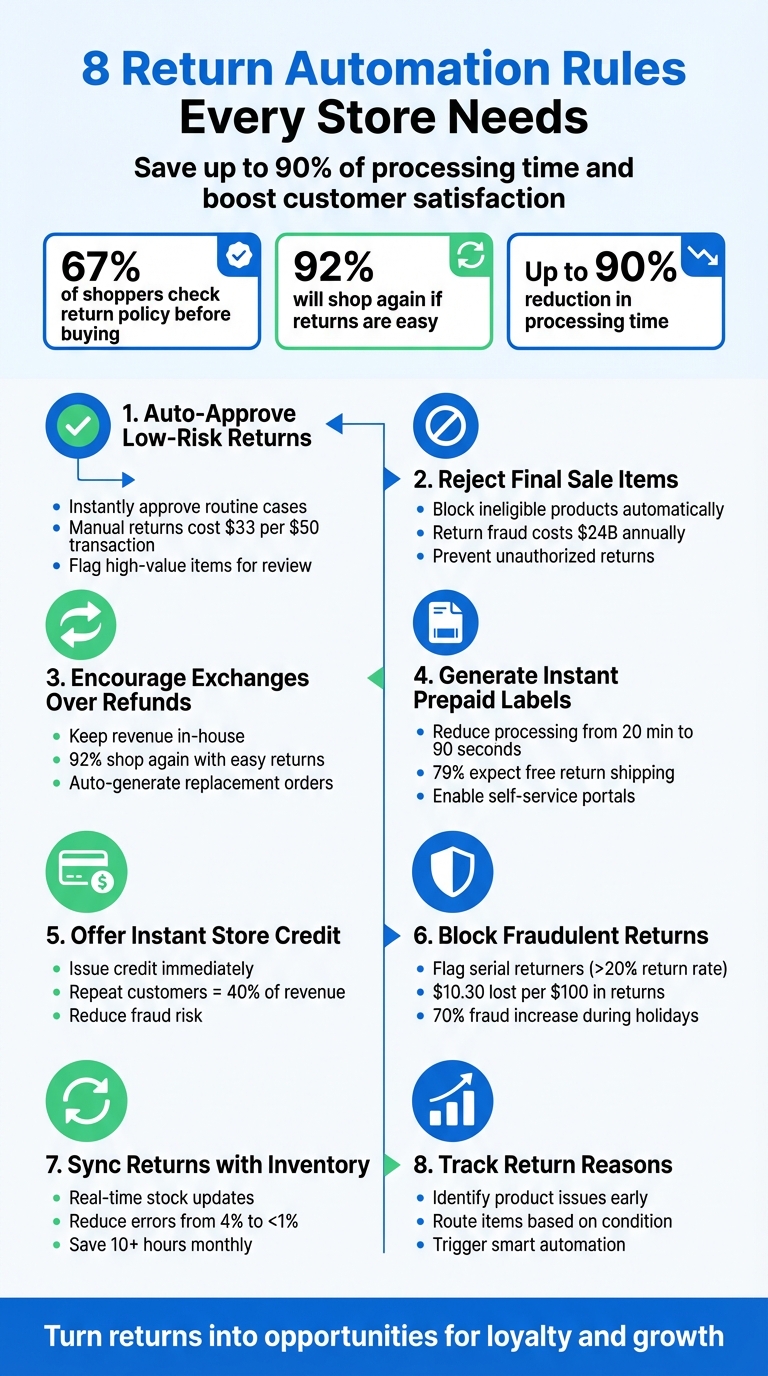
- Auto-Approve Low-Risk Returns: Instantly approve returns for routine cases (e.g., wrong size) while flagging high-value or suspicious ones for manual review.
- Reject Final Sale Items: Block return requests for ineligible products like final sale or perishable items automatically.
- Encourage Exchanges Over Refunds: Automate exchanges to keep revenue in-house and reduce refund requests.
- Generate Instant Prepaid Labels: Let customers create shipping labels through a self-service portal, cutting processing time significantly.
- Offer Instant Store Credit: Provide store credit immediately for approved returns to retain revenue and boost loyalty.
- Block Fraudulent Returns: Use rules to detect and flag serial returners or unusual activity.
- Sync Returns with Inventory: Automate inventory updates in real-time to avoid overselling and improve stock management.
- Track Return Reasons: Use analytics to identify patterns and address product or process issues proactively.
Why It Matters: 67% of shoppers check your return policy before buying, and 92% will shop again if returns are easy. Automating returns not only saves time but also turns refunds into opportunities for loyalty and growth.
8 Essential Return Automation Rules for E-commerce Stores
1. Auto-Approve Low-Risk Returns
Automation Efficiency
Returns often follow predictable patterns - a customer might order the wrong size, change their mind, or find the color isn't quite what they expected. These routine cases don't need lengthy reviews.
By automating these processes, you can skip time-consuming tasks like verifying order IDs, checking return windows, or confirming product eligibility. On average, manual returns cost $33 for every $50 transaction, but automation can slash processing time by up to 90%. This frees up your team to focus on more complex issues, like fraud investigations or unique cases.
Take One Project, a global fashion platform, as an example. They’ve automated their return process from start to finish. Shmulik Konforty, their CTO, shared:
"The process is fully automated, from the customer request to the refund."
For low-value items where the cost of shipping and labor outweighs resale value, returnless refunds can be a smart move. Set a dollar threshold - typically between $15 and $40 - where refunds are issued without requiring the item to be sent back. This strategy minimizes financial losses on less profitable transactions while keeping customers happy.
Streamlining these processes not only saves time but also sets the stage for improved customer satisfaction.
Customer Retention Impact
Speed is everything when it comes to returns. A whopping 72% of online shoppers expect their refund within five days of returning an item. Even more compelling, 92% say they’re likely to shop again if the return process is smooth. Auto-approvals can make this happen by instantly issuing shipping labels or store credits, cutting down on support tickets and those dreaded "Where’s my refund?" emails.
To make this work, define your "low-risk" criteria carefully. For instance, you might auto-approve returns for VIP customers - those with five or more past orders - or for specific low-cost product categories. Use trigger-based workflows, like approving store credit requests instantly for customers with a clean return history. For high-value orders over $500, route them to manual review to protect your bottom line.
Fraud Prevention Measures
While auto-approval speeds up the process, it’s crucial to include safeguards. Return fraud is a major concern, with 93% of retailers identifying it as a significant issue. To protect your business, set rules to flag suspicious activity, such as customers with return rates above 20% or those submitting requests outside the standard return window.
A tiered approval system works well here. Automatically approve low-value items while sending high-value orders to a specialist for review. For claims of "damaged" or "defective" items, require photo uploads in your return portal to deter fraudulent requests. This balance ensures legitimate customers get fast service, while potential abuse is caught early.
| Risk Factor | Mitigation Strategy | Automation Rule Example |
|---|---|---|
| Return Fraud | Flag serial returners | IF customer return rate > 20%, THEN route to manual review |
| Margin Loss | Returnless refunds | IF item value < $15, THEN approve refund and allow customer to keep item |
| High-Value Loss | Price thresholds | IF order value > $500, THEN require manual agent approval |
| Ineligible Items | Final sale protection | IF item is marked "Final Sale", THEN auto-reject return request |
By implementing these measures, you can protect both your margins and your customer relationships while maintaining a smooth returns process.
Operational Integration
To close the loop, automated approvals should tie directly into your inventory system. Without this integration, you risk ending up with unaccounted returns - those "mystery boxes" that show up at your warehouse without clear SKU or quantity details. Connect your automation tools to your Warehouse Management System (WMS) so stock levels update in real time as returns are processed.
ForthRoute, for example, uses webhook integrations to notify 3PL partners as soon as a return is approved and on its way. This ensures accurate inventory tracking and prevents overselling. With trigger-based rules, you can instantly approve store credits for customers with clean histories, while routing exceptions to your team for review.
The ultimate goal? As eDesk puts it:
"The goal of returns automation isn't just to save time; it's to transform a moment of customer disappointment (the return) into a high-satisfaction service experience that drives future loyalty."
2. Reject Final Sale and Ineligible Items
Automation Efficiency
Certain items can't be returned - think final sale items, perishables, personal care products, or deeply discounted goods. Instead of allowing customers to submit return requests that you'll later reject manually, automation can step in to block these attempts right from the start.
By using product tags in your backend system, you can label items as "Non-Returnable" or "Final Sale." When a customer tries to return one of these items, the system immediately flags it as ineligible and provides an explanation. This eliminates the need for email back-and-forth and ensures unauthorized items don’t unexpectedly show up at your warehouse.
Automation also simplifies complex eligibility checks. You can customize return rules based on customer profiles or item categories. This way, your team only has to handle exceptions or edge cases, while the system takes care of the standard decisions. It’s a proactive way to streamline operations and reduce fraud risks.
Fraud Prevention Measures
Return fraud is a costly problem for U.S. retailers, racking up $24 billion annually and accounting for 8% of all returns. Automated rejection rules serve as a frontline defense against fraud tactics like "wardrobing" (using items before returning them) or serial returns by policy abusers.
To make these rules even more effective, you can embed eligibility questions into the return process. For example, ask, “Is the original tag still attached?” If the customer answers “No,” the system automatically marks the item as ineligible and explains why. For high-risk accounts - such as those with return rates over 20% - you can route their requests for manual review instead of outright rejecting them. This approach protects your margins while still accommodating honest customers with legitimate concerns.
Operational Integration
Automation isn’t just about enforcing policies; it also provides valuable feedback for improving your operations. If several customers try to return a specific "Final Sale" item citing issues like "expectation mismatch", that’s a clear signal your product description or imagery might need an update. Tracking these trends can help you address problems at the source and prevent future returns.
Tools like ForthRoute make this process seamless by automatically rejecting "Final Sale" items while keeping the experience transparent for customers. For instance, these systems can sync with your warehouse operations to ensure only approved items generate shipping labels. This not only protects your profit margins but also builds trust with your customers by maintaining clear communication.
| Scenario | Automated Action | Customer Communication |
|---|---|---|
| Final Sale Item | Block request instantly | Display policy reference from purchase page |
| Expired Return Window | Auto-deny with alternative | Offer one-time store credit as a courtesy |
| Missing Original Tags | Mark ineligible via question | Explain hygiene/resale requirements |
| High Return Rate (>20%) | Route to manual review | Notify that a specialist is reviewing the request |
3. Prioritize Exchanges Over Refunds
Automation Efficiency
Cash refunds can hurt your bottom line, but automating exchanges offers a way to keep revenue in-house while simplifying customer service. By turning what used to be a manual, time-consuming process into a seamless self-service option, automation makes a big difference. Take ForthRoute, for example - they automatically generate a replacement order the moment a return shipment is scanned as "in transit" by the carrier. This method keeps customers connected to your brand instead of refunding their money and risking losing them to competitors. One Project, a global fashion platform, implemented automated exchange rules tailored to customer profiles and product types. Their CTO, Shmulik Konforty, explained:
"The process is fully automated, from the customer request to the refund".
Customer Retention Impact
Focusing on exchanges instead of refunds not only preserves revenue but also builds customer loyalty. Research shows that 92% of consumers are more likely to shop again with a retailer if the return process is hassle-free. Additionally, 65% of shoppers say the speed and simplicity of returns influence where they choose to buy. Considering it can cost up to five times more to attract a new customer than to retain an existing one, offering a smooth exchange process is a smart move. A self-service portal where customers can quickly swap for a different size or color can turn a potential loss into a long-term relationship. This approach also ensures that your inventory and customer experience stay aligned through effective operational systems.
Operational Integration
For return automation to work seamlessly, it must integrate tightly with your warehouse and inventory systems. When a customer requests an exchange, the system should immediately check stock levels to confirm the replacement item is available. This avoids the frustration of approving an exchange only to discover later that the item is out of stock. ForthRoute uses webhook integrations to notify warehouses or third-party logistics (3PL) providers as soon as a return is approved and an exchange order is created. To make exchanges even more appealing, the system can offer bonus incentives, encouraging customers to choose an exchange over a cash refund. With this automation in place, your team can focus on handling exceptions while standard exchanges are processed instantly and efficiently.
4. Generate Instant Prepaid Shipping Labels
Automation Efficiency
Manual label generation is a time drain that could be better spent on tasks that add more value. Think about it - when agents manually create, print, and email labels for each return request, it can take up to 20 minutes per transaction. Automation completely changes the game. For example, in June 2024, Travelpro implemented automated label generation in partnership with its carrier. This shift reduced their return processing time from 20 minutes to just 90 seconds per return. Mark Costigliola, Travelpro's eCommerce Operations Manager, described the impact:
"The return process is completely customer-centric. They fill out the request, generate the label, and get a refund."
Self-service portals make this kind of efficiency possible. Customers can access a branded portal anytime, input their order details, and instantly receive a prepaid shipping label. Systems like ForthRoute integrate directly with carriers, generating labels upon approval and offering real-time tracking updates for your warehouse. To keep costs in check, you can use "pay on scan" labels, which only charge your account when the package is scanned by the carrier. This kind of automation lays the groundwork for a smoother, more efficient returns process.
Customer Retention Impact
Speed and convenience in the return process can make or break customer loyalty. A whopping 92% of consumers say they’re more likely to shop again with a retailer if the return process is simple. On top of that, 65% of shoppers note that the speed and ease of getting a refund - starting with how quickly they can send the item back - directly impacts where they choose to shop. Here's another critical stat: 67% of shoppers check a store's return policy before making a purchase. If your process seems slow or overly complicated, you could lose the sale before it even begins.
One way to take convenience even further is through printerless returns. With ForthRoute's EasyPost integration, customers receive a QR code on their phone. They simply show it at a UPS or USPS drop-off location, and the carrier prints the label for them. This eliminates the hassle of needing a home printer, a common frustration for many shoppers. While 79% of consumers expect free return shipping, only 49% of online retailers currently provide it. Instant prepaid labels allow you to meet this expectation while keeping costs manageable through carrier discounts and integrations.
Operational Integration
To make instant label generation seamless, your returns system must connect directly with shipping carriers and your warehouse. When a customer initiates a return through the self-service portal, the system should automatically check your return policy - like whether the item is within the 30-day window or marked as final sale - before generating a label. This ensures that ineligible returns don’t slip through. Webhook integrations can notify your warehouse immediately when a label is created, allowing your team to prepare for incoming inventory and efficiently route items based on their condition.
Real-time tracking further enhances the process. Once the carrier scans the prepaid label, the system updates the return status automatically and triggers the next step - whether that’s issuing a refund, processing an exchange, or flagging the return for inspection. This eliminates the need for manual data entry and reduces the number of calls from customers asking about their refund status.
5. Offer Instant Store Credit Options
Automation Efficiency
Automating store credit issuance removes the frustration of refund delays. When a customer starts a return, the system can instantly issue credit using trigger-condition-action workflows, skipping manual approvals. For instance, you could set up automatic credit approvals for low-risk returns or for customers with a solid purchase history.
You can also configure the system to release credit as soon as the return package is scanned. This reduces waiting time for customers while allowing a reversal if the package doesn’t arrive. Tools like ForthRoute can automatically generate gift cards or discount codes once specific conditions are met. This streamlined process not only speeds things up but also creates opportunities to strengthen customer loyalty.
Customer Retention Impact
Instant store credit is a win-win: it keeps revenue within your business and encourages customers to make future purchases. Statistics show that 92% of consumers are more likely to return to a store if the return process is hassle-free. Offering quick credit reinforces this simplicity, increasing customer satisfaction and loyalty.
Considering that repeat customers contribute about 40% of eCommerce revenue, retaining funds through store credit can significantly impact long-term growth.
Fraud Prevention Measures
Store credit also acts as a safeguard against fraudulent returns, as it avoids immediate cash payouts. Fraudsters typically target liquid cash rather than store credit. By making credit the default option - especially for returns just outside standard policy windows or for subjective reasons like "color not as expected" - you can protect your bottom line while maintaining goodwill with honest customers.
Risk-based triggers can further enhance security. For example, your system could automatically approve store credit for VIPs or low-risk returns while flagging cash refund requests for manual review. With 93% of retailers identifying return fraud as a major concern, this approach balances customer convenience with necessary fraud checks.
Operational Integration
To make this process seamless, it’s essential to sync store credit issuance with your Order Management System. When a customer selects store credit through a self-service portal, automation should confirm that the return meets your policy requirements before generating a gift card or discount code tied to their account. If restocking fees apply, the system can automatically deduct those from the credit total, ensuring accurate financial tracking.
Warehouse integration is another key piece of the puzzle. Credit shouldn’t be issued until the returned item’s condition has been verified. By setting up webhook notifications, your 3PL or warehouse team can get real-time updates when returns are in transit. Once the item is inspected and inventory is updated, the system can finalize the credit issuance or flag discrepancies for further review. This closed-loop process ensures your business is protected while keeping the customer experience smooth and reliable.
sbb-itb-a3e286c
6. Block Serial Refunders and Fraud
Fraud Prevention Measures
Return fraud costs U.S. retailers over $15 billion every year. A staggering 93% of retailers acknowledge it as a significant challenge to their business. On average, for every $100 in returned merchandise, $10.30 is lost to fraud. The problem becomes even more severe during the holiday season, when fraudulent returns surge by 70% compared to other times of the year. To combat this, proactive fraud detection measures are essential for protecting revenue.
Automation plays a critical role in identifying fraud before it impacts your bottom line. Using a rules-based engine, businesses can implement workflows that flag suspicious activity. For instance, if a customer’s return behavior aligns with known fraud patterns or involves high-value purchases, the system can automatically send the request for manual review instead of approving it outright. Additionally, blocklists can be maintained to track email addresses, physical addresses, and payment methods associated with past fraudulent activities, effectively stopping repeat offenders from initiating new return requests.
Automation Efficiency
Relying on manual fraud detection is not only time-consuming but also prone to mistakes. Automated systems, on the other hand, can monitor customer behavior in real time. These systems are designed to identify red flags, such as rapid account creation, unusually high-value orders, or frequent returns made after 30 days. To deter fraudulent practices like wardrobing - where customers wear items once and return them - or bricking, which involves removing essential components from electronics, businesses can require image uploads before issuing Return Merchandise Authorizations (RMAs).
"Robust record-keeping is key to staying ahead of scammers. Systems should gather and assemble receipts, and secure databases should hold the purchase history of your customers."
- Brian Case, Director of Ecommerce and Retail, Selkirk
Operational Integration
Seamlessly integrating fraud prevention tools with helpdesk and inventory systems strengthens your defenses while maintaining operational efficiency. Aligning these measures with automated processes ensures that your store stays secure without compromising on productivity. For example, you can create VIP rules to auto-approve returns for loyal customers with a high lifetime value, while flagging accounts with suspicious activity for manual review. In cases where fraud is suspected, the system can offer store credit or exchanges instead of cash refunds, reducing the financial appeal of fraudulent returns.
Integration with helpdesk software provides a comprehensive view of a customer’s return history during the approval process. This unified approach allows your team to make quick, informed decisions, ensuring both efficiency and security.
7. Sync Returns with Warehouse and Inventory
Automation Efficiency
Once you've streamlined returns and tackled fraud prevention, the next step is syncing returns with your warehouse systems to take efficiency to the next level. Manual inventory updates are not just slow - they’re error-prone. In fact, manual tracking results in mistakes in about 4% of orders. By automating this process and directly connecting your warehouse management system to your sales platform, you can cut that error rate to below 1%.
Real-time syncing ensures stock updates happen immediately after returns are inspected. Take Bared Footwear as an example. This Australian brand transitioned its five retail stores to Shopify POS, allowing them to sync inventory across all channels in real time. Before this change, overselling during promotions was such a big problem that they had to close their physical stores during major online sales. With unified inventory, they now run simultaneous online and in-store promotions without any issues.
Delays in inventory updates can hit your bottom line hard. Processing a single return can cost between 20% and 65% of the item's original price. The longer a returned item sits in limbo waiting for manual updates, the more money you lose. Automation resolves this by saving businesses an average of over 10 hours per month - time that would otherwise be spent manually reconciling disconnected systems. By integrating returns management with real-time inventory tracking, you not only reduce errors but also ensure smooth communication between returns processing and fulfillment operations.
Operational Integration
When a customer’s return is marked as "received" at the warehouse, your system should automatically handle the rest: restocking the item, updating inventory across all sales channels, and initiating the refund or store credit. And all of this should happen without anyone lifting a finger.
A great example of this is Odaje, a French footwear brand that unified inventory data across its 16 stores and online shop using Shopify in 2025. This integration gave their warehouse teams, retail staff, and online customers access to the same real-time stock visibility. The result? A 6% boost in conversion rates and a 25% increase in international sales. This kind of seamless integration shows how automation and real-time data can transform operations and enhance customer satisfaction.
To avoid overpromising on exchanges, set inventory thresholds. For instance, only offer an exchange if there are more than 20 units of the item in stock. This prevents situations where an item sells out before the return is processed. Additionally, barcode scanning at the warehouse can instantly categorize returns - whether they’re ready for resale, damaged, or need cleaning - ensuring your system always knows what’s available.
"Having all our tooling and commerce data unified in a single platform was a real driving factor. All our sales channels display the same stock availability, and we can run a promotion online and in-store concurrently without worrying about overselling."
- Alexandra McNab, COO, Bared Footwear
8. Track Return Reasons and Analytics
Automation Efficiency
Keeping tabs on why customers return items can supercharge automation. For instance, if someone selects "damaged" as the reason, you can immediately process a full refund. If they choose "wrong size", you might offer an exchange on the spot - before the item sells out again. This kind of data-driven automation not only simplifies operations but also makes life easier for your customers.
Return reason data also allows for smarter logistics. Defective items can be sent to a refurbishment center, while "wrong size" returns are restocked at your main warehouse. And here’s a game-changer: if your analytics show a sudden 20% spike in returns, automated alerts can help you catch issues like product defects or warehouse errors before they escalate.
Customer Retention Impact
Using return analytics to refine your processes can make a huge difference in keeping customers loyal. By analyzing what keeps shoppers coming back - whether it's exchanges, store credit, or refunds - you can prioritize solutions that protect your bottom line. After all, 92% of customers say they’d shop again if the return process is hassle-free.
If you notice recurring complaints, like "color mismatch" or "poor fit", it’s a sign to update product photos or size guides. And if a product’s return rate hits 15% to 20%, it’s time for an immediate review of your content and descriptions.
Operational Integration
These insights don’t just sit in a spreadsheet - they should feed directly into your operations. Once items are inspected, you can instantly update inventory and trigger the right next step, whether that’s a refund, an exchange, or issuing store credit.
Sharing this return data with your merchandising and manufacturing teams can close the loop on quality control. If sizing issues or quality defects keep popping up, those teams can fix the root problem instead of just managing the symptoms.
How To Use Shopify Self-Serve Returns - Shopify Tutorial

Conclusion
These eight rules help cut costs, speed up workflows, and encourage repeat business. By removing manual approvals, reducing fraud, and focusing on exchanges, you can save time while protecting your revenue. This kind of streamlined process allows your team to concentrate on growth instead of getting bogged down with tedious administrative tasks.
There’s also a big boost to customer loyalty. Automating approvals, shipping labels, and inventory updates creates a smooth, hassle-free experience that builds trust with your shoppers. Encouraging exchanges or store credit instead of refunds keeps money in your business while giving customers exactly what they want: fast resolutions.
Return data can also drive smarter operational decisions. For example, if a product has a 20% return rate, it might be time to adjust the size guide or update product photos. A sudden spike in "damaged" returns? That could signal a warehouse issue that needs immediate attention. It's not just about managing returns efficiently - it's about stopping them before they happen.
All these strategies come together in one solution: ForthRoute. Designed specifically for Shopify stores, it combines everything you need - branded self-service portals, intelligent approval systems, and AI-driven exchange recommendations. With this unified approach, you can turn returns into a growth opportunity for your business.
Stop wasting time and resources on manual returns. Automate your process to keep revenue in your pocket and turn refunds into loyal customers.
FAQs
How does return automation enhance the customer experience?
Automating returns streamlines essential tasks such as generating labels, approving refunds, and tracking items in real-time. This not only removes delays but also delivers a smooth and clear experience, making customers feel appreciated and boosting their confidence. The result? Happier customers who are more likely to stick around.
On top of that, automated systems cut down on human errors and speed up resolutions, ensuring a return process that's easy and efficient - just what today's customers expect.
How can I reduce the risk of return fraud in my online store?
To cut down on return fraud, start by requiring valid proof of purchase - this could be an order number, receipt, or email confirmation. Always verify this against the original payment method before approving a return. Set a reasonable return window - something like 14 to 30 days - and flag any requests that fall outside of it. For higher-value items, consider asking for extra verification, such as photos or videos showing the item's condition, and ensure all returns include original packaging and accessories.
Leverage data-driven rules to spot suspicious activity. For instance, limit how many returns a customer can make within a specific timeframe, and keep an eye out for repeat offenders. Cross-check details like shipping addresses, IP addresses, and device fingerprints for signs of fraud. Tools that assign risk scores to return requests can help flag high-risk cases, which can then be manually reviewed or even denied.
Lastly, strengthen your payment protections. Use enhanced authentication methods to confirm the original transaction was legitimate before issuing refunds. By combining clear policies, automated fraud detection, and secure payment practices, you can effectively guard against fraudulent returns while ensuring the process remains smooth for honest customers.
Why is it important to sync returns with your inventory?
Keeping your inventory in sync with returns is essential for accurate stock management and smooth day-to-day operations. When return data updates in real time, it minimizes the risk of overselling, reduces mistakes, and ensures customers see the most up-to-date product availability.
On top of that, linking returns with inventory management provides valuable insights into patterns - like identifying which products are returned most often. These insights help businesses tackle potential problems, fine-tune inventory planning, and ultimately improve the shopping experience for customers.