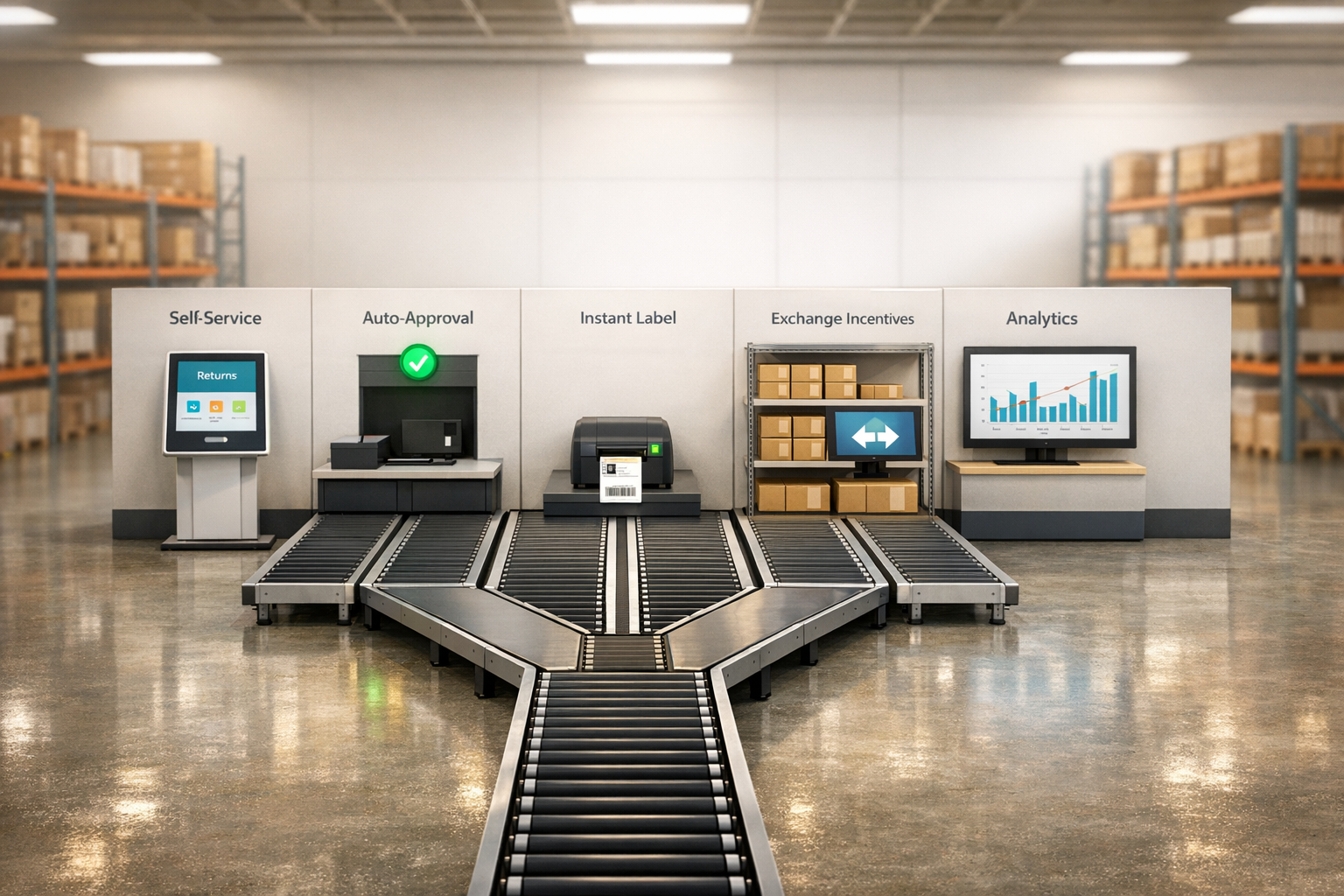
Manual returns are time-consuming and prone to errors, while automation offers speed, accuracy, and scalability. Here's what you need to know:
- Manual returns involve staff handling tasks like emails, shipping labels, and data entry. This process can take up to 20 minutes per return, costs more, and struggles to handle high volumes.
- Automated returns use self-service portals and rule-based systems to process requests in as little as 90 seconds. They reduce errors, save money, and improve customer satisfaction.
Key Takeaways:
- Returns cost businesses up to 65% of an item's value and impact loyalty - 67% of shoppers avoid brands after a bad return experience.
- Automation saves about $2,500 per 1,000 returns and retains revenue by encouraging exchanges.
- While manual systems may work for small businesses with low return volumes, automation is better for growing operations.
Quick Comparison
| Metric | Manual Returns | Automated Returns |
|---|---|---|
| Processing Time | ~20 minutes per return | ~90 seconds per return |
| Resolution Speed | 8.3–9.8 days | 2.4 days faster |
| Error Rates | High (human errors) | Low (rules-based) |
| Scalability | Limited | Handles surges easily |
| Cost per 1,000 Returns | High labor costs | Saves ~$2,500 |
| Customer Effort | High (manual steps) | Low (self-service) |
For businesses managing over 150 returns monthly, automation is the clear choice for efficiency and growth.
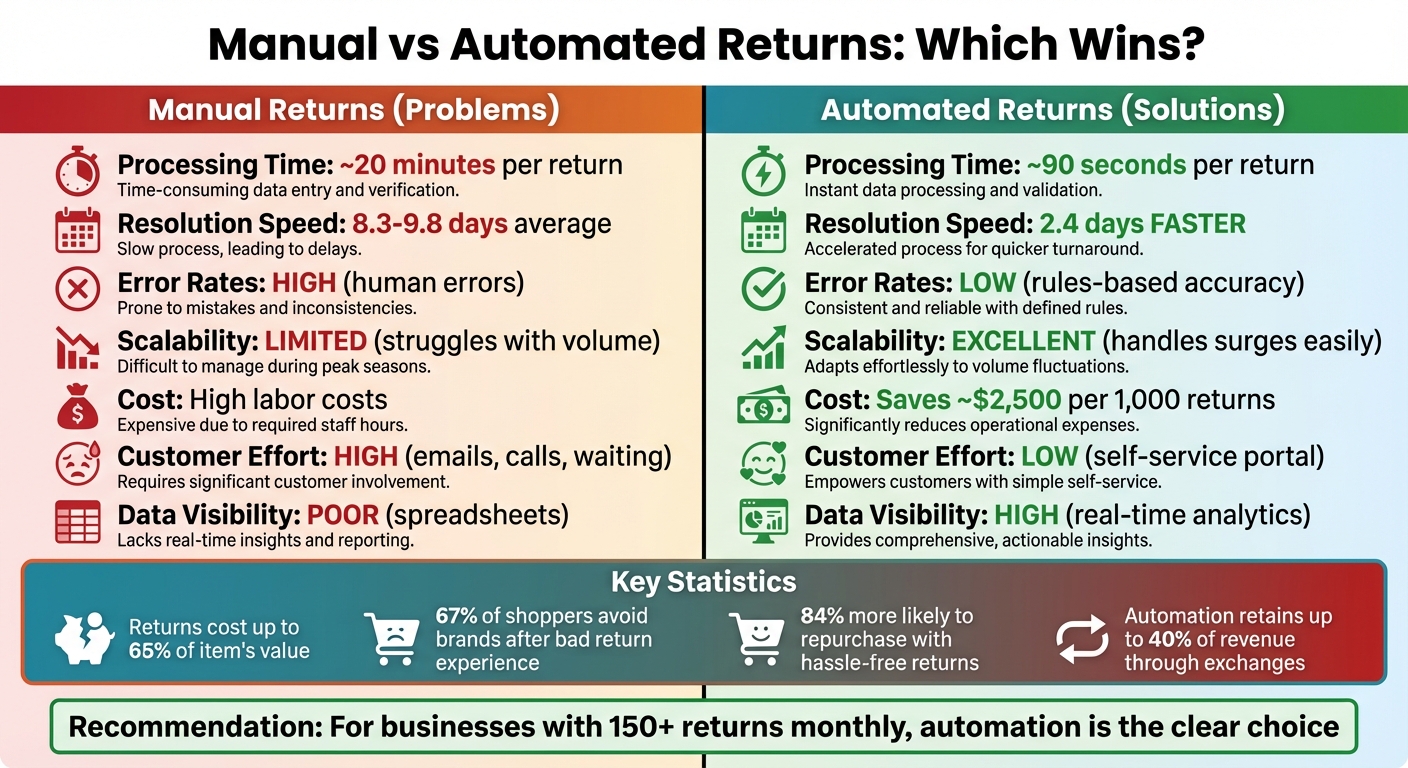
Manual vs Automated Returns: Processing Time, Cost and Efficiency Comparison
E-Commerce Returns: How Automated Sorting & Restocking Are Changing Retail Logistics
How Manual Returns Work and Their Limitations
Let’s break down how manual returns are handled and why this method often falls short.
The Manual Returns Workflow
Handling returns manually follows a straightforward yet time-consuming process. It starts when a customer reaches out - usually via email or phone - to initiate a return. From there, a customer service representative steps in to review the order details, ensuring the request complies with the retailer’s return policy. This back-and-forth communication can take up valuable time.
Once approved, the staff manually log into shipping carrier portals to create a return label, which is then emailed to the customer. When the returned item finally arrives at the warehouse, the process gets even more cumbersome. A team member records the return - often in a shared spreadsheet instead of a streamlined system - and the customer service team must dig through the ecommerce platform or other records to locate the original transaction.
After the item is inspected, it’s either restocked, resold, or discarded. Only then is the refund issued, and inventory updated. This entire process can drag on for up to two weeks, while automated systems can complete similar tasks in minutes. To put this into perspective, returning a $50 item can cost a retailer approximately $33 when factoring in shipping, labor, and restocking expenses.
Consider Travelpro, a luggage manufacturer, as an example. In April 2025, they revealed that their manual return process required customer service staff to dedicate about 20 minutes per return for tasks like generating labels and completing paperwork. After switching to automation, that time dropped to just 90 seconds per return - a staggering 92.5% improvement in efficiency.
While the steps in manual returns might seem orderly, they create several bottlenecks that slow everything down.
Problems with Manual Returns
Despite its structured nature, the manual return process is riddled with inefficiencies. One of the biggest issues is the risk of miscommunication and data errors, which can lead to incorrect refunds or misplaced inventory. A common scenario? Customer service teams often aren’t notified when returned items arrive at the warehouse, leaving frustrated customers wondering, “Where’s my refund?”
"The entire process lacks integration between the various components. For example, it's typically not brought to the attention of customer service when a product is received".
"Manual processes are often prone to human error, which can result in mistakes such as incorrect refunds or mislabeled items".
Scalability is another significant hurdle. As return volumes grow - say, hitting 150 to 200 units per month - manual workflows can become chaotic and unmanageable. For instance, the apparel brand Bummer faced severe delays and backlogs before automating their returns. This shift led to a 74% reduction in their return rate and an 87.5% boost in processing speed.
Labor costs also add up quickly in manual systems, ranging from $2 to $5 per return. On top of that, manual processes waste time, with resolution times averaging 2.4 days longer than automated workflows. Considering that 67% of shoppers check a retailer’s return policy before making a purchase, a slow and clunky process can hurt both sales and customer loyalty.
How ForthRoute Automates the Returns Process
ForthRoute takes the headache out of returns by streamlining every step of the process. No more endless spreadsheets or waiting for responses - everything is automated, making life easier for both customers and staff.
ForthRoute Features and Workflow
It all starts with a branded self-service portal. This portal allows customers to initiate returns themselves by simply entering their order number and email - no need for support tickets or lengthy phone calls. From there, ForthRoute uses a set of rules to automatically approve, reject, or flag returns. These rules are based on criteria like return windows, item condition, or product tags.
For example, one project used these rules to manage tricky scenarios, such as blocking returns for custom-made products and flagging customers who frequently send items back. As Shmulik Konforty, the CTO, explained:
"The process is fully automated, from the customer request to the refund".
ForthRoute doesn’t stop at returns. It integrates real-time tracking and multi-carrier rate shopping through EasyPost, ensuring customers get affordable shipping options and live updates. On top of that, its AI-powered exchange suggestions analyze customer behavior to recommend alternative products, turning potential refunds into exchanges. All this activity feeds into analytics dashboards, helping businesses spot trends like sizing issues or product quality concerns. The result? A smooth process that benefits both operations and customer satisfaction.
Benefits of Automated Returns
With ForthRoute, the time spent processing each return drops from an average of 20 minutes to just 90 seconds. Mark Costigliola, eCommerce Operations Manager at Travelpro, highlighted this customer-first approach:
"The return process is completely customer-centric. They fill out the request, generate the label, and get a refund".
This speed matters - a lot. A whopping 65% of customers say the ease of refunds directly impacts their decision to shop with a business again.
Automation doesn’t just save time; it also reduces errors. By enforcing systematic rules, human mistakes are virtually eliminated . This accuracy, combined with faster processing, saves businesses about $2,500 annually for every 1,000 returns, thanks to reduced manual labor costs . Plus, automated systems can help retain up to 40% of revenue that would otherwise be lost to refunds by nudging customers toward exchanges or store credit .
And here’s the kicker: scalability. As return volumes grow, ForthRoute handles the extra workload seamlessly - no need to hire additional staff . Small businesses that have adopted automation report a 22% boost in customer lifetime value. Meanwhile, 84% of shoppers say a hassle-free returns process makes them more likely to purchase again . Between February 2023 and February 2024, merchants using automated platforms collectively saved an estimated $8.8 million in customer experience time.
sbb-itb-a3e286c
Manual vs Automated Returns: Direct Comparison
Comparison Table: Manual vs Automated
When comparing manual and automated returns, the differences are striking. Here's how they measure up across key metrics:
| Metric | Manual Returns | Automated Returns |
|---|---|---|
| Processing Time | ~20 minutes per return | ~90 seconds per return |
| Resolution Speed | 8.3–9.8 days on average | 2.4 days faster |
| Scalability | Limited; struggles during peak seasons | Efficiently handles surges |
| Error Rates | High (human error prone) | Low (rules-based accuracy) |
| Cost per 1,000 Returns | High labor and overhead costs | Saves around $2,500 in labor |
| Customer Effort | High (emails, calls, waiting) | Low (self-service portal) |
| Data Visibility | Poor (manual tracking via spreadsheets) | High (real-time analytics) |
The data clearly shows the challenges of manual returns, particularly for ecommerce businesses with return rates averaging 20–30%. Manual systems often create bottlenecks, leading to inefficiencies and what some experts call "mystery boxes" - returns that pile up without resolution. Automated systems, by contrast, leverage intelligent routing and rules-based approvals to process thousands of returns with ease.
Pros and Cons of Each Method
Each approach has its strengths and weaknesses, depending on the business's size and return volume.
Manual returns might work for businesses with minimal return activity. They avoid software costs and allow for hands-on decision-making. However, the drawbacks are significant: limited ability to scale, inconsistent enforcement of return policies, and operational bottlenecks that worsen as return volumes increase. These issues can harm customer loyalty - 95% of shoppers say a poor returns experience makes them less likely to shop with a brand again .
Automated returns are better suited for growing businesses. They dramatically reduce processing time - from 20 minutes to just 90 seconds - while improving the customer experience through a 24/7 self-service portal. Automation also cuts costs, saving about $2,500 per 1,000 returns . Additionally, it helps retain revenue by encouraging exchanges instead of refunds. While setting up an automated system might seem daunting, platforms like ForthRoute simplify the process with one-click installation. For ecommerce businesses looking to scale, automation offers the efficiency and customer satisfaction needed to thrive.
When Manual Returns Make Sense
Automation can streamline operations, but for some businesses, sticking with manual returns is the smarter choice. For smaller stores with low return activity, the cost and effort of implementing automated systems might not be worth it. The key is figuring out when manual processes are still practical.
If your business handles fewer than 150–200 returns per month, manual processes can often be more efficient. At this scale, managing return requests through email or phone may save time and money compared to learning or subscribing to new software. Agatha Aviso, Senior Staff Writer at TechnologyAdvice, explains:
"Early-stage brands often overspend on automation before they need it. The threshold I use is volume: when you hit 150 to 200 returns per month, manual reviews start slowing down refunds and tying up support staff".
This volume-based threshold explains why smaller companies often stick to simple, low-tech solutions. Startups and micro-businesses, especially those without integrated inventory systems, can effectively manage returns using tools as basic as a return form and a spreadsheet. For merchants selling unique or non-replenishable items, manual tracking is often the easiest option.
There are also situations where human judgment is essential. High-touch cases, like VIP exceptions or spotting potential fraud, require a personal touch. Even businesses that use automation should ensure their customer experience teams can step in for these special cases. As Shopify points out:
"While automation can help reduce the returns burden, there are often unique scenarios that require judgement calls and extra attention from CX teams".
Many retailers continue to rely on manual processes until their return volumes grow significantly. In fact, 65% of refunds processed through Shopify are still handled manually. This shows that many businesses delay adopting automation until their teams are overwhelmed by the volume of returns, highlighting the challenge of scaling returns management as companies expand.
Conclusion: Why Automation Is Better for Growing Businesses
While manual returns might suffice for smaller businesses, automation becomes a game changer as your operations expand. It not only cuts costs but also simplifies processes. For instance, merchants who transition from manual to automated returns save an average of $2,500 annually for every 1,000 returns processed.
One of the biggest perks of automation is its ability to scale without the need for extra staff. With manual systems, handling more returns often means hiring more people. In contrast, automated systems can handle sudden spikes effortlessly. Between February 2023 and February 2024, businesses using automated platforms saved an estimated $8.8 million in customer experience labor costs. That’s money that can be funneled back into growing your business instead of being spent on administrative tasks.
Automation doesn’t just save money - it also helps retain revenue. Features like self-service return portals and instant exchange options can convert refunds into exchanges, keeping up to 40% of revenue intact. Mark Costigliola, eCommerce Operations Manager at Travelpro, highlights this advantage:
"The return process is completely customer-centric. They fill out the request, generate the label, and get a refund".
For Shopify merchants, platforms like ForthRoute take automation further. With tools like one-click setup, branded return portals, and AI-driven exchange suggestions, ForthRoute integrates directly with your Shopify store. It syncs inventory in real time, eliminates manual data entry, and provides insights into return reasons, helping you tackle issues quickly and efficiently.
FAQs
How does automating the returns process enhance customer satisfaction?
Automating returns takes the headache out of what’s usually a tedious process, making it quicker, clearer, and stress-free. With features like prepaid return labels generated automatically, instant approval of requests, and real-time status updates, customers no longer have to deal with the delays of manual handling. Plus, refunds or store credits can be issued right after a return is scanned, eliminating the waiting period that often leads to frustration.
This self-service model puts customers in the driver’s seat, giving them more control and peace of mind. Real-time tracking keeps them informed about their return’s progress, while fast solutions - like immediate refunds or exchanges - show that the retailer values their time and satisfaction. The payoff? Happier customers, stronger loyalty, fewer support tickets, and a boost in repeat purchases and positive recommendations.
What are the cost savings of moving from manual to automated returns?
Switching to an automated returns process can help businesses cut costs and streamline operations. Manual returns often involve multiple steps - processing requests, creating labels, inspecting items, and issuing refunds - all of which require significant staff time. Automation simplifies these tasks, reducing the time spent and lowering the risk of human error, which can otherwise be expensive to fix. By freeing up employees from these repetitive duties, companies can redirect their focus toward more valuable activities, cutting down on payroll and overtime costs.
Automated systems also help trim other expenses. Features like shipping label generation and real-time tracking can reduce carrier fees and prevent issues like lost or misrouted packages. Additionally, built-in fraud detection tools can identify and block abusive return claims, protecting your bottom line. Faster processing times also increase the chances of converting refunds into exchanges, helping to maintain revenue. In short, automation offers a scalable way to lower operating costs while boosting efficiency and keeping customers happy.
When is it better for a business to use manual returns instead of automation?
Manual returns can be a sensible option for businesses with low order volumes or straightforward operations. Take smaller retailers, for instance - they might only deal with a few dozen returns each month. In such cases, managing returns manually through emails, phone calls, or spreadsheets can be entirely manageable. Plus, it eliminates the need for upfront investments and the effort involved in setting up automation tools.
This approach is also suitable for businesses operating on tight budgets or with limited technical resources. If a company doesn’t have a dedicated team or software to handle tasks like checking return eligibility or spotting fraud, manual methods can serve as a workable solution - at least until the business grows and requires more advanced systems.
So, if your returns are rare, your product lineup is simple, and you’re looking to avoid the expense or complexity of automation, a manual process could be a practical, short-term choice.