E-commerce returns are a growing challenge, costing U.S. merchants $743 billion in 2023. A smart return management tool can cut costs, save time, and keep customers coming back. This guide compares five tools for Shopify merchants based on features, pricing, and automation.
Key Takeaways:
- ForthRoute ($19/month): Affordable, automates returns, and promotes exchanges with AI-powered suggestions.
- Loop Returns (from $59/month): Focuses on exchanges, fraud detection, and advanced workflows for high-volume sellers.
- AfterShip Returns Center (from $11/month): Offers global carrier support and fraud management, ideal for scaling businesses.
- Return Genie: Limited information and unclear performance make it hard to recommend.
- ReturnMagic: Outdated with basic features, suitable only for small operations.
Quick Comparison:
| Tool | Starting Price | Key Features | Best For |
|---|---|---|---|
| ForthRoute | $19/month | AI exchanges, automation, analytics | Small to medium Shopify stores |
| Loop Returns | $59/month | Exchange-first, fraud prevention | High-volume merchants |
| AfterShip | $11/month | Global reach, fraud analysis | Scaling businesses |
| Return Genie | N/A | Limited info | Undetermined |
| ReturnMagic | N/A | Basic returns portal | Small retailers |
Why it matters: Easy returns influence 92% of shoppers' decisions to buy again. Choose a tool that aligns with your budget and goals to turn returns into opportunities.
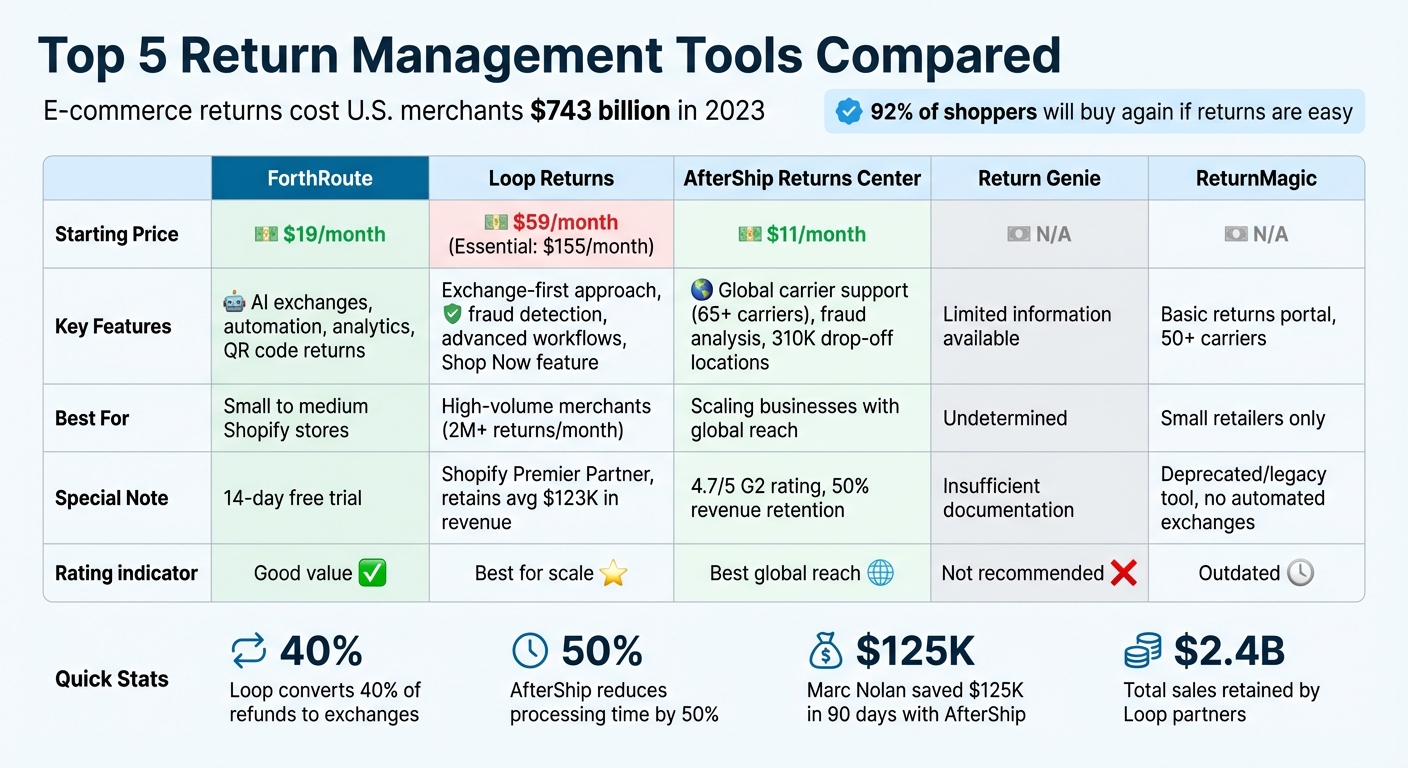
Return Management Tools Comparison: Features, Pricing, and Best Use Cases
5 Best Return Management Apps for Shopify

1. ForthRoute
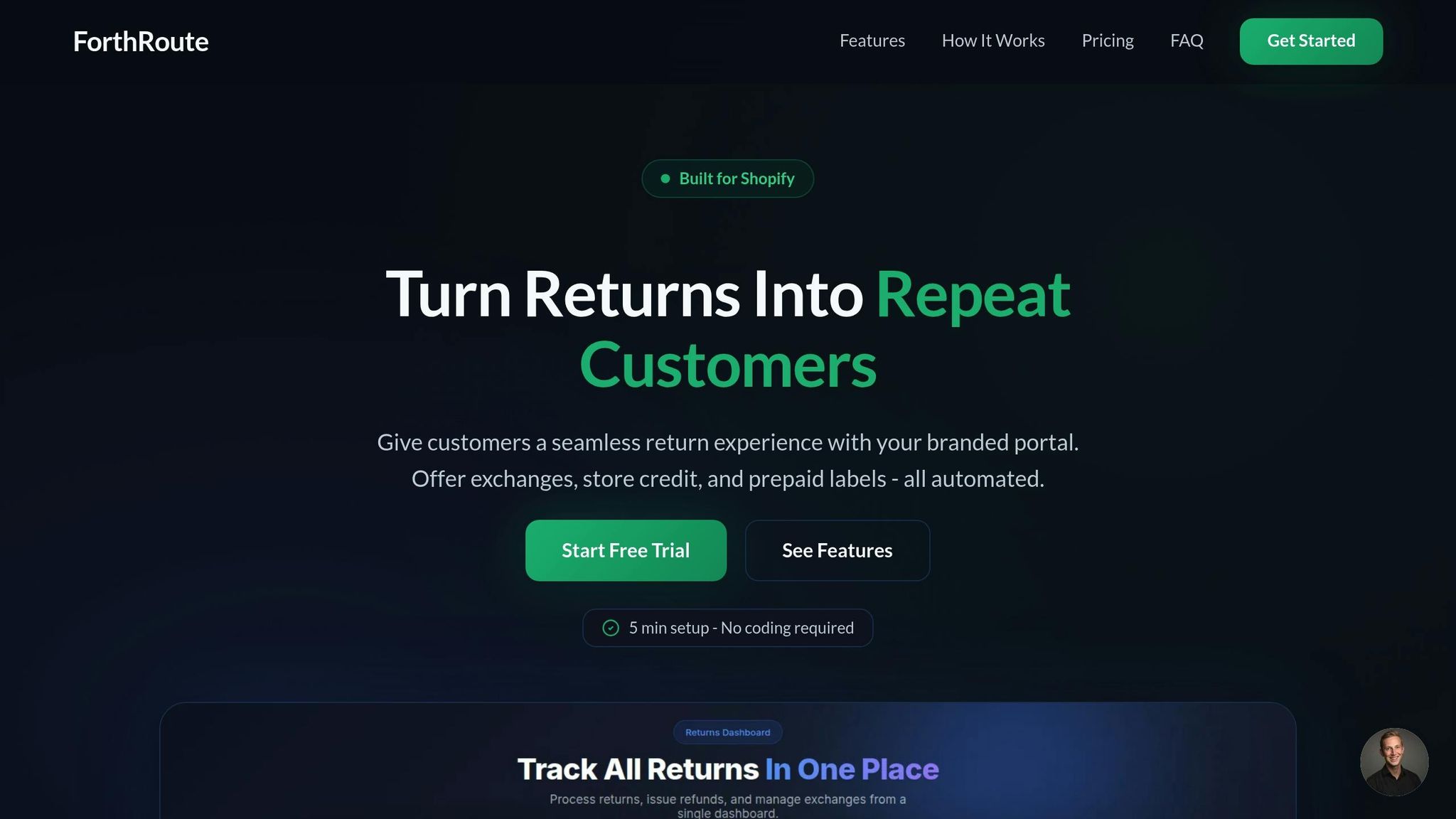
ForthRoute is a returns management app specifically designed for Shopify merchants, simplifying the entire returns process while helping businesses retain revenue. Instead of juggling endless email threads and manual approvals, ForthRoute provides a sleek, customizable portal where customers can quickly initiate returns, generate shipping labels, or request exchanges. It eliminates the need for spreadsheets and support tickets by automating approvals, label generation, and exchange workflows.
Features
ForthRoute focuses on three key areas: automation, retention, and optimization.
- Automation: With its powerful rules engine, ForthRoute streamlines returns by automatically approving eligible requests and creating prepaid shipping labels through its EasyPost integration. It even supports printerless returns via QR codes, allowing customers to print labels instantly at carrier drop-off points.
- Retention: The app encourages exchanges and store credit over refunds, keeping more revenue within your business. It offers intelligent product recommendations based on return reasons and provides instant store credit, enabling customers to shop immediately without waiting for a refund.
- Optimization: Real-time analytics help you spot trends like sizing issues or frequently returned items, giving you actionable insights to improve product descriptions or inventory strategies. Additionally, warehouse webhook integrations notify your fulfillment team or 3PL provider as soon as a return is initiated, ensuring smooth operations.
Pricing
ForthRoute keeps pricing simple and transparent. The Professional Plan costs $19 per month, offering access to a branded portal, automation tools, and analytics. There’s a $1.50 fee per generated label, plus the carrier’s shipping rate. A 14-day free trial is available, and no credit card is required to get started.
Shopify Integration
Built exclusively for Shopify, ForthRoute seamlessly integrates with your store’s order data, inventory, and customer records. Customers can access the returns portal through a link like “Start a Return” added to your store’s footer. By entering their Order ID and email, they instantly see their eligible items - no manual lookups or CSV exports needed. Once a return is approved, all updates are automatically synced with your Shopify backend, ensuring a hassle-free experience.
Automation Capabilities
ForthRoute’s automation tools take the guesswork out of returns. You can set specific conditions, such as automatically approving certain requests or flagging others for review. Once a return is approved, the system generates a shipping label, sends tracking updates to the customer, and alerts your warehouse team via webhook - all in real time. This process cuts down on unnecessary back-and-forth communication and improves efficiency.
Suitability for Business Sizes
ForthRoute is designed to grow with your business. Whether you’re handling a handful of returns or managing high volumes during peak seasons, its flexible features and affordable pricing make it a great fit for Shopify merchants of all sizes. It’s a solution that adapts as your business evolves.
2. Loop Returns
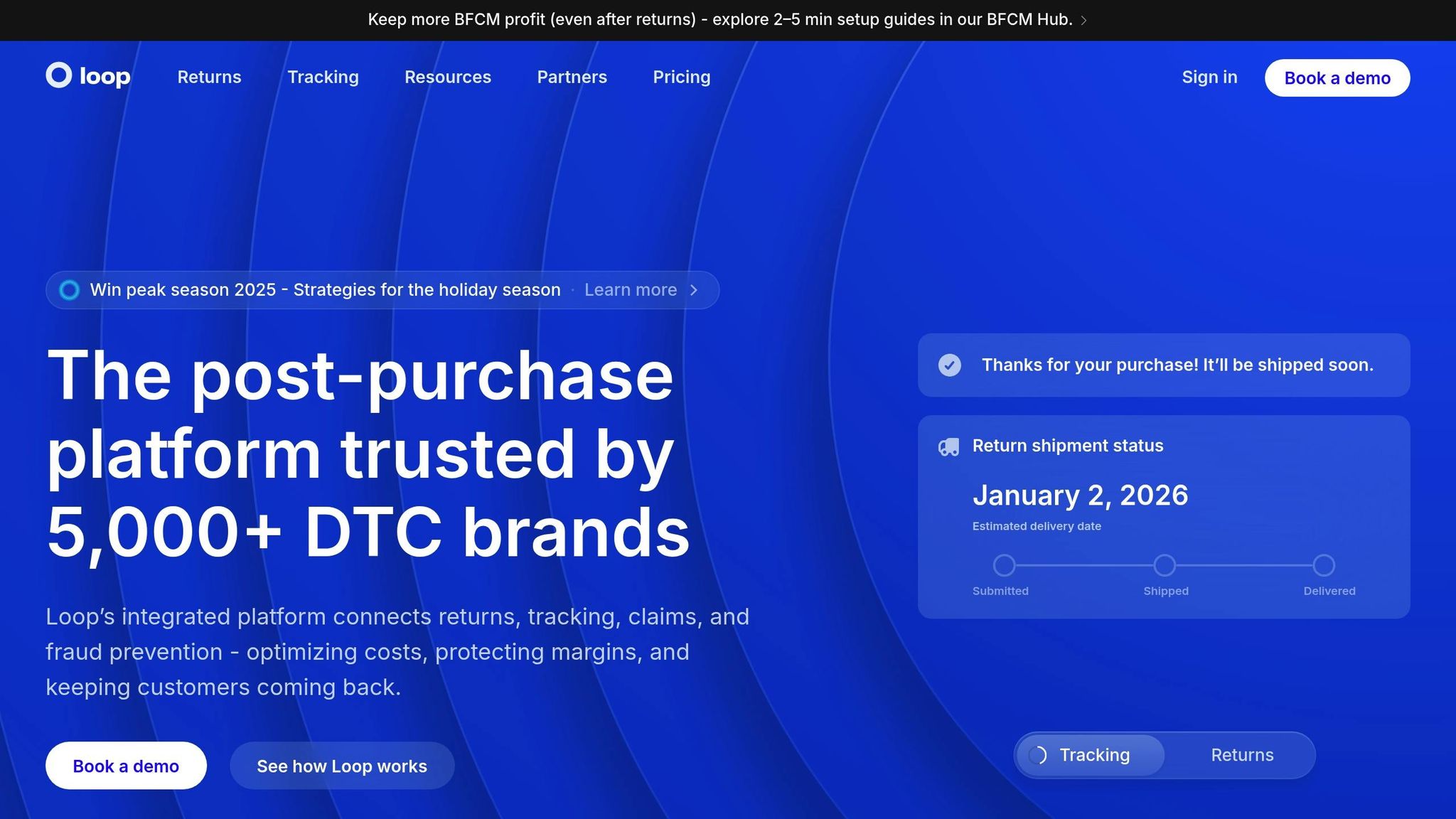
Loop Returns handles returns for brands accounting for over 15% of Shopify's GMV. With more than 2 million returns processed monthly across 5,000+ brands, the platform helps businesses retain an average of $123,000 in revenue. Let’s explore its standout features, pricing, and integrations.
Features
Loop takes an exchange-first approach, offering tools like "Instant Exchanges" and "Advanced Exchanges". These options let customers swap items for different sizes, colors, or even entirely new products. With the "Shop Now" feature, the return portal doubles as a shopping experience, while "Bonus Credit" encourages customers to choose exchanges over refunds.
For flexibility, Loop provides a no-code workflow editor. This tool allows businesses to create custom return policies based on factors like product type, customer tags (e.g., VIP status), order value, or return frequency. Its omnichannel support, including Point of Sale integration, lets online shoppers return items in-store, saving brands approximately 780 hours of labor annually. Additionally, Loop’s fraud detection system uses smart grading and blocklists to reduce return abuse.
In 2025, apparel brand LSKD used Loop’s exchange workflows to retain 53% of its return revenue and achieved an average upsell value of $1.81 per return.
"Loop's fraud system has been invaluable in helping us keep a close eye on potentially fraudulent returns while effectively mitigating fraud overall".
Pricing
Loop offers flexible pricing plans to suit businesses of all sizes:
- Free Checkout+ plan: Covers basic returns and domestic labels for the US and Canada.
- Starter plan: $59/month, includes basic automation and custom policies.
- Essential plan: $155/month, offering unlimited destinations, automated policies, and workflows.
- Advanced plan: $272/month, adding features like Shop Now, Instant Exchange, Bonus Credit, and advanced fraud prevention.
- Enterprise pricing: Tailored for larger businesses needing custom solutions.
- Usage-based option: $29/month with additional per-return fees.
Shopify Integration
Loop seamlessly integrates with Shopify, connecting directly to Shopify's admin and themes. It also works with over 120 Shopify-specific apps, such as Gorgias, Klaviyo, Attentive, ShipHero, and Shopify Flow. The Shopify POS integration ensures that online and in-store return data are unified.
Automation Capabilities
With Loop, customers can initiate returns through a self-service portal, streamlining the process. The platform automatically approves refunds, processes exchanges, or suggests a "Keep Item" option for low-value goods, helping businesses save on shipping costs. Impressively, Loop converts about 40% of refunds into exchanges.
Suitability for Business Sizes
Loop caters to businesses of all sizes. Smaller companies can start with the free or $59/month plans, while growing brands often choose the Essential or Advanced tiers for added features. Enterprise customers benefit from custom support and integrations. Collectively, Loop has helped its partners retain over $2.4 billion in sales.
3. AfterShip Returns Center
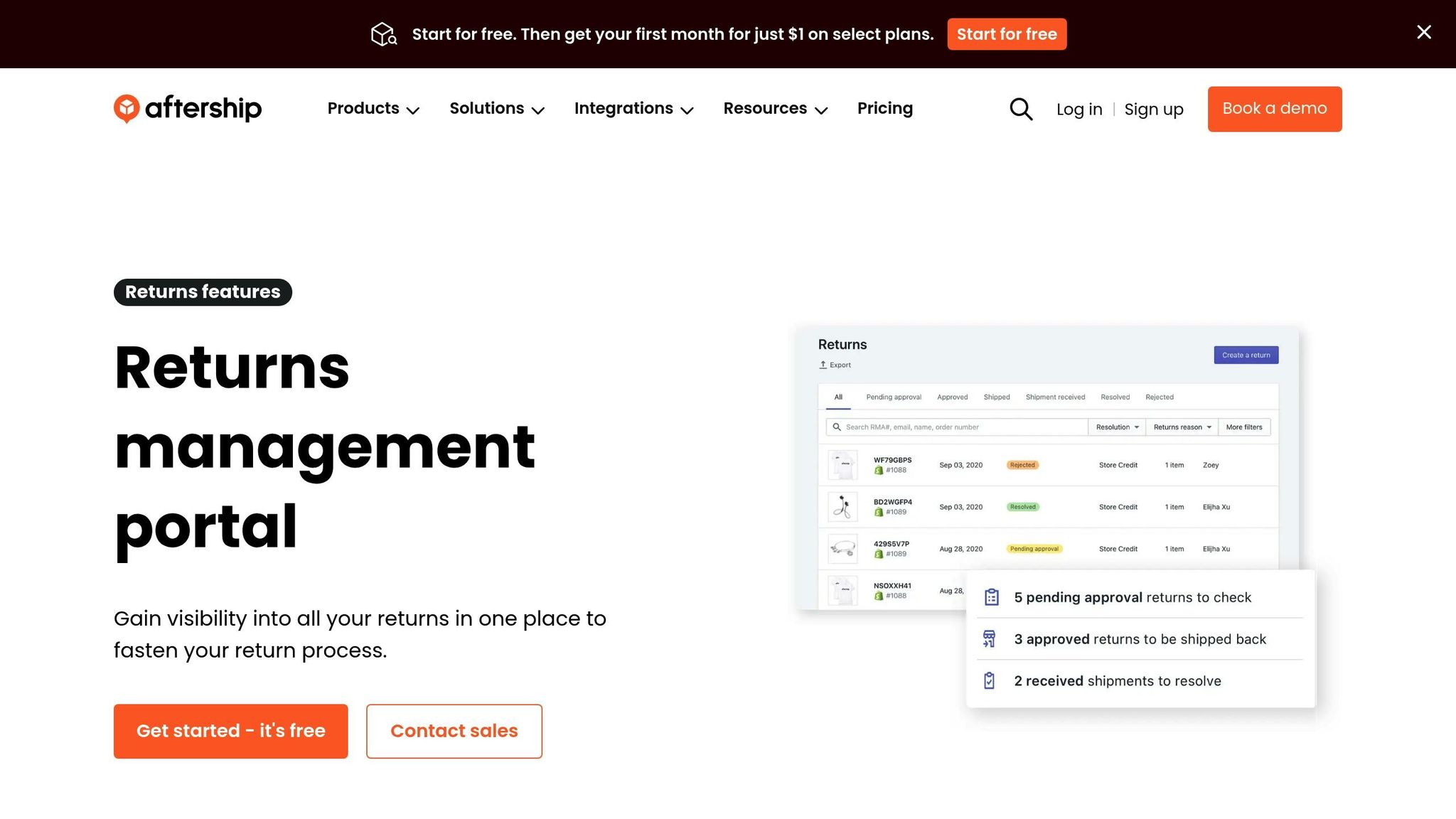
AfterShip Returns Center connects with over 310,000 drop-off locations worldwide and has earned a solid 4.7/5 rating on G2. By streamlining returns and encouraging exchanges, it helps businesses save time and retain revenue. A standout example comes from Marc Nolan, a footwear brand, which saved $125,000 in just 90 days using AfterShip's system. Nikolas Callas, their Director of Operations, highlighted its impact:
"This exchange feature took every problem away. It's also saved a lot of revenue - saving us $125k in the last 90 days".
Let’s dive into its standout features, pricing options, and Shopify integration.
Features
AfterShip offers a branded self-service portal that simplifies the returns process for customers. Through this portal, customers can initiate returns, choose resolutions (refunds, exchanges, or store credit), and create shipping labels. The platform uses conditional routing rules to approve or decline returns instantly, based on factors like return reasons, item type, or customer segments. For added protection, it flags potential fraud by analyzing return frequency and spotting weight discrepancies in returned packages.
The platform’s "on-store" exchange feature is a game-changer, offering bonus store credit to encourage exchanges instead of refunds. For low-value or bulky items, its green returns option lets customers keep the product while still receiving a refund or credit, cutting down on reverse logistics costs. Additionally, AfterShip supports partial returns for bundles, so customers don’t need to return the entire package.
"With AfterShip Returns, what used to take our team upwards of 8 hours a week to do, now only takes us 1 hour."
- Sarah D., Customer Service and Retention Manager, Lume
Pricing
AfterShip has four pricing tiers tailored to businesses of different sizes:
- Essentials: $11/month ($9/month billed annually) for 20 returns per month, including a branded portal and basic analytics.
- Pro: $59/month ($49/month billed annually) for 100 returns per month, with added exchange incentives and automation rules.
- Premium: $239/month ($199/month billed annually) for 200 returns per month, featuring advanced routing and fraud management.
- Enterprise: Custom pricing for unlimited returns and dedicated account management.
For startups, a limited free plan is also available.
Shopify Integration
AfterShip’s seamless integration with Shopify makes it a strong choice for e-commerce brands. It supports variant exchanges and syncs directly with Shopify Checkout and Stripe. Once a return is approved, the system automatically creates a new exchange order in Shopify. Additionally, it integrates with 3PL systems like ShipBob and ShipHero, generating RMAs and Advanced Shipping Notices automatically upon return approval.
Automation Capabilities
The platform simplifies logistics by generating prepaid labels from over 65 carriers, including FedEx, USPS, and UPS. Retailers using AfterShip report a 50% reduction in processing time for returns, along with retaining 50% of revenue through automated exchanges. Emails sent via AfterShip also see strong engagement, with a 78% open rate.
Suitability for Business Sizes
AfterShip’s tiered plans make it a versatile solution for businesses of all sizes, from small startups to large, multi-channel retailers. It’s particularly effective for Shopify-based brands looking for a scalable, end-to-end returns management system.
sbb-itb-a3e286c
4. Return Genie
As of late 2025, Return Genie hasn’t been widely recognized as a leading Shopify return management tool. Information about its features, pricing, and integrations is sparse, with little in the way of verified documentation or user feedback. This lack of transparency makes it tough to evaluate how well it performs in real-world scenarios.
When choosing a returns management platform, merchants typically look for tools that provide clear documentation, detailed case studies, and reliable user reviews. These elements help assess critical aspects like automation capabilities, customer support, and overall effectiveness. Without this information, it’s hard to determine whether Return Genie is a good fit for e-commerce operations.
For businesses, selecting a tool with measurable performance and straightforward pricing is key. The absence of these insights in Return Genie's case highlights the importance of exploring other solutions in the market.
5. ReturnMagic
ReturnMagic, one of Shopify's earlier returns apps, is now considered a legacy tool. While it was once a go-to option for handling returns, it lacks the advanced features and automation offered by newer solutions. In fact, many merchants have moved on to more modern platforms, as multiple sources confirm that ReturnMagic is now deprecated. This makes it a less-than-ideal choice for businesses seeking a long-term solution for returns management.
Features
ReturnMagic provides a branded returns portal, allowing customers to initiate returns through a customized interface. It integrates with over 50 carriers worldwide, offering merchants flexibility with pickup locations for return shipments. For Canadian businesses, it even supports direct integration with Canada Post for domestic returns.
However, the platform falls short in key areas. It doesn’t support automated exchanges, meaning merchants must manually process refunds and create replacement orders. Additionally, it lacks features like bonus credits or other incentives that encourage customers to choose exchanges over refunds - features that many modern tools now include to help retain revenue.
Shopify Integration
While ReturnMagic does integrate with Shopify, it has limitations. It cannot generate return labels directly, requiring merchants to rely on third-party services like Shippo, EasyPost, or ShipStation. Devaraj Mahantesh, SEO Analyst at ClickPost, explains:
"Return Magic currently only integrates with third-party platforms like Shippo, EasyPost, and ShipStation. This means you can't directly link it to your Shopify store [to generate labels]".
This dependency not only increases subscription costs but also adds complexity to the setup, making the process less efficient.
Automation Capabilities
Although ReturnMagic offers some API-driven automation for reverse logistics, its lack of automated exchanges and direct carrier integrations means much of the returns process remains manual. This creates extra work for merchants and slows down processing times compared to more comprehensive, all-in-one solutions.
Suitability for Business Sizes
Due to its limited functionality, ReturnMagic is best suited for small retailers with basic returns management needs. Its reliance on third-party shipping platforms and manual processes makes it less scalable and cost-effective. For businesses aiming to grow and seeking advanced features like analytics, automated workflows, and seamless integrations, ReturnMagic simply doesn’t meet the mark. This outdated approach highlights the growing need for modern, scalable tools in today’s fast-paced ecommerce world.
Advantages and Disadvantages
Every return management tool has its own set of strengths and limitations. Let’s start with ForthRoute, which offers a $19/month Professional Plan and features AI-powered exchange suggestions to help retain revenue. On the other hand, Loop Returns is Shopify's only Premier Partner, boasting an exchange-first strategy and seamless integration aimed at boosting revenue retention. However, its pricing - ranging from a 1-3% per-return fee or monthly plans starting at $155 - can increase costs and restrict flexibility for businesses outside the Shopify ecosystem.
Another noteworthy tool is AfterShip Returns Center, known for its global reach and flexible pricing. It provides a free plan for up to 50 shipments and paid options starting at $11/month, supporting over 1,100 global carriers. Despite these advantages, some users have noted that customer support and analytics on lower-tier plans could be improved.
Other tools, like Return Genie and ReturnMagic, require closer evaluation. Return Genie shows promise for mid-tier users but suffers from limited documentation, making its overall performance harder to gauge. Meanwhile, ReturnMagic caters to small businesses with a basic feature set, but it may fall short for those with more complex needs.
These comparisons highlight the critical role of automation and revenue retention in streamlining Shopify returns. Research indicates that 92% of consumers are likely to shop again if the returns process is hassle-free. As Lee Barwin from the ZigZag team emphasizes:
"The returns platform you choose can be the reason why shoppers decide to come back to your online store or never come back."
Choosing the right tool isn’t just about handling returns - it’s about creating a seamless customer experience that encourages loyalty and repeat purchases.
Conclusion
Picking the best return management tool boils down to balancing three key factors: your budget, the volume of returns you handle, and whether your focus leans more toward retaining revenue or streamlining operations. This decision requires aligning the detailed features of each tool with your business goals.
Each platform caters to different needs and budgets. ForthRoute is a strong option for small to medium-sized Shopify stores, offering AI-powered exchange suggestions and automated workflows at just $19/month - great for keeping revenue within your business. Loop Returns, priced at $155/month, shines in handling high-volume operations, while AfterShip Returns Center provides flexibility, starting at $11/month, with robust global carrier support. For more specialized needs, Return Genie and ReturnMagic might be worth exploring.
Here’s something to keep in mind: 92% of consumers are likely to shop again if the return process is easy. On the flip side, a single return can cost up to 65% of its retail price. Choosing the right tool isn’t just about managing returns - it’s about turning them into opportunities to build customer loyalty and protect your bottom line. Opt for a solution that solves today’s challenges and sets the stage for your business to grow tomorrow.
FAQs
How can a return management tool help lower e-commerce costs?
A return management tool can significantly cut e-commerce expenses by automating essential tasks such as processing return requests, creating shipping labels, and coordinating with carriers. This automation eliminates much of the manual effort, saving both time and labor costs.
On top of that, these tools can apply validation rules to reduce errors, curb fraudulent activities, and control shipping costs more effectively. By simplifying the entire returns process, businesses not only boost operational efficiency but also lower costs and deliver a smoother experience for their customers.
What features should I prioritize in a return management tool for my Shopify store?
When choosing a return management tool for your Shopify store, focus on features that make the process straightforward for both you and your customers, while keeping expenses under control.
Start with tools that offer seamless integration with Shopify, so you can handle returns directly from your Shopify admin panel. A self-service portal is a must-have, giving customers the ability to initiate returns on their own. At the same time, flexible settings allow you to establish rules like return eligibility, timeframes, and restocking fees.
Automation can be a game-changer. Look for tools that handle tasks like generating return labels, tracking shipments, and processing refunds or exchanges automatically. For added value, consider advanced features such as fraud detection, shipping cost recovery, and in-depth analytics to fine-tune your return policies. These capabilities not only enhance the shopping experience for U.S. customers but also help you manage costs, protect your bottom line, and build long-term customer loyalty.
Why is it better to encourage product exchanges instead of refunds in return management?
Encouraging exchanges instead of refunds comes with some clear advantages for your business. For starters, it helps you keep revenue that might otherwise disappear with a refund, which can make a noticeable difference to your bottom line. Plus, it cuts down on the expenses tied to processing returns, like restocking and handling fees.
But it’s not just about the numbers - exchanges can also boost customer loyalty. When you offer an exchange, you’re not ending the interaction with a refund; you’re taking an extra step to make sure the customer walks away with a product they’re satisfied with. This simple gesture can improve their post-purchase experience and make them more likely to come back in the future.