Refunds hurt your bottom line, but exchanges and store credit can help you keep revenue in-house. For e-commerce businesses, especially Shopify stores with return rates averaging 27%, managing returns efficiently is critical. Here's how you can turn refunds into retained revenue:
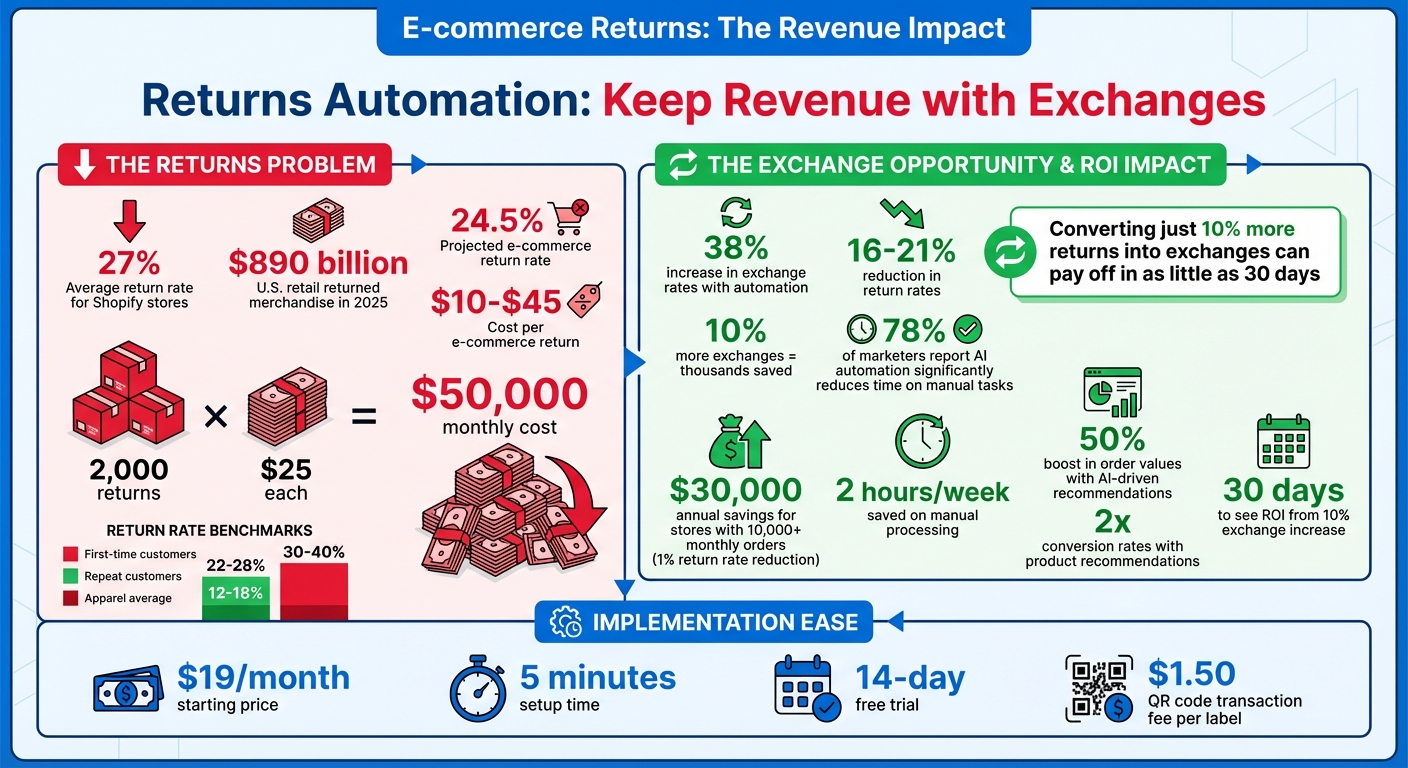
- Refunds are costly: They result in lost sales, return shipping expenses, and often unsellable items. For example, 2,000 returns at $25 each cost $50,000 monthly.
- Exchanges and store credit save revenue: Encourage customers to swap products or use instant store credit instead of opting for refunds. Even a 10% increase in exchanges can save thousands.
- Automation simplifies returns: A self-service portal speeds up the process, reduces manual work, and improves customer satisfaction. Features like prepaid shipping labels and AI-powered product recommendations make exchanges easier.
- Data drives improvement: Tracking metrics like exchange rates and return reasons helps refine policies and fix product issues, reducing future returns.
Switching to automated returns with tools like Forthroute can streamline operations, boost exchange rates, and protect your profits. Start by implementing a branded, user-friendly returns portal and using automation to guide customers toward exchanges. This small shift can save thousands annually while enhancing the customer experience.
E-commerce Returns Impact: Refunds vs Exchanges Revenue Retention
Returns Management Software Turns Refunds Into Revenue - Here’s How
sbb-itb-a3e286c
Setting Up a Self-Service Returns Portal
Creating a self-service returns portal not only lightens the load on your support team but also encourages exchanges that help retain revenue within your business.
How the Forthroute Portal Works
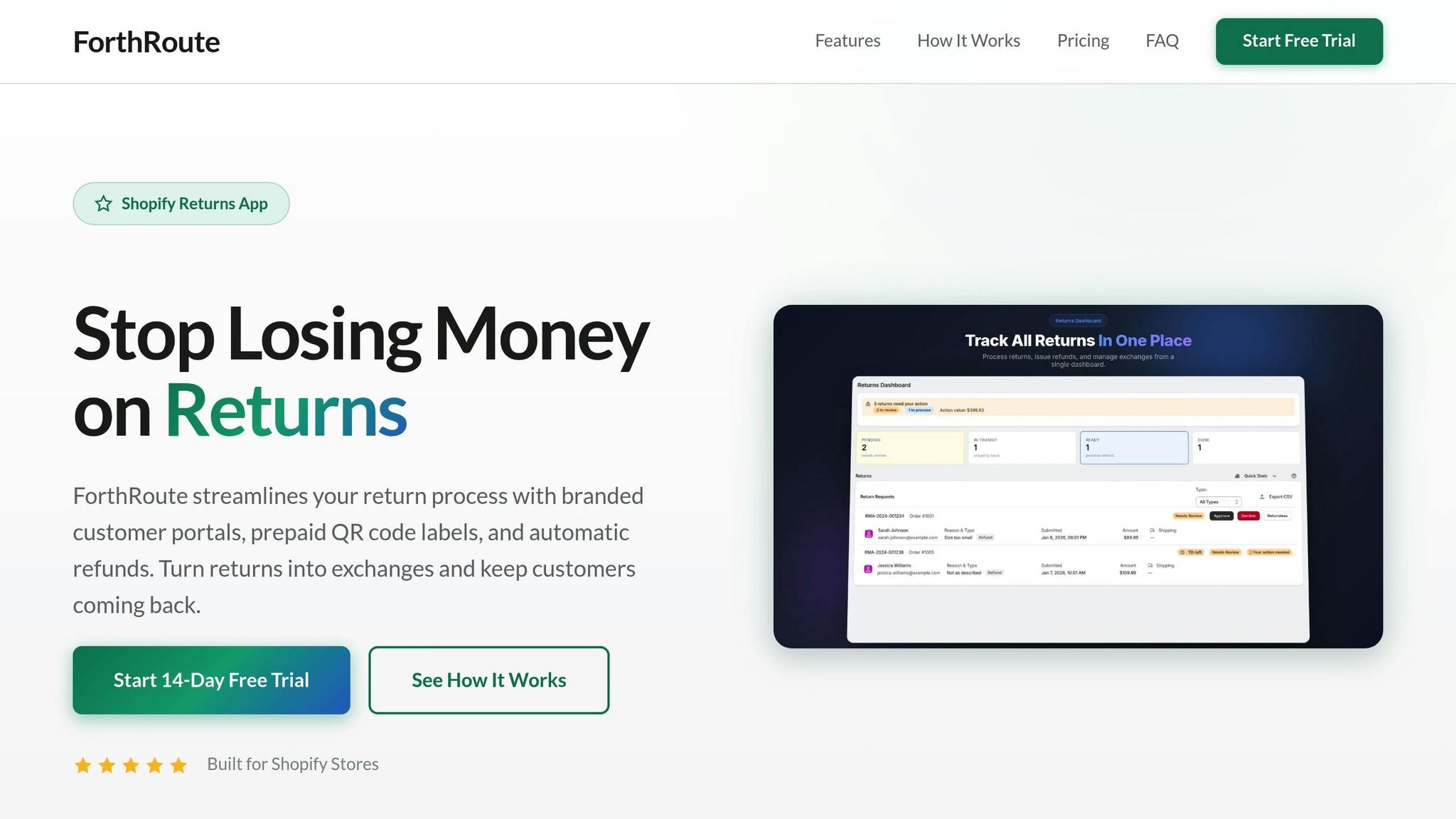
Start with a simple "Start a Return" button. Place it in your store's footer, and customers can manage returns without needing to contact your support team. Clicking the button prompts them to enter their order number and email, allowing instant access to eligible items. From there, they can select the items they wish to return, provide a reason (like "Too small" or "Wrong color"), choose a resolution (refund, exchange, or store credit), and - if approved - receive an instant prepaid shipping label. No back-and-forth emails. No delays.
Setting up the portal is quick and painless. With one-click authorization via the Shopify App Store, the system takes care of everything: from automated approval workflows to shipping label creation and even exchange suggestions. This means your support team can focus on other tasks while customers enjoy a seamless experience with immediate confirmation. It’s a simple way to ensure returns are handled efficiently while maintaining a professional, brand-aligned process.
Customizing the Portal to Match Your Brand
A generic returns page can feel out of place and disrupt your brand’s image. Forthroute solves this by allowing you to personalize the portal. Upload your logo, incorporate your brand colors, and craft custom messaging that reflects your brand’s tone. This ensures the entire customer journey - from browsing to purchasing to returning - feels polished and cohesive.
You can also set custom return windows and approval thresholds. These automated rules take the guesswork out of returns, reducing internal back-and-forth as your business scales. Want to make it even easier for customers? Modernize the process with features like QR code returns.
QR Code Returns for Customer Convenience
Say goodbye to printers with QR code returns. Thanks to Forthroute's EasyPost integration, customers receive a QR code directly on their phone instead of a PDF label. They simply bring their package to a USPS, UPS, or FedEx drop-off location, show the QR code to the staff, and the carrier prints the label on-site.
This hassle-free option boosts customer satisfaction while speeding up inventory recovery. The cost? You’ll pay the carrier rate plus a $1.50 transaction fee per label, and you’re only charged if the label is used. It’s a win-win for both your customers and your business.
Using Automation Rules to Drive Exchanges
Keep your revenue intact by steering customers toward exchanges instead of refunds. Automation rules make this shift easier by encouraging exchanges and store credit, all while leveraging the efficiency of a self-service portal. When properly implemented, these rules eliminate manual steps and help protect your profits. Here’s how automation can simplify returns and boost exchange rates.
Auto-Approval Rules That Streamline Returns
Set your return policies once, and let the system take care of the rest. With Forthroute, you can establish rules like "Automatically approve returns under $50" or "Reject items marked as Final Sale." The platform ensures eligible returns are processed without delay and rejects those that don’t meet your criteria. For instance, if you set a 30-day return window, the system will only accept requests within that timeframe - no need for your support team to step in.
Forthroute’s automation engine works seamlessly across all Shopify plans and integrates with your warehouse using webhook APIs. Once items are received and inspected, actions are triggered automatically, saving time and effort.
And it doesn’t stop at approvals - smart recommendations take exchanges to the next level.
AI-Powered Product Recommendations for Exchanges
If a customer selects "Too small" as their reason for return, Forthroute’s AI steps in to suggest the same item in a different size or style. By analyzing the return reason, the system offers alternatives like other sizes, colors, or even complementary products - right within the self-service portal. This quick and personalized approach allows customers to swap their item in seconds instead of waiting for a refund and shopping elsewhere.
The results speak for themselves: merchants using Forthroute’s exchange-focused automation have seen exchange rates rise by 38% and return rates drop by 16–21%.
Incentivizing Exchanges with Bonus Store Credit
A little extra store credit can go a long way in making exchanges more appealing. By offering bonus store credit, you not only retain revenue but also encourage additional purchases. Forthroute simplifies this process with instant store credit that customers can use right away, turning a return into an opportunity for increased sales.
Tracking Returns Data to Improve Your Process
Returns data shines a light on revenue leaks and recurring customer pain points. Without it, you’re left guessing about patterns that could be costing your business. Accurate returns data is the foundation for refining exchange strategies and safeguarding revenue. With Forthroute's analytics dashboard, you gain the clarity needed to make smarter decisions about your products, policies, and operations. Once you’ve got the data, the next step is zeroing in on key metrics that can drive meaningful improvements.
Key Metrics to Monitor with Forthroute Analytics
To sharpen your returns process, focus on tracking these key metrics:
- Exchange rates: Understand how often customers opt for exchanges instead of refunds.
- Return reasons: Identify patterns in why items are sent back.
- Shipping costs: Include carrier rates plus the $1.50 fee to get the full picture.
- Replenishment times: Use 3PL integration to measure how quickly returned items are restocked.
- Support volume: Gauge how much customer service effort is tied to returns.
These metrics provide actionable insights to guide the corrective steps outlined below.
Using Return Reasons to Fix Product Issues
Analyzing return reasons can uncover specific product problems. For example, frequent complaints like "too small" suggest sizing inconsistencies. Shopify's reporting tools can help you quantify return rates for each product as a percentage, making it easier to identify outliers. Research shows that first-time customers typically return items at rates between 22% and 28%, while repeat customers average between 12% and 18%.
Export your return data and use pivot tables to break it down by product, reason, and customer segment. This deeper analysis helps you prioritize fixes. Let’s say your apparel line generally sees return rates in the 30–40% range, but one specific dress is being returned at a 50% rate. That’s your cue to dig deeper - whether it’s updating size charts, improving product photos, or revising descriptions.
Refining Your Returns Policy Over Time
A returns policy isn’t something you set and forget. Reviewing analytics every 90 days allows you to spot trends and make adjustments. For instance, if 65% of returns happen within the first 30 days of purchase, you might experiment with reducing your return window from 60 days to 45 days without negatively impacting customer satisfaction.
Use these insights to tweak automated rules and streamline the exchange process. If certain products are consistently returned in perfect condition, consider auto-approving those returns. On the flip side, items that often arrive damaged might require photo evidence before approval. Monitoring exchange rates and shipping costs will also help you determine whether these changes are boosting your bottom line.
It’s worth noting that the U.S. retail sector handled $890 billion in returned merchandise in 2025, with ecommerce return rates projected to hit 24.5%. Leveraging analytics can help you stay ahead of these trends - whether that means revising product descriptions, updating size guides, or fine-tuning return policies for specific categories.
Conclusion
Returns automation can turn what feels like a financial drain into an opportunity to retain revenue. By shifting focus from refunds to exchanges and store credits, you're actively safeguarding your bottom line. Data shows that converting just 10% more returns into exchanges can pay off in as little as 30 days, while also saving your team around 2 hours each week on manual processing tasks.
Tools like self-service portals, automated approval systems, and AI-powered product recommendations bring a range of benefits. Self-service options resolve issues instantly, reducing the workload on support teams and keeping revenue within your business. In fact, 78% of marketers have noted that AI automation significantly cuts down time spent on tasks like data entry. The benefits go well beyond returns management.
For stores handling over 10,000 orders monthly, even a small 1% reduction in return rates can save up to $30,000 annually - especially considering that e-commerce returns typically cost between $10 and $45 each. On top of that, AI-driven product recommendations can amplify revenue, double conversion rates, and boost order values by 50%.
What’s more, implementing returns automation is straightforward and low-cost. Forthroute offers plans starting at just $19 per month, with setup taking less than five minutes. Plus, their 14-day free trial lets you explore the system risk-free. Together, these tools create a seamless system that promotes exchanges while reducing manual effort.
The benefits - both operational and financial - highlight why transforming your returns process is worth it. Retailers thriving in 2026 won’t necessarily have the most flexible return policies; they’ll be the ones who’ve mastered turning returns into exchanges. Start with an easy-to-use returns portal, add smart automation, and watch your exchange rates rise while support tickets shrink.
FAQs
What is Forthroute?
Forthroute is a Shopify app designed to simplify the returns process for both businesses and their customers. With its branded self-service portal, customers can easily start returns, print shipping labels, or choose exchange options - all without hassle. The app automates approval rules and even suggests instant exchanges, making it easier for businesses to retain revenue while enhancing the overall post-purchase experience.
How does the self-service portal work?
Customers can begin a return by clicking a link like "Start a Return", entering their order number and email address, and selecting the items they wish to return. They’ll then pick a reason for the return (e.g., "Too small") and choose how they’d like it resolved - whether through an exchange, refund, or store credit. The system handles approval rules automatically and instantly generates shipping labels, streamlining the process for a smooth and efficient experience.
How much does it cost?
The Professional Plan from Forthroute is priced at $19 per month. It comes packed with features like a branded portal, automation rules, and analytics to streamline your operations.
However, keep in mind there’s an additional $1.50 fee for each shipping label you generate.
Want to try it out first? You can take advantage of their 14-day free trial - and the best part? You don’t need to provide a credit card to get started.
Can I offer printerless returns?
Customers can now take advantage of printerless returns by using QR code labels. All they need to do is show the QR code at a carrier drop-off location, and the carrier will handle printing the shipping label for them. This hassle-free process makes returns easier and helps create a better overall experience for your customers.
How does it help me keep revenue?
Forthroute focuses on helping businesses keep their revenue by encouraging exchanges or store credit instead of refunds. Using AI-driven suggestions, it offers alternatives like different sizes or products, transforming potential refunds into exchanges. This approach not only retains revenue but also cuts down on costs tied to refunds.
Can I automate approvals?
Yes, you can set up automated approvals by applying smart rules. For example, you might automatically approve returns below a certain dollar amount or that meet specific conditions. This approach simplifies the process, cuts down on manual reviews, and frees up your support team to focus on more complex tasks.