Partial refunds help Shopify merchants keep more revenue while solving customer issues. Instead of refunding entire orders, you only return the value of the problem item. This approach saves 80–90% of the sale, reduces transaction fee losses, and improves customer satisfaction. Automating partial refunds with tools like Forthroute speeds up resolutions, lowers support tickets by 40–60%, and provides insights into return trends. For $19/month, Forthroute offers features like automated rules, a self-service portal, and AI-driven exchange suggestions to simplify the process and protect your bottom line.
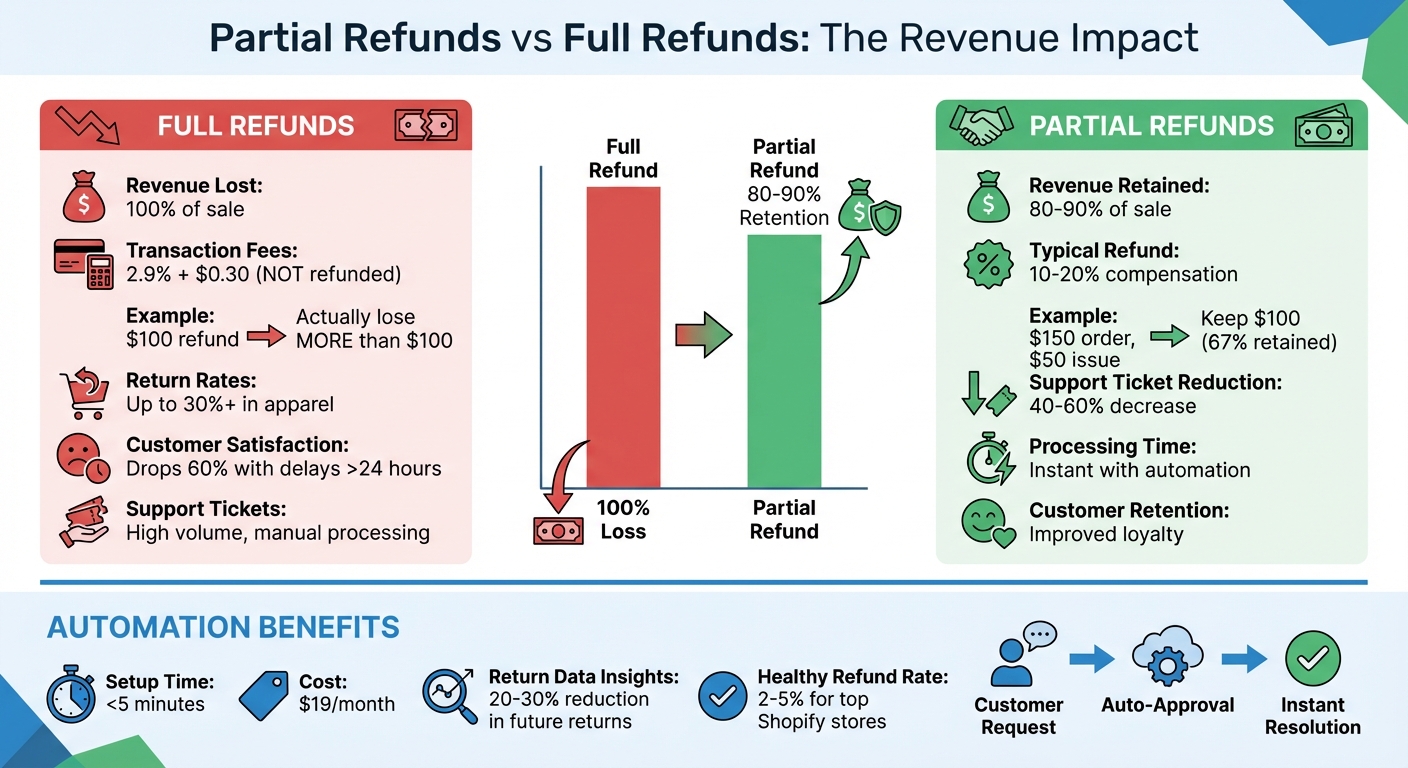
Partial Refunds vs Full Refunds: Revenue Impact Comparison for Shopify Merchants
The Problem: Full Refunds Drain Revenue
How Full Refunds Hurt Your Business
Offering full refunds doesn’t just mean giving back the money - it triggers a ripple effect of losses across your operations. When a customer returns an item, you lose 100% of the revenue from that sale. On top of that, Shopify’s transaction fees (2.9% + $0.30) aren’t reimbursed. So, for a $100 refund, you’re actually losing more than $100 once fees are factored in.
Refunds also come directly out of your future payouts. For example, if you’re expecting a $1,000 payout and process a $100 refund, only $900 will hit your account. Meanwhile, you’ve already spent money on fulfillment, inventory, and shipping, leaving you with nothing to cover those costs. For apparel businesses, where return rates can climb above 30%, this can lead to serious cash flow problems.
And let’s not forget the condition of returned items. Many come back damaged, outdated, or otherwise unsellable, further adding to your losses. Then there’s the added expense of shipping - both outbound and return shipping costs pile up quickly. Beyond the financial hit, these full refunds often leave customers with a less-than-ideal experience.
Manual Returns: A Customer Experience Nightmare
The financial strain is just one side of the coin. Full refund policies often go hand-in-hand with manual return processes that frustrate customers. Processing refunds manually can take several days, leaving customers stuck in a tedious loop. They have to email your support team, wait for approval, and handle printing return labels - all while wondering when they’ll see their money again. Research shows that delays longer than 24 hours can slash customer satisfaction by as much as 60%.
This drawn-out process can leave a bad taste in your customers’ mouths. Often, they remember the hassle of returning the product more than the issue with the product itself. Without efficient, self-service return options, your support team also ends up buried in emails and manual tasks, pulling their attention away from activities that drive growth.
sbb-itb-a3e286c
What Are Partial Refunds and How Do They Work?
Understanding Partial Refunds
A partial refund involves returning only a portion of a customer's payment while keeping the rest of the sale intact. When issued, the order status changes to "Partially refunded", and additional partial refunds can be processed later if necessary.
For instance, imagine a customer purchases three items for $150, but one arrives damaged. Instead of refunding the full amount, you could refund just $50 for the damaged item, leaving the remaining $100 untouched. Shopify offers various options for partial refunds, allowing merchants to refund specific products, custom dollar amounts, or even just the shipping costs. This flexibility means you're not forced into an all-or-nothing decision when resolving customer issues.
Refunded amounts are typically returned to the customer’s original payment method within 5-10 business days. This method allows businesses to address problems efficiently while minimizing financial impact.
Why Merchants Benefit from Partial Refunds
Partial refunds offer a way to address customer concerns without sacrificing the entire sale value. Compared to full refunds, they help preserve revenue while resolving specific issues. For example, offering a 10-20% refund as compensation allows the customer to keep the product at a discount while you retain most of the revenue - often around 80%.
Scenarios where partial refunds work well include:
- Damaged products: The customer keeps the order but receives compensation for the damage.
- Shipping delays: A partial refund helps offset the inconvenience caused by late delivery.
- Pricing adjustments: If a customer buys an item before a sale, a partial refund covers the price difference without requiring a return or repurchase.
This approach demonstrates that you value your customers’ concerns without needing to cancel entire orders. It also helps strengthen customer relationships, encouraging loyalty and repeat business over time.
How Forthroute Automates Partial Refunds
Setting Up Automated Refund Rules
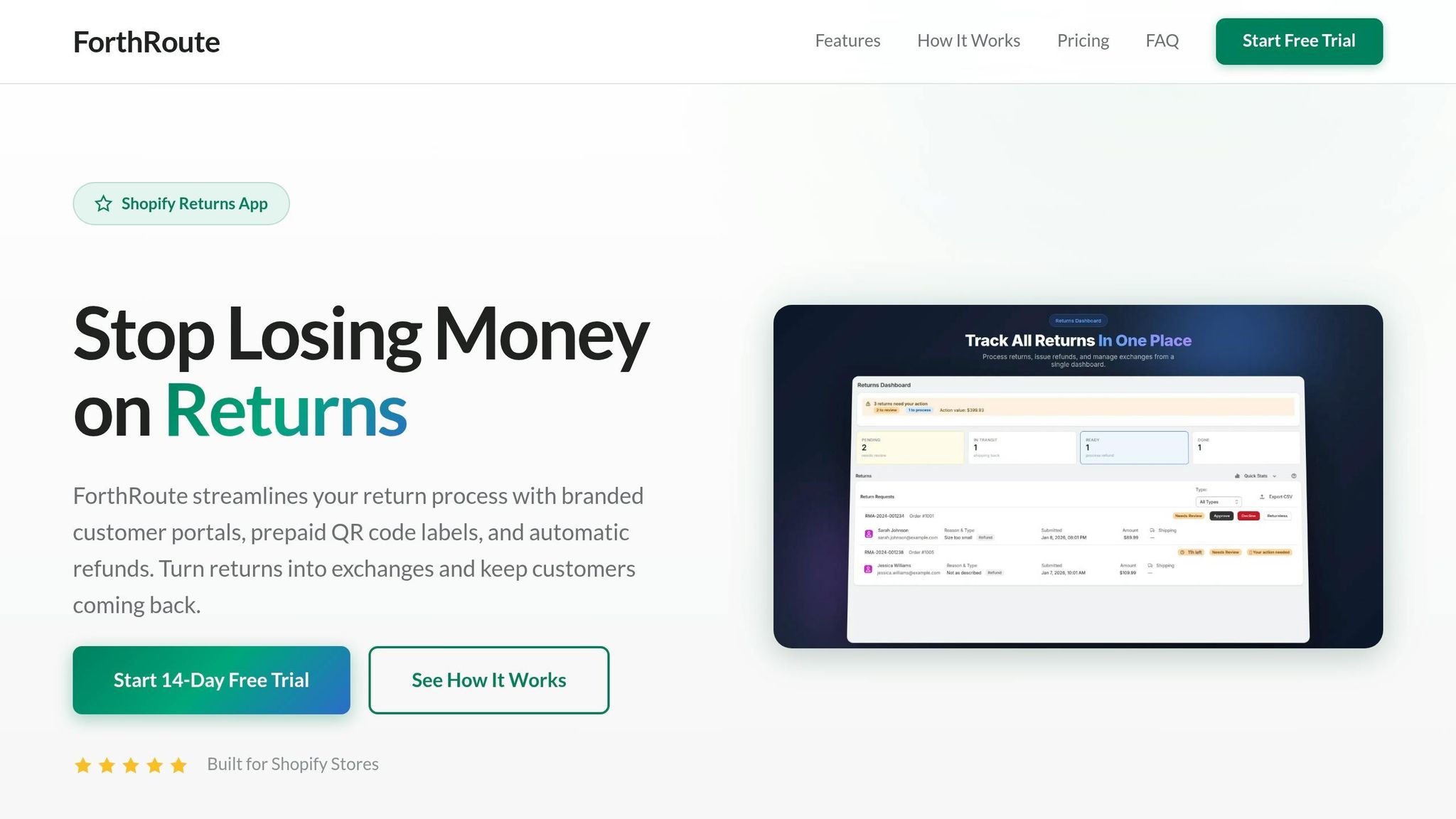
Forthroute streamlines partial refunds with customizable rules. For instance, you can set parameters to automatically approve refunds below a specific amount - like $50 - or reject returns for items marked as final sale. These rules can handle various scenarios, such as partial returns of a multi-item order or returns of specific products.
The setup process is quick, taking less than five minutes through the dashboard. Once configured, the system takes over, automatically processing qualifying refund requests, generating credit memos, and updating Shopify payments. For example, if a customer buys three items totaling $150 but returns one worth $50, the system can approve the $50 refund while keeping the remaining $100 intact. This automation integrates smoothly into your returns management workflow, saving time and effort.
Self-Service Portal for Customer Requests
Forthroute’s self-service portal makes returns hassle-free for customers. Instead of contacting support, customers can start the return process themselves by clicking a "Start a Return" link, usually found in your store’s footer. From there, they simply enter their Order ID and email to view their purchases. They can then select the items they want to return, provide a reason (like "Too small"), and choose a resolution - whether that’s a partial refund, an exchange, or store credit.
If the request meets the automated rules, it’s processed instantly. Customers may also receive a prepaid shipping label for their return. Merchants using this tool have seen support ticket volumes drop by 40–60%. Additionally, the portal supports printerless QR code returns via EasyPost. This feature allows customers to show a QR code on their phone at USPS or UPS locations, eliminating the need for printed labels.
Prioritizing Exchanges and Store Credit Over Refunds
Forthroute emphasizes exchanges and store credit to minimize revenue loss. When a customer starts a return, the system uses AI to suggest alternatives, such as a different size or color, turning potential refunds into exchanges. For example, if a customer requests a refund for a damaged item, the system might suggest exchanging it for a similar product, preserving the full order value.
Instant store credit is another option, giving customers immediate purchasing power while keeping funds within the business. This approach not only helps retain revenue but also avoids losses tied to non-refundable transaction fees. By focusing on exchanges and store credit, Forthroute boosts customer loyalty while protecting your bottom line.
Benefits of Automating Partial Refunds
Better Customer Retention Rates
Partial refunds can be a game-changer for keeping customers loyal while retaining most of the sale. Imagine this: a package arrives two days late, and you offer the customer a $20 partial refund (about 10–20% of the order value). They get to keep the product and feel appreciated, while you retain 80% of the revenue. What could have been a frustrating experience transforms into an opportunity to build loyalty.
By automating this process, resolutions happen almost instantly. Approvals and shipping labels are generated in seconds, creating the smooth experience that today’s shoppers expect. This quick turnaround not only encourages repeat business but also lightens the load for your team.
Less Manual Work for Support Teams
Automation doesn’t just help customers - it’s a relief for your support team too. Auto-approval rules can handle routine requests, like approving refunds under $50 or rejecting final sale items, without needing human input. The system takes care of generating shipping labels, processing refunds, and even updating Shopify payments automatically.
This reduces support ticket volumes by 40–60%, giving your team more time to focus on higher-value tasks, such as improving the overall customer experience or solving more complex issues. On top of that, finance and operations teams benefit from automated credit memos and payment processing, eliminating the need for manual data entry.
Using Return Data to Make Better Decisions
Automated systems also provide valuable insights into why customers are returning products. Reasons like "Too small" or "Color didn’t match photo" can be synced directly to your Shopify dashboard, making it easier to spot patterns and address underlying issues.
For context, successful Shopify stores typically maintain refund rates between 2–5%. If your rates climb above 5%, it’s a sign that something needs attention. Automated tools track these metrics in real time, and merchants who use this data effectively can lower future returns by 20–30%. Whether it’s optimizing inventory, fixing quality issues, or improving product photos, these insights help you make smarter decisions. Knowing what’s being returned and why allows you to act quickly, cutting losses and turning refunds into opportunities to retain revenue.
Shopify Partial and Full Refunds
Conclusion
Partial refund automation serves as a key strategy for protecting revenue for Shopify merchants. By automating the returns process and offering alternatives like exchanges and store credit, you can preserve revenue that might otherwise be lost. Full refunds are more costly than they seem - not only do you forfeit the sale, but you also lose non-refundable transaction fees of 2.9% + $0.30, making each refund hit harder.
Top-performing Shopify stores typically keep refund rates between 2-5%, and those leveraging automation to encourage exchanges over refunds achieve much stronger revenue retention. Offering partial refunds for specific issues allows you to recover 80-90% of the sale value while still addressing customer concerns effectively.
Forthroute simplifies this process with automation. For $19/month, you gain access to a branded self-service portal, automated approval workflows, AI-driven exchange suggestions, and printerless QR code returns. Setup takes less than five minutes, and the 14-day free trial doesn’t even require a credit card.
This automation not only reduces the workload for your support team but also ensures customers receive quick resolutions. Plus, the data collected from automated returns provides valuable insights. Whether it’s identifying sizing problems or product quality issues, these insights help you address recurring problems early, improving customer satisfaction and retention.
FAQs
What is Forthroute?
Forthroute is a Shopify app designed to simplify the returns process with a branded, self-service portal. Customers can quickly initiate returns, print shipping labels, or choose exchanges in just a few clicks. The app takes care of automating approval rules and even suggests instant exchanges, cutting down on the manual workload for support teams. At the same time, it helps build customer loyalty by offering a seamless and efficient returns experience.
How does the self-service portal work?
Customers can initiate a return by entering their order number and email into the branded self-service portal. From there, they can select the items they want to return, specify a reason (like "Too small"), and choose how they'd like it resolved - whether that's a refund, an exchange, or store credit. Once approved, they’ll immediately receive a shipping label. For extra convenience, printerless returns are available through a QR code option.
How much does it cost?
Forthroute's pricing begins at $19 per month for the Professional Plan. This plan comes with features like a branded portal, automation rules, and analytics. However, keep in mind there's an extra $1.50 transaction fee for every shipping label you generate.
Can I offer printerless returns?
Yes, Forthroute offers printerless returns using QR code labels. Customers simply bring their package to a carrier drop-off location, display the QR code on their phone, and the carrier takes care of printing the label. This streamlined process makes returns easier and more convenient, enhancing the overall customer experience.
How does it help me keep revenue?
Forthroute focuses on keeping your revenue intact by emphasizing exchanges and store credit instead of processing refunds. Using AI-driven suggestions, it offers tailored recommendations - like suggesting a different size or an alternative product - when a refund request comes in. This strategy not only minimizes revenue loss but also helps improve the overall customer experience.
Can I automate approvals?
Automating return approvals is possible by establishing rules tailored to factors such as return value, product type, or return window. With these guidelines in place, the system can make decisions on its own, cutting down on manual tasks and saving your team valuable time.