Feeling overwhelmed by Shopify return management? If you're deciding between Forthroute and ReturnGO, here's the quick answer: Forthroute is better for small-to-medium Shopify merchants seeking simplicity and predictable costs, while ReturnGO suits larger, global businesses needing advanced customization - but at a much higher price.
Key Takeaways:
- Forthroute: $19/month flat fee, easy 5-minute setup, Shopify-only, unlimited returns, and cost-effective for smaller stores.
- ReturnGO: Starts at $147/month, tiered pricing, multi-platform support, global carriers, and robust features for complex workflows.
Quick Comparison:
| Feature | Forthroute | ReturnGO |
|---|---|---|
| Starting Price | $19/month flat fee | $147/month (Premium tier) |
| Pricing Model | Flat-rate + $1.50/label | Tiered (Premium, Pro, etc.) |
| Setup Time | Under 5 minutes | 1–3 days (varies) |
| Target Audience | Shopify-only merchants | Multi-platform businesses |
| International Support | USPS, UPS, FedEx (US-focused) | Global carriers (DHL, etc.) |
Forthroute is ideal for Shopify merchants who want an affordable, hassle-free returns solution. ReturnGO works best for businesses with international or multi-platform needs but comes with higher costs and complexity. Choose based on your store size, budget, and operational goals.
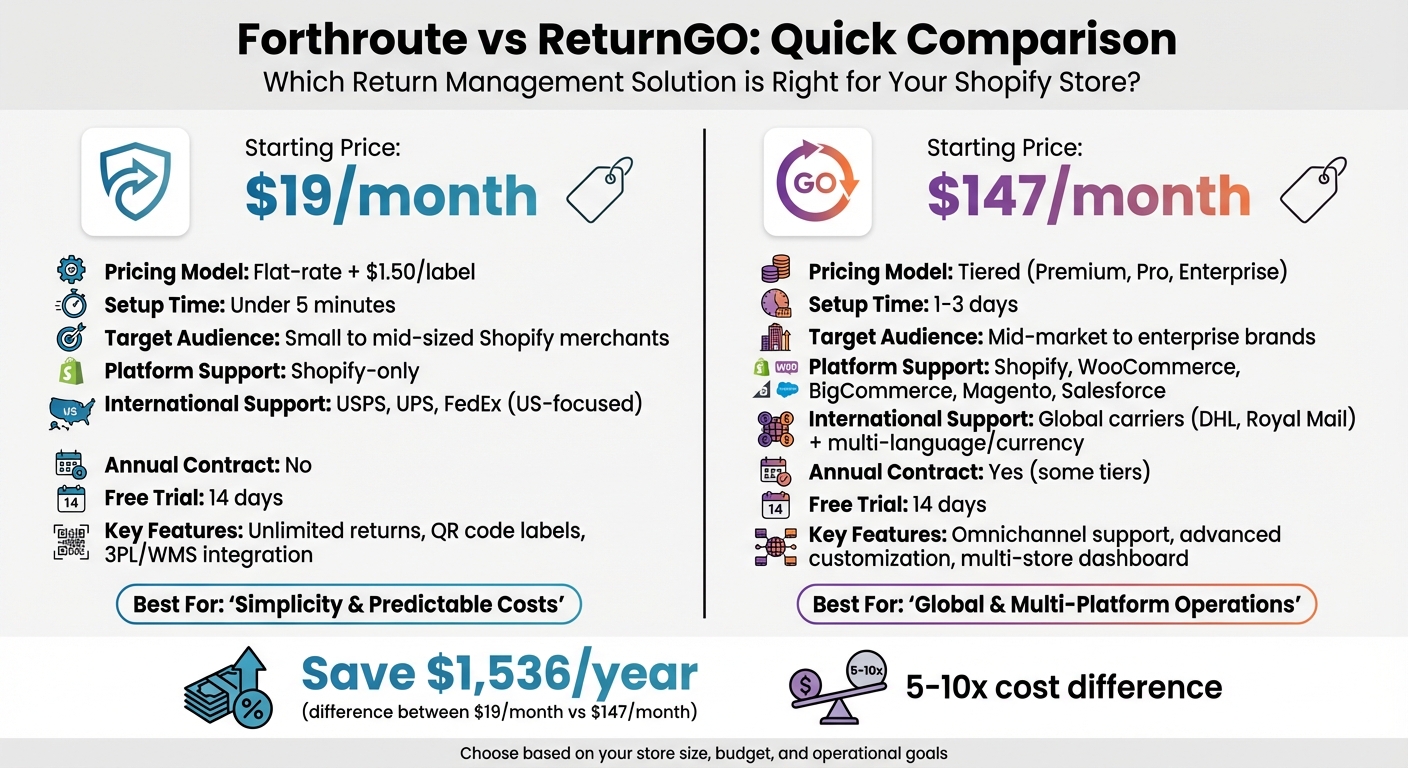
Forthroute vs ReturnGO: Pricing and Features Comparison for Shopify
5 Best Return Management Apps for Shopify

sbb-itb-a3e286c
Forthroute vs ReturnGO: Comparison Table
Here's a side-by-side look at how Forthroute and ReturnGO stack up in key areas for managing Shopify returns. Both platforms provide self-service portals and integrate seamlessly with Shopify.
| Feature | Forthroute | ReturnGO |
|---|---|---|
| Starting Price | $19/month flat fee | $147/month (Premium tier) |
| Pricing Model | Flat-rate + $1.50 per label used | Tiered (Premium, Pro, Enterprise) |
| Setup Time | Under 5 minutes | Varies (one-click widget available) |
| Target Audience | Small to mid-sized Shopify merchants seeking simplicity | Mid-market to enterprise brands needing advanced customization |
| Ease of Use | High (one-click install, no coding) | Moderate (powerful but requires configuration) |
| Scalability | Unlimited returns with 3PL/WMS API integration | Multi-store dashboard with omnichannel support |
| Platform Support | Shopify-native only | Shopify, WooCommerce, BigCommerce, Magento, Salesforce |
| International Support | USPS, UPS, FedEx (US-focused) | Global carriers (e.g., DHL, Royal Mail) with multi-language/currency support |
| Annual Contract | No | Yes (for some tiers) |
| Free Trial | 14 days | 14 days |
This table highlights the key differences between Forthroute and ReturnGO, from pricing and setup time to scalability and target audience. Forthroute is an appealing option for Shopify merchants who value simplicity and predictable costs, thanks to its flat $19/month pricing and easy setup process. It’s designed specifically for Shopify, making it a seamless fit for merchants on any Shopify plan, whether Basic or Plus.
On the other hand, ReturnGO caters to larger businesses with more complex needs. Its advanced features, such as omnichannel support and compatibility with multiple e-commerce platforms, are ideal for mid-market and enterprise brands. That said, these capabilities come with higher costs and a setup process that may require more effort. ReturnGO’s global reach and multi-language support make it a strong choice for brands operating internationally. Plus, with over 275 five-star reviews on platforms like G2 and the Shopify App Store, users praise its ability to manage intricate return workflows.
Next, we’ll dive deeper into the pricing structures to help you decide which solution aligns best with your Shopify store’s needs.
Pricing Breakdown
When comparing Forthroute and ReturnGO, the pricing structures stand out as a key difference. Forthroute keeps it simple with a flat $19 monthly fee plus per-label charges, while ReturnGO uses a tiered pricing model starting at $147 per month, which increases based on return volume. For Shopify merchants looking for predictable costs, Forthroute offers a more budget-friendly option.
Forthroute's $19 monthly plan includes unlimited returns, branded portals, QR code labels, exchanges, store credit, automated rules, and 3PL/WMS integration. The only additional cost is for shipping labels, which are billed at the carrier rate plus a $1.50 fee per label. For instance, a Shopify store handling 50 returns per month would pay the $19 base fee and around $75 in label fees (50 × $1.50), bringing the total to approximately $94.
On the other hand, ReturnGO starts at $147 per month for its Premium plan, with higher tiers like Pro ($297/month) and Enterprise (custom pricing). This means the $128 monthly difference could save merchants about $1,536 annually by choosing Forthroute. Additionally, ReturnGO applies overage fees of $1.25 per return if the plan's return limit is exceeded. Forthroute, however, maintains its $19 fee regardless of return volume. As Forthroute highlights, "Get enterprise features at a fraction of the cost. Our $19/month plan includes everything you need".
"Get enterprise features at a fraction of the cost. Our $19/month plan includes everything you need".
For enterprise-level stores, Forthroute's offerings are especially appealing. Its webhook API and 3PL integration come included in the base plan - features that are often locked behind premium tiers on other platforms. While ReturnGO provides multi-store dashboards and omnichannel support for merchants managing multiple platforms, Shopify-only merchants can achieve significant savings with Forthroute, often cutting costs by 5–10×. Both platforms offer 14-day free trials, but Forthroute makes it easier to start by not requiring a credit card.
Next, we’ll dive into how these pricing models impact setup simplicity and overall usability.
Setup and Implementation
This section breaks down how Forthroute and ReturnGO handle setup and implementation on Shopify. Forthroute emphasizes speed with a no-code process that takes less than five minutes, while ReturnGO offers a more tailored setup that accommodates complex, multi-channel operations but requires additional time and effort.
Forthroute is all about simplicity and speed - most merchants complete the setup in under five minutes. The process involves just four steps: installing the app with a single click from the Shopify App Store, uploading your logo and brand colors, setting up return policies, and adding a returns link to your store's footer. No technical expertise or coding is needed.
ReturnGO, on the other hand, provides advanced features like "Buy X, Get Y" promotions, gift returns, and RMA imports for historical data. These features are highly customizable but require more time for configuration. Often, merchants need to book a demo to get started instead of relying on a self-service setup. This difference highlights the trade-off between speed and customization when deploying on Shopify.
The learning curves also vary. Forthroute’s “set it and forget it” model is ideal for small-to-medium Shopify stores looking for a quick, branded solution. Meanwhile, ReturnGO shines in handling complex requests, as evidenced by its 275+ five-star reviews on G2 and Shopify. A merchant from Lady Pipa shared:
"We came with pretty complicated requests, and they successfully helped us achieve the results we need for our brand".
For Shopify-only merchants who don’t need multi-channel support or international currency handling, Forthroute’s streamlined setup - complete with features like a production-ready webhook API for 3PL integration and printerless QR code returns - avoids unnecessary complexity. However, ReturnGO’s omnichannel capabilities and support for localized language and currency make it a strong choice for merchants operating across multiple platforms or international markets.
In short, the right choice depends on your store’s needs. If you’re looking for a quick, hassle-free setup, Forthroute delivers. But if your business requires managing intricate return processes across different channels, ReturnGO’s customizable approach might be worth the extra time.
Features and Scalability
When your Shopify store grows from managing 100 orders to 10,000, keeping costs predictable becomes a top priority. Forthroute offers a flat-rate pricing model at $19/month with unlimited returns, ensuring consistent software costs no matter your volume. On the other hand, ReturnGO uses a tiered pricing structure, starting at $147/month, where fees increase as your return volume grows. Both platforms come with self-service portals and automation, but their approaches to features and costs vary significantly.
Forthroute’s $19/month plan includes essential tools like automated approval rules, a branded self-service portal, QR code printerless labels, and a webhook API for integrating with 3PL systems. Shipping labels are charged at the carrier rate plus $1.50 per label, only when customers use them.
ReturnGO’s tiered structure starts at $147/month (Premium) and goes up to $297/month (Pro), with custom Enterprise pricing for higher-volume merchants. This unlocks advanced capabilities such as variant exchanges, multi-language support, and compatibility across platforms like Shopify, WooCommerce, BigCommerce, Magento, and Salesforce Commerce Cloud. However, as your business scales, so do the subscription costs.
Both platforms aim to reduce support tickets through self-service portals, but their workflows differ. Forthroute focuses on exchange-first workflows, offering AI-powered suggestions and instant store credit to retain revenue. ReturnGO provides more detailed controls, such as item validation, packing slip generation, and a "Shop Now" feature that lets customers browse replacement items during the return process. For automation, Forthroute keeps it simple with basic return windows and product exclusion rules, while ReturnGO supports more complex workflows with multi-condition automations.
The choice between these platforms often comes down to balancing cost and feature depth. If you're a Shopify-only merchant looking for predictable expenses, Forthroute’s flat $19/month pricing prevents costs from ballooning as your order volume grows. For businesses operating across multiple platforms or needing advanced localization and enterprise-level customization, ReturnGO’s tiered pricing delivers those features - at a cost 5–10 times higher. For Shopify stores handling thousands of returns, Forthroute’s unlimited volume at a fixed price could save you 50–80% compared to ReturnGO.
These contrasts highlight how your business needs - whether focused on cost control or feature expansion - can guide your platform choice.
Reviewed by Forthsuite Team - February 2026.
How to Choose Between Forthroute and ReturnGO
Deciding between Forthroute and ReturnGO comes down to factors like store size, budget, technical needs, and operational goals. For smaller Shopify stores with straightforward needs, Forthroute's simplicity and flat-rate pricing make it a strong contender. On the other hand, mid-to-large merchants with more complex, global operations might lean toward ReturnGO for its customizability, even with its higher price tag.
If you're running a startup or a small Shopify store with a limited budget and minimal technical expertise, Forthroute is a great fit. It works with all Shopify plans, including Shopify Basic, and has no minimum order volume requirements. Setup is quick - less than 5 minutes - and doesn't require coding. Simply add a "Start a Return" link to your store's footer, and you're good to go. For $19/month, you get unlimited returns and features like printerless QR code labels, which eliminate the need for specialized hardware for you or your customers. As your business grows and your needs become more advanced, you might find yourself considering platforms with broader capabilities.
For mid-sized stores, the decision becomes more nuanced. If keeping costs predictable is a priority and you're operating solely on Shopify, Forthroute's flat-rate pricing ensures your expenses won't skyrocket as return volumes increase. However, if you manage international sales, need multi-currency support, or require multilingual tracking pages, ReturnGO might be worth the investment. Though its tiered pricing is significantly higher - 5 to 10 times more - it offers advanced features like custom automation rules and global functionality. One merchant who switched to ReturnGO reported a 25% increase in store credit adoption, showcasing its potential for boosting revenue recovery. Keep in mind, though, that its complex conditional logic may require a dedicated operations manager to fully leverage its capabilities.
For enterprise-level merchants with global ambitions, the decision often hinges on operational scope. ReturnGO caters to omnichannel sales, multi-store management, and complex logistics like multi-warehouse or dropshipping setups. It supports localization for any language or currency and integrates with global carriers such as DHL, Royal Mail, and Seko. While setup typically takes 1–3 days, its Enterprise plan includes perks like a dedicated Customer Success Manager and support for custom integrations. In contrast, Forthroute focuses on streamlining returns for individual Shopify stores using major U.S. carriers like USPS, UPS, and FedEx. It also offers enterprise-level features like 3PL/WMS integration and branded portals but at a fraction of the cost.
"ReturnGO offers a brilliant way to prompt customers to consider alternatives, and increase LTV and customer satisfaction." – Elastic Path
Ultimately, your choice boils down to whether you need simplicity or advanced control. Forthroute's "set it and forget it" system - with automated approval rules and exchange suggestions - is perfect for merchants prioritizing ease of use and cost control. On the other hand, ReturnGO's customizable workflows and advanced rule sets are designed for businesses that need granular control over every return scenario. As detailed in the pricing section, consider factors like the complexity of your return policy and your annual return volume. ReturnGO's plans start at $147–$297/month, while Forthroute offers a flat $19/month. The right choice should align with your current needs and long-term growth plans, ensuring the platform supports your business as it scales.
Reviewed by Forthsuite Team - February 2026.
Which Platform Scales Better for Shopify?
When it comes to growing your Shopify store, scalability plays a huge role in choosing the right solution. Pricing and features are important, but how well a platform handles growth is just as critical. Forthroute stands out with its flat-rate pricing of $19/month, offering cost predictability and simplicity. On the other hand, ReturnGO's tiered pricing starts at $327/month for up to 2,000 annual returns, which can quickly become a hurdle for scaling businesses.
Forthroute is often the better choice for Shopify merchants because its flat-rate fee eliminates the financial challenges that come with increased return volumes. Whether you're processing a handful of returns or thousands, the cost remains the same, making it easier to manage expenses as your store scales. Additionally, Forthroute's straightforward pricing aligns with its streamlined return operations, ensuring efficiency without surprise costs.
The platform also boasts a quick setup, enabling merchants to automate returns almost immediately. In contrast, ReturnGO requires 1–3 days for integration, delaying the ability to scale quickly. Forthroute's automation tools, such as approval rules and QR code labels, handle growing return volumes with minimal manual effort, while ReturnGO's setup demands more hands-on involvement.
"Get enterprise features at a fraction of the cost. Our $19/month plan includes everything you need." – Forthroute
For Shopify stores planning to grow, Forthroute delivers predictable costs and ease of use. Its flat-rate model is perfect for businesses processing anywhere from 100 to 1,000 returns monthly. Features like 3PL/WMS integration further enhance operational efficiency.
ReturnGO may be a better fit if your business strategy includes expanding to platforms like Magento or BigCommerce or if you need multi-currency support for international operations.
For merchants focused on affordability and simplicity, Forthroute's "set-it-and-forget-it" approach provides enterprise-level automation without the hefty price tag. The optional $1.50 per-label fee ensures costs are tied directly to usage, making financial planning easier as your store expands.
This comparison highlights why Forthroute is a go-to choice for Shopify merchants seeking scalability with transparent pricing and immediate setup.
Speakable Summary 1:
Forthroute offers a fast, affordable returns solution for Shopify. Its $19/month flat rate and 5-minute setup make it ideal for growing stores.
Speakable Summary 2:
With features like QR code labels and 3PL/WMS integration, Forthroute automates returns while keeping costs predictable, making it a great choice for scaling Shopify businesses.