If you're a Shopify merchant looking for a returns management platform, cost and ease of use are probably top of mind. Here's the bottom line:
- Forthroute offers a flat $19/month pricing model, with no volume-based fees and a quick 5-minute setup. Ideal for small to mid-sized stores, it includes features like branded return portals, QR code labels, and automated approvals. Additional costs include $1.50 per return label plus carrier fees.
- Loop Returns starts at $155/month (up to $340/month for advanced features) and is designed for larger merchants handling high return volumes. It provides tools like "Shop Now" for upselling during returns, AI fraud detection, and integrations with over 120 tools. However, it requires annual contracts and a lengthy onboarding process of 15–45 days.
Quick Comparison
| Feature | Forthroute | Loop Returns |
|---|---|---|
| Base Cost | $19/month flat | $155–$340+/month |
| Setup Time | Under 5 minutes | 15–45 days |
| Contract | Month-to-month | Annual (Essential/Advanced) |
| Return Volume Limits | Unlimited | Tiered (≈2,000/month baseline) |
| Per-Label Fee | $1.50 + carrier costs | Varies by plan |
| Target Audience | Small to mid-sized stores | High-volume merchants |
Key takeaway: Forthroute is best for budget-conscious Shopify merchants needing a simple, affordable solution. Loop Returns caters to larger brands with complex workflows and higher budgets.
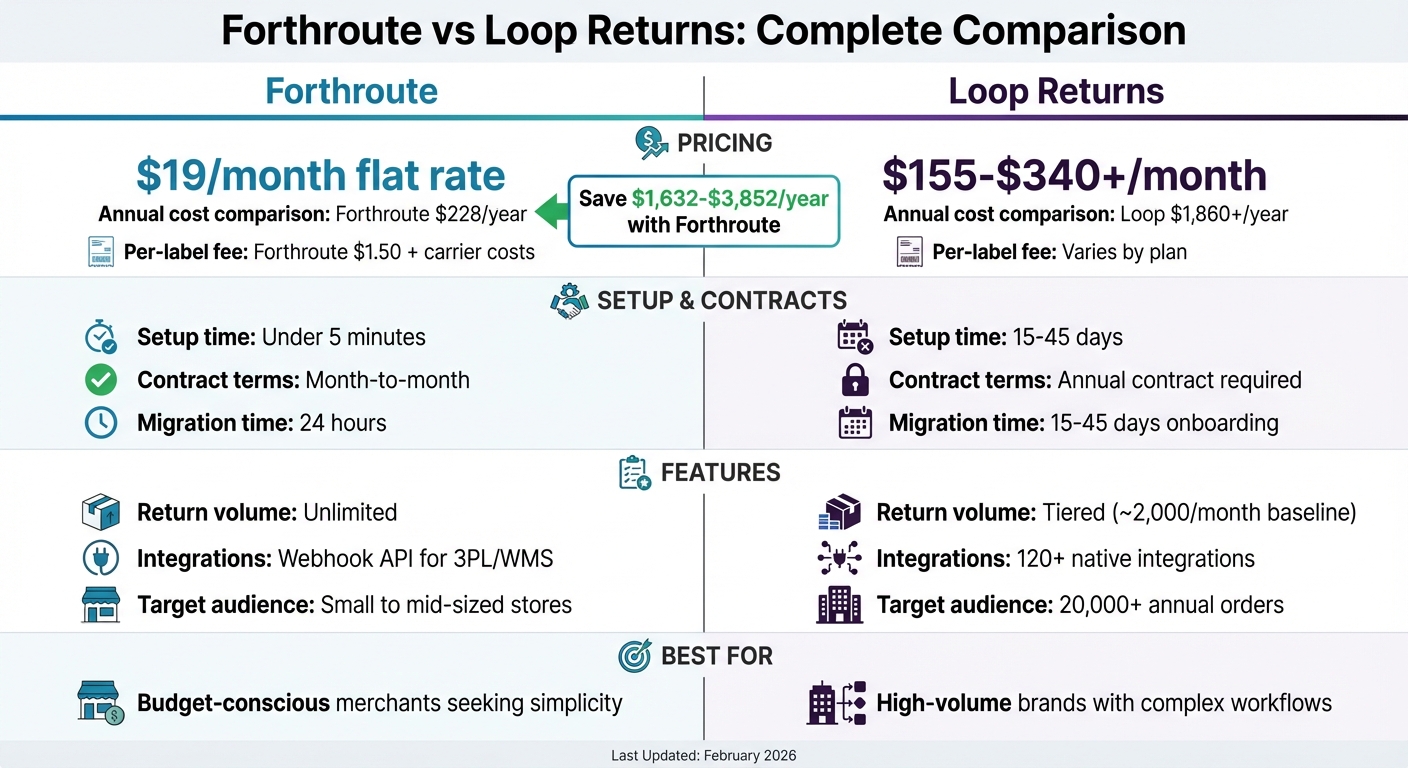
Forthroute vs Loop Returns Pricing and Features Comparison 2026
Comparison Table: Forthroute vs Loop Returns
This section provides a detailed side-by-side comparison of Forthroute and Loop Returns, focusing on key factors like pricing, setup time, contract terms, and scalability. This breakdown helps Shopify merchants quickly determine which platform aligns best with their business needs and budget.
Side-by-Side Comparison
Here's how the two platforms stack up:
| Feature | Forthroute | Loop Returns |
|---|---|---|
| Base Monthly Cost | $19/month flat rate | $155–$340+/month (tiered) |
| Setup Time | Under 5 minutes | 15–45 days |
| Contract Terms | Month-to-month, cancel anytime | Annual contract (Essential/Advanced plans) |
| Return Volume Limits | Unlimited returns included | Tiered based on shipment volume (≈2,000/month baseline) |
| Per-Label Fee | Carrier cost + $1.50 per label | Varies by plan; may include additional processing fees |
| Technical Setup | One-click Shopify install; no coding required | Sales-led onboarding with dedicated setup support |
| Target Audience | Small to growing Shopify stores | Mid-market to enterprise (typically 20,000+ annual orders) |
| Integrations | Webhook API for 3PL/WMS | Over 120 native ecosystem integrations |
This table highlights the primary distinctions, offering clarity on which platform may be better suited for different business sizes and operational demands.
Cost Savings Breakdown
The pricing difference between these platforms is stark. For a Shopify store processing 200 returns per month, Forthroute costs approximately $228 annually ($19/month), while Loop Returns' Essential plan starts at $1,860 per year. Even with Forthroute's $1.50 per-label fee, its flat-rate model remains far more affordable. Additionally, Loop Returns imposes a Stripe processing fee of 2.9% + $0.30 on exchanges. For apparel brands, this adds roughly $0.50 per transaction, assuming an average handling fee of $7 per exchange.
This comparison underscores why many Shopify merchants lean toward Forthroute for a cost-effective return management solution.
Last updated: February 2026
sbb-itb-a3e286c
How to Choose Between Forthroute and Loop Returns
Selecting the right returns platform comes down to your store's size, budget, and operational needs. Both Forthroute and Loop Returns cater to Shopify merchants but serve different purposes depending on where your business stands. The goal is to avoid overpaying for unused features or skimping on tools that could improve revenue retention. Let’s break it down.
Decision Criteria
Budget considerations come first. For stores earning less than $10,000 in monthly revenue, Forthroute's $19 flat rate is a more affordable option compared to Loop's plans, which start at $155 and are geared toward merchants processing over 20,000 orders annually.
Setup and contract terms also matter. Forthroute offers a quick, one-click setup that takes less than five minutes and operates on month-to-month billing. Loop, on the other hand, requires 15–45 days for implementation and typically involves annual contracts for its Essential and Advanced plans, though its Checkout+ plan allows monthly billing. If you need to get started quickly or want the flexibility to cancel without penalties, Forthroute is the safer bet.
Feature complexity is another differentiator. Loop provides advanced tools like over 120 technology integrations, AI-powered fraud detection, and a "Shop Now" feature that lets customers use return credit to shop your catalog. Forthroute focuses on essentials, such as branded return portals, printerless QR code labels, and smart exchange suggestions. For merchants needing complex workflows - like waiving fees for damaged goods or applying specific handling fees based on product tags - Loop's advanced automation is the better choice. Meanwhile, Forthroute is ideal for straightforward automation without the added cost of enterprise features.
Forthroute is a better fit if: You're a small-to-mid-sized Shopify merchant looking for simple, affordable returns automation with no annual commitments. It's perfect for those who value ease of setup and predictable costs over advanced features.
Loop Returns is a better fit if: You're a high-volume merchant handling 20,000+ orders annually, focused on upselling during returns, or managing cross-border logistics. With tools like "Instant Exchanges" and "Shop Now", Loop is designed to maximize the value of every return interaction.
These guidelines help clarify which platform suits your specific needs.
Real Store Examples
Fashion brands with high exchange rates thrive with Loop's "Shop Now" feature. Take Maude, for example. In 2023, they used Loop's Delivery Promise to provide precise delivery dates, which boosted their add-to-cart rates by 12% and checkout conversions by 20%. For apparel retailers dealing with frequent size-related returns, Loop's ability to keep revenue in-house through return-credit shopping is a game-changer.
Small Shopify stores with limited budgets benefit from Forthroute’s transparent pricing. For instance, a boutique handling around 150 returns per month pays just $19 monthly plus carrier fees based on usage. This approach often saves money compared to Loop's $155 Essential plan, which also requires an annual contract.
Large enterprises with intricate workflows lean toward Loop. If your return policies vary by product type - like offering free returns on clothing but charging a restocking fee for electronics - Loop’s conditional workflows and detailed fee configurations can handle that complexity. Forthroute, by contrast, is designed for simpler return policies and lacks these advanced options.
Merchants with international operations should weigh logistics support. Loop integrates with local carriers in the UK, EU, and Australia, simplifying cross-border returns. Forthroute, however, focuses on U.S. carriers (USPS, UPS, FedEx) through its EasyPost integration, making it less suited for global returns.
Forthroute Pricing and Features
Forthroute keeps things simple with a transparent pricing model: $19 per month for the Professional Plan, plus a $1.50 service fee for each shipping label, in addition to the carrier's cost. Here's the best part - you only pay for a label when a customer actually uses it to initiate a return. There are no annual contracts, hidden fees, or charges based on your order volume or SKU count. Plus, you can test the platform with a 14-day free trial, no credit card required.
This flat-rate pricing makes it easy to plan your budget. Whether you're a small boutique processing 50 returns a month or a larger operation handling 500, your base fee stays the same. The only variable cost is the per-label fee, which depends on actual usage. If a customer changes their mind and keeps the item after starting a return, you won't be charged for the unused label.
What Forthroute Includes
Forthroute’s pricing comes with a full range of features designed to simplify returns management. For $19 a month, you get access to all the platform's core tools without any tiered restrictions. One standout feature is the branded, self-service return portal. You can customize it with your store's logo, colors, and messaging. Customers enter their order number and email, select items for return, and choose between a refund, exchange, or store credit - no need to contact support.
The platform also offers automated approval rules. You can set policies to handle routine returns automatically, like approving returns under $50, rejecting "Final Sale" items, or defining return windows for specific product categories. This automation reduces manual work for your support team.
Forthroute supports printerless QR code returns through its EasyPost integration. Customers can show a QR code on their phone at a carrier drop-off point, where the label is printed on-site. This eliminates the need for home printers and speeds up the return process. Beyond this, the platform uses AI to encourage exchanges instead of refunds.
For example, if a customer returns an item because it’s too small, the system might suggest the next size up. This feature helps convert refunds into exchanges, keeping revenue in your pocket. Customers also have the option to receive instant store credit, allowing them to shop right away instead of waiting for a refund.
For merchants working with third-party logistics or warehouse systems, Forthroute provides a webhook API. This sends real-time updates when returns are received, inspected, and restocked, keeping your inventory data accurate without extra effort.
The platform also integrates with Shopify in just one click, letting you set up and customize your return portal in under five minutes - no coding skills needed. These features make Forthroute a practical option for Shopify-based merchants.
Pros and Cons
Forthroute has a lot to offer, but like any tool, it comes with both advantages and limitations.
Pros:
- Transparent pricing with no hidden fees or volume-based charges.
- Quick, hassle-free setup in just minutes.
- Flexible month-to-month billing with no long-term commitments.
- All core features included in the $19 plan - no need for upgrades.
- Pay-per-use label fees ensure you only pay for actual returns.
- Seamless Shopify integration tailored to the platform’s workflow.
Cons:
- Per-label fees can add up for stores with high return volumes.
- Fewer advanced features compared to enterprise-level platforms (e.g., AI fraud detection).
- Limited to Shopify, with no support for other e-commerce platforms.
- Basic analytics, lacking detailed insights into return trends and customer behavior.
For high-volume merchants, the per-label fees can become a significant expense. For instance, processing 1,000 returns in a month would result in costs around $1,519 ($19 base fee plus roughly $1,500 in label fees). At this scale, it might be worth exploring alternatives like Loop Returns, which offers plans starting at $155 per month and includes bundled label costs.
Loop Returns Pricing and Features
Loop Returns takes a tiered pricing approach, unlike Forthroute's flat-rate model, catering to businesses with more intricate needs. It offers three plans: Checkout+ (Free), Essential ($155/month), and Advanced ($340/month). Both Essential and Advanced plans require annual commitments and are designed for merchants handling around 2,000 shipments per month. For businesses processing over 20,000 orders annually, Loop provides a custom enterprise plan that includes dedicated support. These pricing tiers reflect the platform's emphasis on advanced features, which can significantly impact merchant operations.
Currently, Loop works with over 5,000 Shopify brands and integrates with a wide range of third-party logistics providers, shipping carriers, and ERP systems. This broad integration network makes it a strong choice for stores with complex setups, but it also comes with a higher price tag and a longer onboarding period - typically 15 to 45 days for standard Shopify merchants.
What Loop Returns Includes
Loop Returns offers tools that go beyond standard return processing, focusing on retaining revenue during returns. The platform emphasizes an "exchange-first" strategy, with features like Shop Now, which allows customers to browse your entire catalog during a return, and Instant Exchanges, enabling immediate reorders before the original item is even shipped back. The Advanced plan ($340/month) includes Bonus Credit, letting merchants offer extra store credit (e.g., $110 for a $100 return) to encourage customers to keep spending within the store.
Fraud prevention is another standout feature. Using AI, Loop's tools automatically detect risky return patterns by analyzing customer behavior across multiple merchants. However, this capability is only available on the Advanced plan, leaving Essential plan users without access to these safeguards.
Loop also provides Return Bars, physical drop-off points where customers can return items without needing to print labels. This QR code-based system works with participating carriers, offering a printer-free return experience and is available on all paid plans. Additionally, the platform includes an analytics dashboard that tracks return reasons, customer behavior, and financial metrics. However, some merchants feel the insights provided don't justify the high price tag.
One area of concern is the platform's handling fee system, which adds complexity. Loop offers four fee options: flat rate, percentage of label cost, percentage of return value, or product-specific tags. These fees are processed through a separate Stripe account, with an added 2.9% plus $0.30 per transaction. These costs aren't included in the base monthly fee, which can lead to unexpected expenses.
Common Complaints
Merchant feedback reveals a 59% negative sentiment toward Loop Returns, with complaints focusing on its complexity, cost, and occasional workflow bugs. While the platform's feature set is extensive, it also introduces a steep learning curve. Merchants often need to juggle multiple tools like Workflows, Edit Return options, and manual fee configurations to manage return outcomes effectively. For businesses seeking straightforward return processing, this can feel unnecessarily complicated.
The onboarding process, which takes 15 to 45 days, is another sore spot for many merchants. While the platform's support team receives positive feedback, the lengthy setup period and mandatory annual contracts can be a challenge for seasonal businesses or those experimenting with return solutions for the first time.
Cost is a recurring issue as well. With a starting price of $155/month, Loop is over eight times more expensive than Forthroute's $19/month flat rate. For merchants processing fewer than 2,000 shipments per month, the pricing doesn't scale down, meaning you're often paying for unused capacity. When you factor in Stripe fees for handling charges and carrier costs for return labels, smaller operations can easily see their monthly expenses exceed $200.
Technical issues have also been reported, particularly with currency conversions and complex return scenarios. For instance, if an item is returned in a different currency, the refund automatically converts, but store credit remains in the shop's base currency. This inconsistency can confuse international customers and often requires workarounds, adding to the platform's complexity. These challenges underline why Loop Returns may be a costly option, especially for smaller retailers or those with simpler return needs.
Migration from Loop Returns to Forthroute
This section explains how Shopify merchants can transition effortlessly from Loop Returns to Forthroute. The process includes quick installation, portal customization, integration with third-party logistics (3PL) systems, and automatic rule setup. With a setup time of under 5 minutes and a full migration completed within 24 hours, merchants can switch over with minimal disruption.
Switching from Loop Returns to Forthroute is straightforward - install the app with just one click in under 5 minutes. The entire migration, including policy setup and 3PL integration, can be completed in a single day, a stark contrast to Loop's onboarding process, which takes 15 to 45 days.
Migration Steps
To begin, download the Forthroute app from the Shopify App Store. Authorize it with a single click - no technical expertise or coding is required. Once installed, you can customize your branded return portal by uploading your logo, selecting your brand colors, and setting up return policies, such as return windows and product exclusions. These configurations seamlessly replace the workflows you were using with Loop.
Forthroute also allows you to set up automated approval rules and exchange suggestions, ensuring you maintain the same level of automation. If you work with external warehouses, Forthroute's webhook API provides real-time updates on return statuses, inspections, and restocking. To finalize the setup, use the one-click option to add the return portal link to your Shopify store's footer, replacing the Loop Returns link.
Unlike Loop's complex fee structures - such as percentage-based fees, product-tag fees, or flat-rate options processed through a separate Stripe account - Forthroute offers a simpler pricing model: $19 per month plus $1.50 per label. This transparent approach eliminates hidden charges. To avoid downtime, configure your return policies and branding during Forthroute's 14-day free trial, ensuring a smooth transition before disconnecting Loop.
By following these steps, the entire migration can be completed in just one day, highlighting Forthroute's focus on simplicity and cost-effectiveness for Shopify merchants.
Timeline and Effort
The outlined process demonstrates how Forthroute ensures a fast and efficient migration compared to Loop's extended onboarding.
"Most merchants complete setup in under 5 minutes. Install from the Shopify App Store, add your logo and brand colors, configure your return policies, and you're ready to go." – Forthroute
While the technical setup is quick, the full migration typically takes 24 hours. This includes testing policies, integrating with 3PL systems, and updating customer messaging. Running Forthroute in parallel during the trial period ensures your warehouse receives real-time updates via webhooks before disconnecting Loop. Once the portal is live, immediately update the "Start a Return" link in your store's footer to prevent customers from landing on an inactive Loop page.
Frequently Asked Questions
These questions address key concerns about pricing, migration, and feature differences between Forthroute and Loop Returns. They aim to help Shopify merchants make informed decisions based on their store's needs and budget.
How does Forthroute pricing compare to Loop Returns?
Forthroute charges a straightforward $19 per month, plus $1.50 per shipping label. On the other hand, Loop Returns starts at $155 per month for its Essential plan and $340 per month for its Advanced plan, both requiring annual contracts. Unlike Loop Returns, Forthroute keeps its pricing consistent, regardless of SKU count or transaction volume, making it simpler and more predictable.
Voice Q: "What is Forthroute's monthly price?"
A: "$19 per month with no hidden fees."
Last updated: February 2026
What is Loop Returns's biggest drawback?
Loop Returns can be complicated and time-consuming to implement. For Shopify brands, onboarding takes between 15 and 45 days and involves dedicated teams and multi-week setup phases. Additionally, its fee structure is complex, with four different paradigms for handling fees. Collecting fees on exchanges even requires a separate Stripe integration, which adds a 2.9% + $0.30 per transaction cost. In contrast, Forthroute offers a quick, 5-minute setup that doesn’t require technical expertise.
Voice Q: "How long does Loop Returns onboarding take?"
A: "15 to 45 days for standard Shopify merchants."
This comparison highlights Forthroute's simplicity and focus on saving time and money.
How hard is it to migrate from Loop Returns to Forthroute?
Migrating to Forthroute is designed to be simple and efficient. The process starts with a one-click Shopify install, and the full migration - including policy testing, 3PL integration, and updating customer messaging - takes just 24 hours. To ensure business continuity, most stores use the 14-day free trial to run Forthroute alongside Loop Returns before making the switch. Forthroute's support team is also available to help with configuring automated approval rules and webhook APIs for syncing with warehouses.
Voice Q: "How long does Forthroute migration take?"
A: "24 hours for complete setup and testing."
Does Forthroute offer features that Loop Returns doesn't?
Yes, Forthroute provides several advantages. It offers flat-rate pricing at $19 per month with no per-SKU fees, a one-click Shopify setup, and month-to-month billing with the flexibility to cancel anytime. In contrast, Loop Returns requires annual contracts for its Essential and Advanced plans, and its Checkout+ plan - while more flexible - requires shoppers to pay for package protection or return shipping coverage at checkout. Forthroute also includes 3PL/WMS webhook integrations as part of its base plan, whereas Loop reserves advanced integrations for higher-tier plans. Both platforms support QR code printerless returns, but Forthroute stands out with its transparent label fee: carrier cost plus $1.50, with no hidden charges.
Voice Q: "Does Forthroute require annual contracts?"
A: "No, Forthroute offers month-to-month billing."
This underscores Forthroute's commitment to straightforward pricing.
Is Forthroute good enough for growing Shopify stores?
Yes, Forthroute is built to scale with businesses of all sizes, from startups to enterprises, while keeping its $19 per month pricing constant, no matter the return volume. It integrates seamlessly with all Shopify plans, including Shopify Plus, and offers production-ready webhook APIs for complex logistics needs. Unlike Loop Returns, which adjusts pricing based on shipment volume and requires a minimum of 20,000+ annual orders to access a dedicated Merchant Success Manager, Forthroute provides unlimited returns and automated rules at a fixed price, helping merchants manage diverse product catalogs without worrying about overage fees.
Voice Q: "Can Forthroute handle high return volumes?"
A: "Yes, with unlimited returns at a fixed $19/month price."
This highlights Forthroute's scalability and predictable pricing for growing businesses.
Conclusion
The choice between these platforms ultimately boils down to pricing clarity versus tiered complexity. Forthroute offers advanced features like branded portals, QR code labels, 3PL integrations, and automated workflows - all for just $19 per month with no annual contracts required. Meanwhile, Loop Returns starts at $155 per month for its Essential plan and $340 per month for Advanced, both demanding annual commitments and pricing tied to shipment volume. That’s a difference of $1,632 to $3,852 per year in base software costs alone.
Main Points
Here’s a quick recap of the key differences between the two platforms. Forthroute’s flat-fee model ensures predictable costs: $19 per month regardless of return volume, with an additional $1.50 per shipping label on top of carrier fees. There are no hidden charges or SKU-based fees, making it easy to budget as your store grows. Plus, setup is quick and seamless with one-click Shopify integration, while Loop Returns involves a more time-intensive onboarding process.
The pricing gap widens as your business scales. Loop Returns adjusts costs based on shipment volume, starting at 2,000 shipments per month, whereas Forthroute sticks to its $19 rate whether you handle 50 returns or 5,000. For growing brands, this consistency allows you to channel savings into critical areas like inventory, marketing, or customer acquisition instead of higher software expenses.
Our Recommendation
Given the cost savings and simplicity, the choice is clear. Forthroute stands out for its transparent pricing, quick deployment, and comprehensive features - all at an affordable, flat rate. Plus, with a 14-day free trial that doesn’t require a credit card, you can explore the platform risk-free. Most merchants complete their migration within 24 hours.
This analysis underscores the importance of predictable pricing for Shopify merchants. Want to cut your returns management costs by 50–80%? Start your free trial at forthroute.io and discover why so many Shopify merchants are moving away from complex, contract-heavy platforms in favor of simple, scalable solutions.
Last updated: February 2026