Want to keep customers happy and boost your bottom line? Start with your return process.
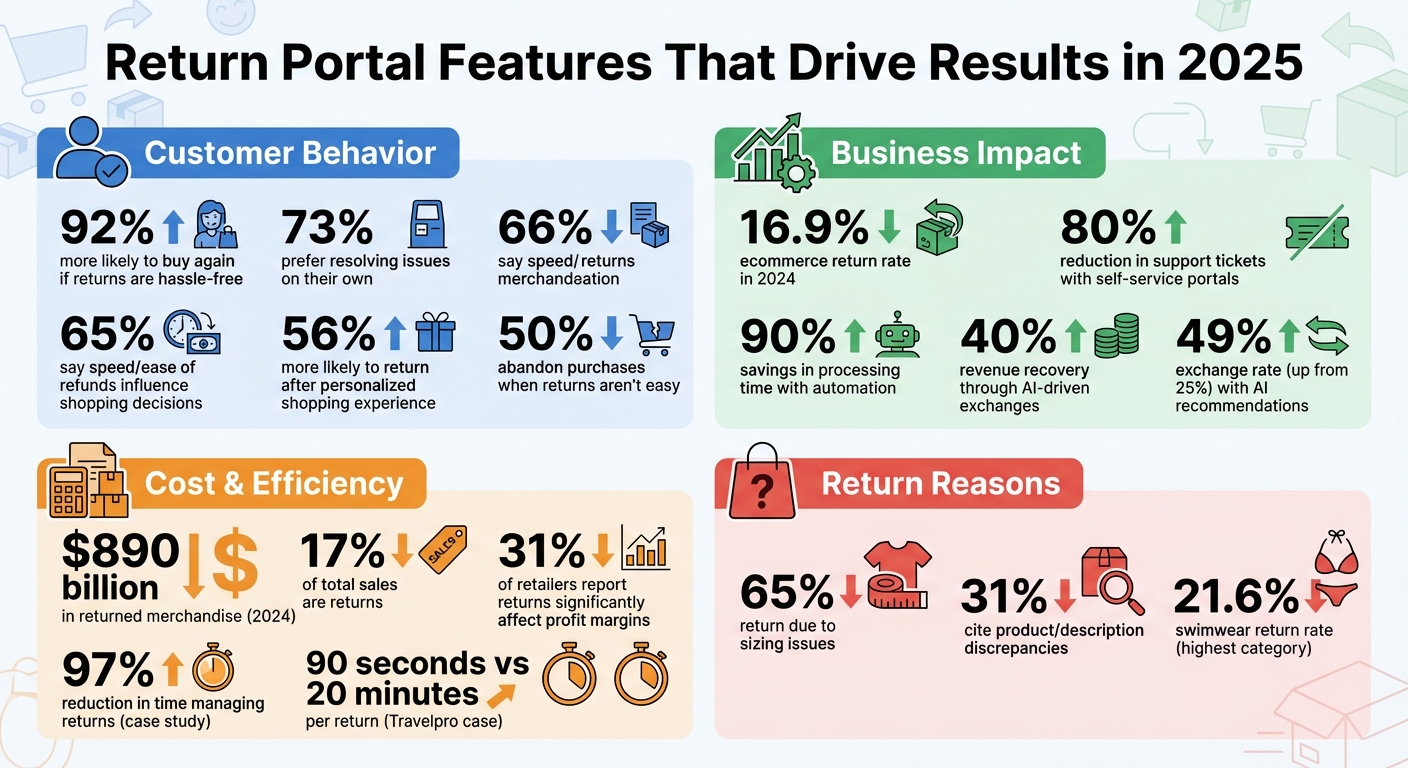
In 2024, returns cost businesses billions, with ecommerce return rates hitting 16.9%. But here’s the good news: 92% of shoppers are more likely to buy again if returns are hassle-free. The best return portals in 2025 are designed to make returns simple, fast, and customer-friendly while saving businesses time and money.
Key features include:
- Self-service portals: Let customers manage returns 24/7, cutting support tickets by up to 80%.
- Automation: Approve low-risk returns instantly and save up to 90% of processing time.
- AI-powered exchanges: Turn refunds into exchanges with smart product recommendations and instant store credit.
- Shipping integrations: Offer prepaid labels, QR code returns, and live tracking for a smooth experience.
- Return data insights: Use analytics to fix product issues, reduce returns, and improve profitability.
Efficient return portals aren’t just about cutting costs - they’re about building trust, retaining customers, and recovering revenue.
Return Portal Features ROI: Key Statistics for 2025
Ecommerce Returns Best Practices to Save Time and Money
sbb-itb-a3e286c
Branded Self-Service Return Portals
A self-service return portal gives customers the power to manage their returns without needing assistance. This approach caters to the 73% of consumers who prefer resolving issues on their own. By automating tasks like generating return labels and sending tracking updates, these portals not only simplify the process for customers but also reduce the workload for support teams. These features pave the way for even smoother, mobile-friendly processes discussed later.
Simple Customer Return Process
The best return portals are designed to minimize unnecessary steps, keeping the process as straightforward as possible. Shoppers typically need just an order ID and email to view eligible items for return. From there, the portal guides them through selecting a return reason. Smart logic can then step in - for example, if a customer selects "wrong size", the system might suggest an exchange for a different size before offering a refund option.
Since 75% of consumers use mobile devices for purchases and related tasks, mobile optimization is critical. A well-designed portal should load quickly on smartphones, feature large, easy-to-tap buttons, and have clear text that doesn’t require zooming.
Brand Customization Options
A generic return page can raise doubts. If the portal doesn’t align visually with the main store, customers might hesitate to provide personal information. Consistency in design and messaging reassures shoppers and enhances trust. Studies show that maintaining a unified brand identity across all platforms can boost revenue by 33%, while consistent use of brand colors increases recognition by 80%. Modern return portals allow merchants to customize every detail - logos, color schemes, fonts, button styles, and more - ensuring the portal matches the store’s overall design.
Language customization is equally important. For example, replacing a generic "Submit Request" button with something more engaging, like "Get Your Exchange Started", can align the process with your brand’s voice. Automated emails for return confirmations, shipping updates, and refund notifications should also reflect your branding, creating a seamless customer experience. Amy Mokris, Head of Partner Marketing at Returnly, highlights this point:
"Consistent branding across customer touchpoints helps reinforce a merchant's story, sparking a connection with shoppers and serving as a competitive differentiator".
Take fashion brand Popa as an example. By automating their entire RMA process and integrating features like bonus store credit and direct payment options for exchange price differences, they added over $197,000 in extra revenue while saving significant support time. José Ignacio Pérez Alcocer, eCommerce Manager at Popa, explained:
"The customer has the ability to choose their preferred return method, always tailored to their needs".
Automated Return Approval Rules
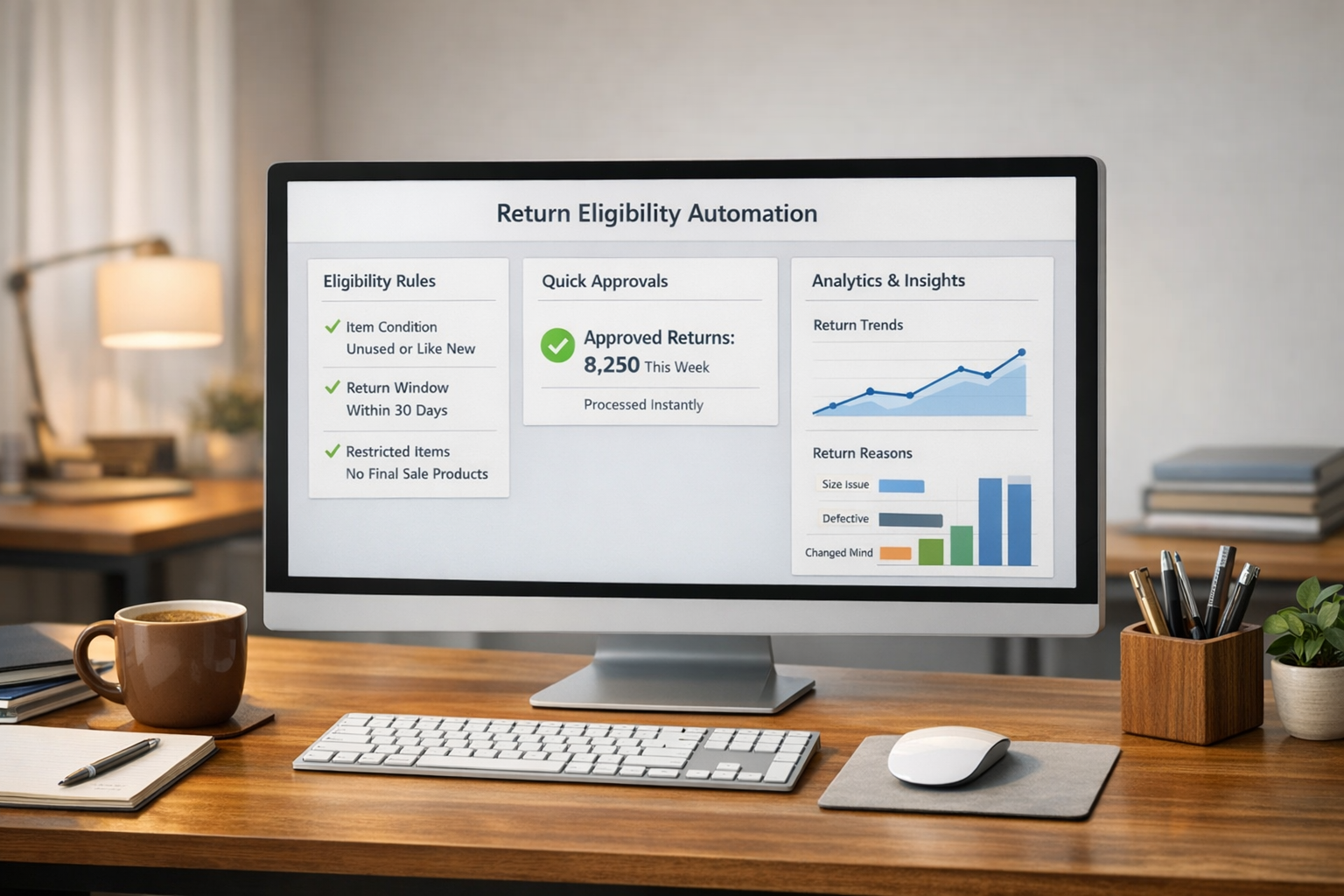
Manually approving returns can bog down the process, creating unnecessary delays and frustration. Automated return approval rules solve this issue by using a straightforward trigger–condition–action system. Here’s how it works: when a customer initiates a return (trigger) and meets predefined criteria (condition), the system automatically processes the next step (action), completely removing the need for human intervention.
These rules can be as simple or complex as needed. For example, a merchant might auto-approve returns under $50 to quickly handle low-value requests. At the same time, they might automatically reject items labeled "Final Sale" or those outside the return window. For damaged goods, the system can instantly approve the return and issue a prepaid shipping label. This kind of automation can cut return processing time by up to 90% and slash return-related support tickets by 80%.
Auto-Approval Rules
A well-designed return portal allows merchants to create rules tailored to their needs. These rules can combine multiple criteria, such as order value and return reasons. For instance:
- Automatically approve returns under a specific dollar amount to keep low-risk requests moving.
- Block returns for "Final Sale" items or suggest an exchange when customers select "wrong size."
- Require customers to upload photos for damaged items before auto-approving, based on purchase history or other factors.
Some merchants even set customer-specific rules. VIP customers with a history of high-value purchases might get instant approvals, while frequent returners could be flagged for further review.
Take Travelpro® as an example. In April 2025, this luggage manufacturer revamped its return process by incorporating automated rules. What was once a 20-minute process per return now takes just 90 seconds. Mark Costigliola, eCommerce Operations Manager at Travelpro, shared:
"The return process is completely customer-centric. They fill out the request, generate the label, and get a refund".
Similarly, the fashion platform One Project automated its standard return requests, eliminating the need for manual reviews. Shmulik Konforty, CTO at One Project, explained:
"The process is fully automated, from the customer request to the refund".
These automated systems ensure that support teams only need to handle exceptions, freeing up time for more complex tasks.
Less Work for Support Teams
Automation doesn’t just benefit customers - it also lightens the load for support teams. Without automation, these teams spend valuable time verifying order details, checking return eligibility, calculating refunds, and generating shipping labels. Automated systems handle all of this, allowing teams to focus on high-value or unusual cases that require human judgment.
When customers can instantly receive approvals and shipping labels through a self-service portal, inquiries like "Where’s my label?" or "Has my return been approved?" become far less common. This improvement is crucial because 65% of shoppers say the speed and ease of getting a refund influence their shopping decisions. And with returns accounting for 17% of total sales - adding up to roughly $890 billion in merchandise in 2024 - automation is no longer optional. It’s a necessity for staying competitive while keeping costs under control.
AI-Powered Exchanges and Revenue Retention
AI tools are taking returns to the next level by transforming refund requests into opportunities for smart exchanges. By leveraging automation and customer insights, these tools help businesses retain revenue while improving the overall shopping experience.
AI Product Recommendations
When a customer initiates a return, AI-powered systems analyze the reason behind it and suggest tailored alternatives. For instance, if someone returns an item because it’s "too big", the system might recommend the same product in a smaller size. If the issue is "didn't like the style", it could suggest visually similar products or highlight current bestsellers that align with the customer's preferences.
Take the example of shoe retailer Marc Nolan. In March 2024, they introduced an automated exchange recommendation system and saw their exchange rate nearly double. Before the change, 75% of returns ended in refunds, with only 25% resulting in exchanges. After implementing the system, 49% of returns were converted into exchanges, and the time spent managing returns plummeted by 97%.
The technology driving these recommendations relies on Natural Language Processing (NLP) to turn customer feedback into actionable insights. For example, if multiple customers mention that a shirt "runs small" or note that the "fit is off", the AI detects these patterns and adjusts future recommendations accordingly. To sweeten the deal, the system can apply original discounts to exchange items for purchases made during promotions, ensuring customers feel they’re getting the same value.
These personalized suggestions not only improve exchange rates but also create financial incentives for customers, such as instant store credit.
Instant Store Credit
Instant store credit is another powerful tool for keeping customers engaged. Refund delays can push shoppers toward competitors, but instant credit removes that risk. As soon as a return is approved, customers receive credits they can use immediately for new purchases.
The financial upside is hard to ignore. Brands using AI-driven return systems can recover up to 40% of what would otherwise be lost revenue through a mix of exchange suggestions and store credit incentives. Some retailers even offer extra perks, like $5 to $10 in bonus credit, to encourage customers to choose an exchange over a refund.
Other strategies include offering limited-time discounts for using store credit quickly. For example, shoppers who make a purchase within 24 hours of receiving their credit might get an additional percentage off. Some merchants also enable instant exchanges, where new orders are processed immediately while securely holding the customer’s credit card information until the return is finalized. This smooth process eliminates the hassle of re-entering payment details.
Data underscores the impact of these efforts: 56% of consumers are more likely to return to a brand after a personalized shopping experience. By combining AI-powered product recommendations with instant store credit, businesses don’t just save sales - they deliver a seamless experience that turns occasional shoppers into loyal customers.
Shipping and Tracking Integration
Getting a return label shouldn’t feel like pulling teeth. The top return portals of 2025 streamline the process with instant prepaid labels and printer-free options, letting customers handle returns directly from their smartphones. Add in real-time tracking, and what used to feel like a chore is now a quick and painless task. These advancements are setting the standard for printerless returns and live tracking.
QR Code Returns Without Printing
Gone are the days of scrambling to find a printer just to return an item. Modern return portals now offer QR codes, solving a major hassle for shoppers without printing access. Customers simply receive a scannable QR code, which they can take to locations like FedEx Office, Walgreens, or USPS for on-the-spot label printing.
Here’s why this matters: in 2023, U.S. shoppers returned a staggering $743 billion worth of merchandise, and 78% of consumers described their most recent return experience as frustrating. Printing return labels was a major sticking point - 50% of online shoppers admitted to abandoning a purchase when returns weren’t easy.
"Shopify's customer self-serve returns save me so much time. I no longer need to respond to requests via email and ask for missing order details."
- Maria Acle, Phenom Boxing
By generating QR codes only when necessary, these portals not only reduce the hassle of printing but also cut down on paper waste. Plus, QR codes help speed up the return process, ensuring packages don’t sit idle for long and allowing merchants to restock inventory faster.
Prepaid Labels and Live Tracking
While QR codes are a game-changer, the convenience doesn’t stop there. Automated systems now deliver prepaid shipping labels instantly once a return is approved - no waiting for manual reviews. This automation significantly reduces "Where’s my return?" questions from customers.
Real-time tracking takes it a step further, keeping both customers and merchants informed at every stage, from drop-off to refund completion. For instance, luggage brand Travelpro integrated automated label generation with their shipping carrier, slashing return processing times from 20 minutes to just 90 seconds per return.
"The return process is completely customer-centric. They fill out the request, generate the label, and get a refund."
- Mark Costigliola, Travelpro's eCommerce Operations Manager
Transparency is key here. A whopping 65% of customers say that the ease and speed of refunds influence where they shop. Even more telling, 92% are more likely to stick with a brand if the return process is simple. Live tracking adds another layer of reassurance, with email or SMS updates at every step, reducing the need for customers to contact support and easing the workload for service teams.
These integrations are redefining returns, turning what used to be a headache into a fast, stress-free experience for everyone involved.
Return Data and Analytics
With automated workflows and instant approvals becoming the norm, return data has become a game-changer for merchants. It helps refine product offerings and cut unnecessary costs. Returns are no longer just a logistical headache - they provide actionable insights. The top return portals in 2025 are transforming returns into valuable data, allowing merchants to identify problematic products and understand the reasons behind them. Considering the average ecommerce return rate was 16.9% in 2024, tracking the right metrics has never been more critical. This information not only sheds light on product issues but also guides smarter business decisions.
Return Reason Analysis
Every return tells a story, and savvy merchants are listening. When customers indicate why they’re returning an item - whether it’s "too small", "damaged", or "didn’t match description" - that data becomes a tool for improvement. For example, in 2024, one merchant analyzed their returns and found a particular product line was often labeled as "too small." By updating the product pages with detailed sizing guidance, they managed to cut their overall return rate by 10%.
The statistics are eye-opening. Around 65% of online shoppers have returned items due to sizing issues, while 31% cite discrepancies between the product and its online description. In another case, a women’s fashion brand used return data to identify problematic fabrics and improve product descriptions, reducing its return rate to 9%, far below the industry average of 25–30%.
Tracking returns at the SKU level can uncover trends that might otherwise go unnoticed. For instance, if a specific color variant is frequently returned as "not as described", updating product images could address the issue. Similarly, if a particular size often causes fit complaints, adding a note like "runs small" on the product page can help customers make better-informed decisions. These small but targeted changes, driven by data, can significantly reduce future returns.
While return reasons help identify product issues, analyzing shipping costs reveals their impact on profitability.
Shipping Costs and Product Performance
Returns don’t affect all products equally - some items can seriously erode profit margins because of high shipping and processing costs. Modern return portals now track crucial metrics like the Item Return Rate (returned items divided by units sold) and the Average Label Cost per Carrier, helping merchants spot which SKUs are hurting their bottom line.
In fact, 31% of retailers report that managing returns significantly affects their profit margins. By comparing shipping costs to recouped fees - evaluating label expenses against handling fees collected from customers - merchants can better understand the financial impact of their return policies. Take swimwear, for instance, which has an industry-high return rate of 21.6%. Brands in this category must pay close attention to shipping costs to avoid losing money.
Return data can also inspire operational improvements. One retailer selling dog crates introduced 3D models and augmented reality on their Shopify store, allowing customers to virtually place a crate next to their pet. This led to a 5% drop in return rates and a 40% boost in conversions.
Merchants also keep a close eye on cycle times - the days it takes for a return to move from "in-transit" to processed and restocked. Faster cycle times free up capital, improving cash flow. For low-value items, where shipping and processing costs may exceed the product's worth, automated "keep item" policies can refund customers without requiring a return, saving both time and money.
Conclusion
Return portals in 2025 are shaping up to be powerful tools for boosting revenue retention and strengthening customer loyalty. With 92% of consumers saying they’re more likely to shop again if returns are hassle-free, the message is clear: simplifying returns can directly impact repeat business. Features like automation, which cuts processing time by over 85%, AI-driven exchanges, and actionable return data are making this possible.
For merchants, the path forward is clear. Now is the time to implement a branded, self-service return portal with automated approval rules and data-driven insights. These tools not only enhance customer satisfaction but also streamline operations. Plus, analyzing return data can help fine-tune product details like descriptions and sizing to reduce future returns. Alexandria Collis from Princess Polly highlights the potential here:
"Making returns difficult shouldn't be the goal - there's actually a real opportunity to create loyalty through the return experience".
The numbers back this up. Case studies reveal that optimized return processes can reduce return rates by up to 5% and increase conversions by 40%. One standout example is a women’s fashion brand that lowered its return rate to just 9% - far below the industry average of 25–30% - by using return data to improve sizing guidance. These examples show that treating returns as a resource for learning, rather than just a cost, can drive both efficiency and customer satisfaction.
FAQs
How do self-service return portals enhance the customer experience?
Self-service return portals transform the way customers handle returns by giving them round-the-clock control over the process. With just a few clicks, shoppers can initiate a return, print prepaid shipping labels, and track every step - all from their own device. This streamlined approach eliminates common frustrations like waiting on hold or dealing with endless email exchanges.
Behind the scenes, automation takes care of tasks like approvals, label generation, and refund processing. This means customers can often get their refunds or exchanges within minutes rather than waiting days. A thoughtfully designed portal with an intuitive interface fosters trust, while real-time updates ensure customers stay informed throughout the process.
By simplifying returns and making them stress-free, these portals don’t just solve problems - they create happier customers who are more likely to shop again and remain loyal over time.
How does AI help reduce refund requests by encouraging exchanges?
AI is transforming how businesses handle refunds by diving deep into return data and pinpointing why customers send items back. Instead of just processing refunds, it suggests tailored exchanges that better match what shoppers are looking for. This approach feels more personal and makes the entire process smoother for customers.
Focusing on exchanges rather than refunds doesn’t just boost customer happiness - it also helps businesses hold onto revenue and strengthen customer loyalty. With these intelligent systems in place, companies can create a hassle-free post-purchase experience while cutting down on the number of returns overall.
Why is it important for return portals to be mobile-friendly?
Mobile optimization plays a key role in the success of return portals. Most shoppers today expect the convenience of handling returns directly from their smartphones or tablets. When a portal is designed to run smoothly on mobile devices, customers can easily start a return, track updates in real time, and complete the entire process without needing to switch to a desktop. This eliminates unnecessary hassles, reducing frustration and boosting overall satisfaction.
A mobile-friendly portal also opens the door to essential self-service features like instant label generation and personalized updates. These tools streamline the return process, making it quicker and more user-friendly. The result? Fewer customers abandon their returns mid-process and more leave with a positive impression, helping turn what could be a negative experience into a moment that strengthens customer loyalty.