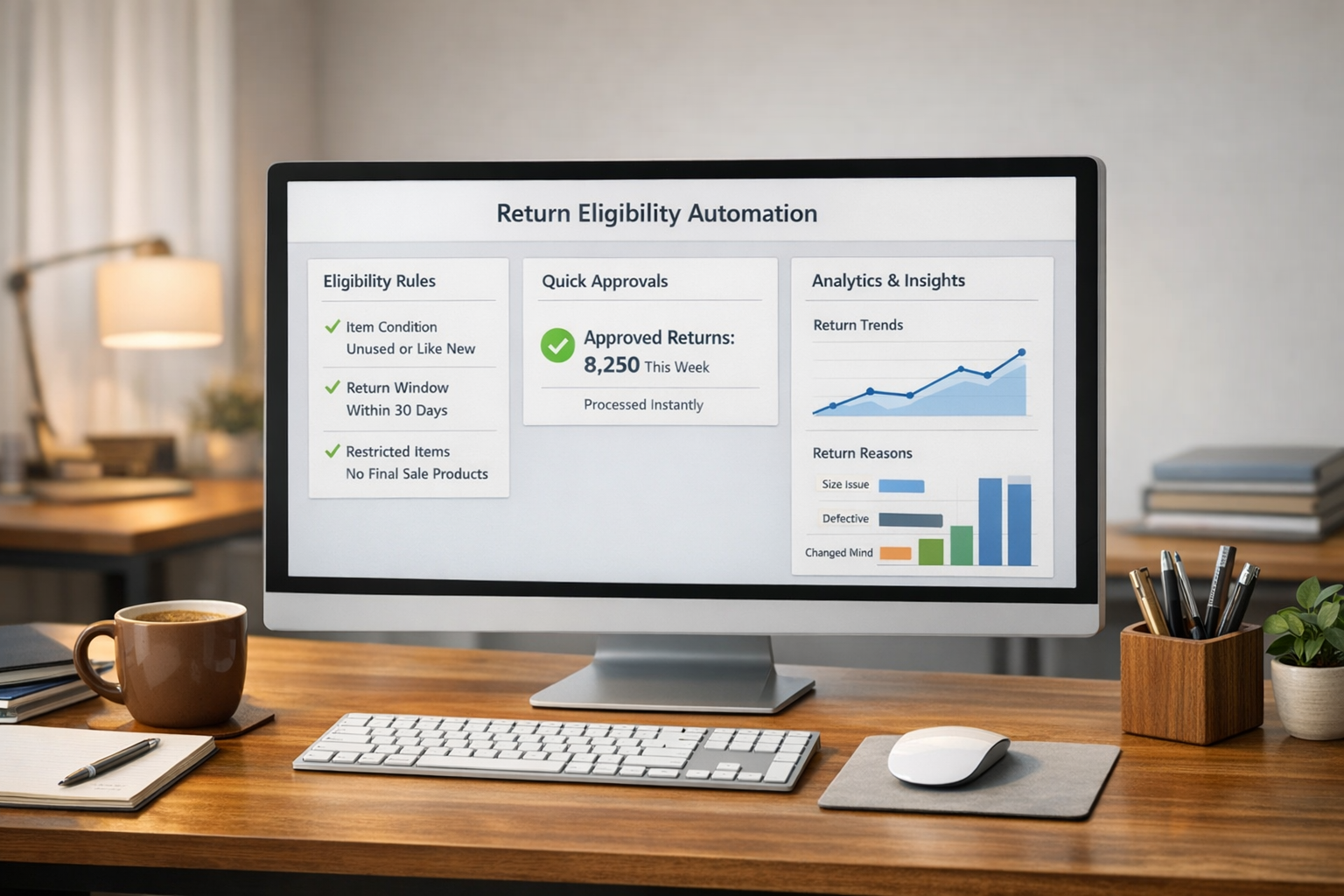
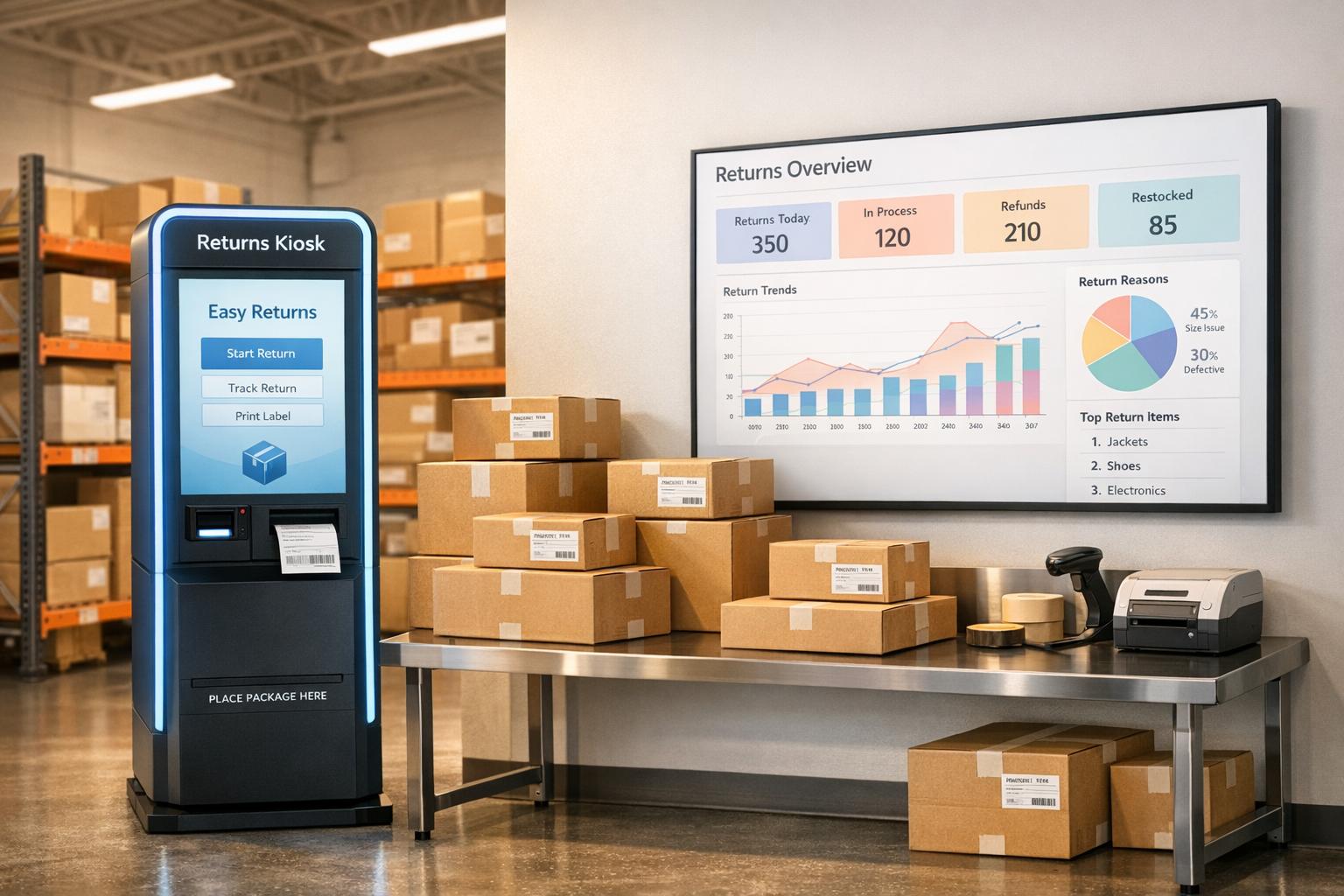
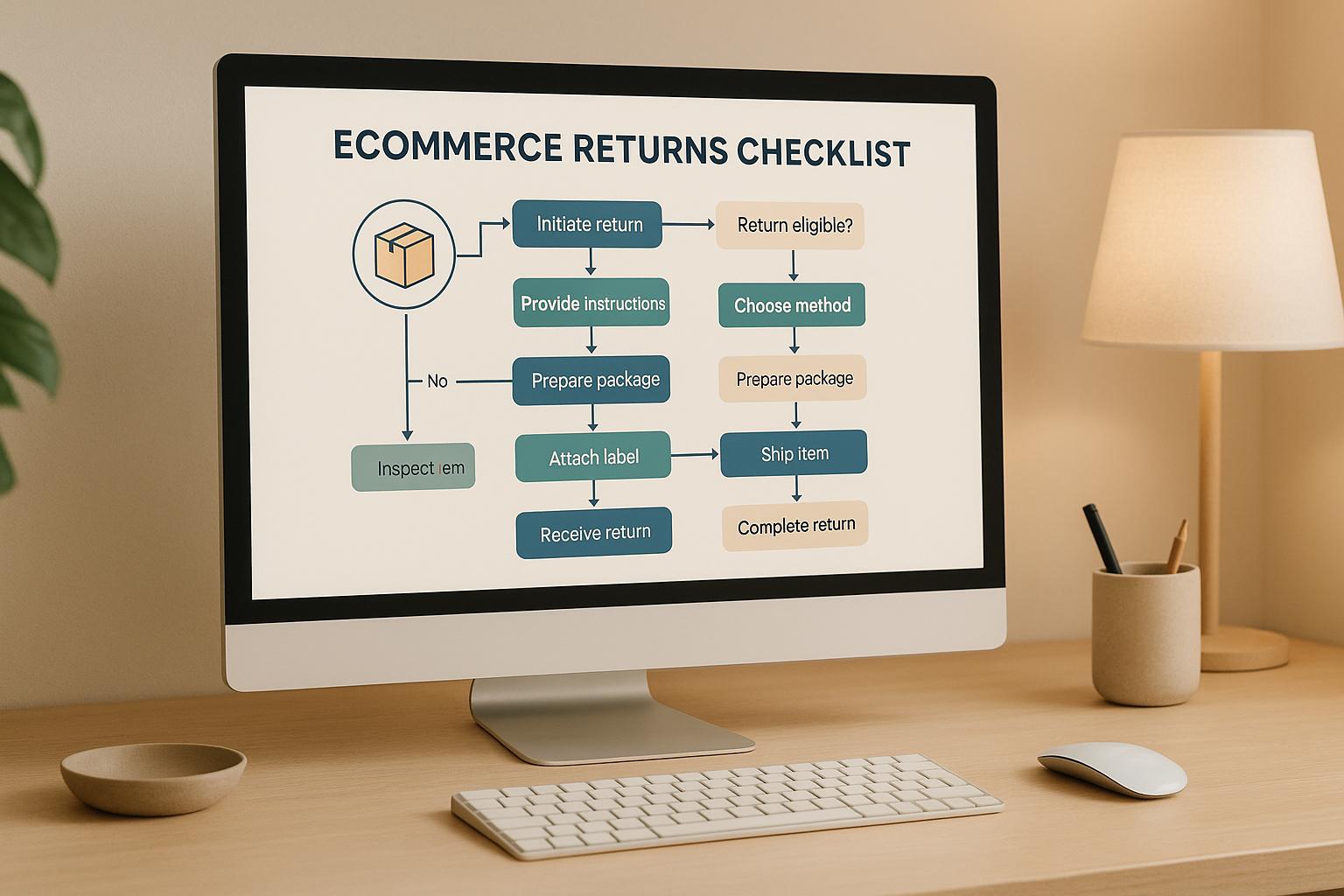
Automating returns can save businesses time, money, and improve customer satisfaction. Here's why it matters:
- Cost Savings: Manual return processes are expensive, costing businesses about $2,500 per 1,000 returns. Automation reduces labor costs and shipping expenses by using pre-negotiated carrier rates and smart rules like "Keep Item" for low-value returns.
- Efficiency: Manual returns take 2–3 times longer than shipping new orders. Automation speeds up the process by up to 50%, with features like self-service portals and instant label generation.
- Revenue Retention: Automated systems encourage exchanges and store credit over refunds, helping businesses retain up to 80% of potential revenue.
- Customer Experience: Automation provides faster resolutions, real-time updates, and convenient options like printerless QR code returns, keeping customers happy and loyal.
Switching to automated returns not only cuts costs but also turns returns into an opportunity to protect profits and build stronger customer relationships. Platforms like ForthRoute make this possible with tools that streamline the entire process.
How Automation Improves Returns Management
Handling returns manually can slow down operations significantly, especially as your business grows. Brian Lim, Founder and CEO of INTO THE AM, puts it plainly:
The biggest challenge for reverse logistics is the sheer amount of time it takes to process one return versus shipping out one order. It takes at least two to three times the amount of time.
This time drain becomes even more problematic when shipping discounts tied to volume are on the line.
Without automation, your customer service team is often bogged down with repetitive tasks for every return inquiry. This not only eats up valuable time but can also lead to inconsistent enforcement of return policies and higher shipping costs. By automating these tedious steps, businesses can save both time and money.
Automation platforms, such as Forthroute, streamline the returns process from start to finish. Instead of relying on back-and-forth email communication, customers can use a branded self-service portal to initiate returns. They simply enter their order number, select the items for return, and receive a prepaid shipping label instantly. The platform enforces your return policies automatically - for example, rejecting final sale items or flagging high-value returns for manual review - while low-risk returns are processed immediately. Inventory updates happen as soon as the carrier scans the package, cutting down the usual delay of waiting for items to reach the warehouse.
The financial impact of automation is hard to ignore. Merchants save an average of $2,500 per 1,000 returns by reducing labor costs, speeding up inventory updates, and negotiating better shipping rates through consolidated volume. For larger brands, first-year savings can climb as high as $23,700. Faster inventory turnover also reduces carrying costs, which often account for 20% to 30% of inventory value.
Beyond cost savings, automation helps retain revenue. Encouraging exchanges or store credit instead of refunds allows businesses to keep up to 80% of potential revenue. Additionally, 96% of shoppers who encounter a smooth returns process are likely to shop with the retailer again. This improved experience not only boosts customer loyalty but also transforms returns management from a financial drain into a competitive edge. When combined with volume-based shipping discounts, the result is stronger profit margins and happier customers.
1. Manual Returns Workflow
Shipping Cost Optimization
Handling returns manually can quickly drive up shipping costs, thanks to inefficient carrier choices and poor packaging decisions. Many businesses stick with familiar national carriers without comparing rates tailored to specific zones or package weights. On top of that, staff often select oversized boxes for smaller items - a mistake Kris Gösser from Shipium refers to as unused shipping space. This practice triggers dimensional weight fees, which can double or even triple shipping expenses.
Manual data entry adds another layer of cost. Errors like incorrect addresses or misrouted packages lead to carrier surcharges, re-shipment fees, and chargebacks. Without automation, returned items often take unnecessary detours - traveling to a central warehouse before being sent to a liquidation center or donation facility. These extra shipping legs chip away at profit margins. FreightPOP sums it up well:
Manual workflows often default to 'what's familiar' rather than 'what's best.' This results in avoidable overspending - shipment after shipment.
These inefficiencies not only inflate shipping costs but also create ripple effects that complicate other aspects of the operation.
Operational Efficiency
Manual systems slow everything down, creating bottlenecks at nearly every step. Tasks like label generation, return approvals, and tracking are done manually, often using outdated systems. In the warehouse, staff must individually inspect returned items to decide whether they should be restocked, liquidated, or donated - often without clear accountability or ownership of these decisions.
Even basic shipping tasks, like switching between carrier portals, creating labels, and updating records, can cost a business approximately $15,600 per employee annually for just 10 hours of manual work each week. With up to 30% of ecommerce orders resulting in returns, these inefficiencies only grow as your business scales.
Revenue Retention
Manual returns workflows directly impact your bottom line. Refunds are often the default resolution, meaning you lose the original sale, any customer acquisition costs, and fulfillment expenses. This is especially concerning when 65% of refunds across Shopify businesses are still processed manually.
On top of that, manual approval processes can lead to unnecessary revenue losses. Returns that should be rejected - like final sale items - are often approved, while opportunities to suggest exchanges that retain revenue are missed. The financial toll adds up fast: processing a single return can cost between 20% and 65% of the item's original value. Businesses relying on manual workflows lose around $2,500 annually for every 1,000 returns compared to those using automated systems.
Customer Experience
Manual handling doesn’t just hurt your operations - it also erodes customer trust. Without real-time tracking or automated updates, customers are left in the dark about their return status. This lack of transparency drives up support tickets and weakens brand loyalty. Slow response times further frustrate customers, contributing to a troubling statistic: 80% of shoppers won’t return to a brand after a negative post-purchase experience. When your team is bogged down with manual tasks, delivering the seamless experience customers expect becomes nearly impossible.
2. Automated Returns Workflow (e.g., Forthroute)
Shipping Cost Optimization
Automation takes the guesswork out of shipping costs by using pre-negotiated, volume-based carrier rates that most merchants wouldn’t have access to on their own. Forthroute, for instance, secures exclusive discounts with USPS and FedEx, offering savings of 2–10% per shipping label. It automatically compares rates across carriers to pick the most cost-effective option, saving time and eliminating the need for manual research.
It also helps merchants make smarter decisions about returns. For example, you can set up "Keep Item" rules for low-value products where return shipping costs more than the item itself - completely cutting out unnecessary shipping and processing expenses. Dynamic fee settings allow you to charge for refunds but offer free shipping on exchanges, nudging customers toward options that help retain revenue. Together, these tools add up to meaningful annual savings.
Operational Efficiency
Automation doesn’t just save money - it saves time. Processing manual returns often takes two to three times longer than handling outbound shipments. Automated workflows, on the other hand, can cut processing time by up to 50%. Customers can use self-service portals to initiate returns, select resolutions, and print shipping labels instantly, without needing to contact support.
Between February 2023 and February 2024, merchants using automated returns platforms collectively saved an estimated $8.8 million in customer support labor costs by reducing return-status inquiries. Enterprise merchants who switched from manual processes saved an average of $23,700 in their first year, with resolution times improving by 2.4 days - a nearly 10% improvement. These time and cost efficiencies help businesses focus on retaining revenue and improving customer satisfaction.
Revenue Retention
Automated returns shift the focus from refunds to exchanges and store credit, helping businesses keep more revenue. Forthroute’s system promotes exchanges first, using AI to suggest alternatives - like recommending a larger size when a customer returns an item for being too small. This approach can help brands retain up to 80% of revenue that might otherwise be lost.
The platform also facilitates instant exchanges by shipping replacement items as soon as the return is initiated. Plus, offering bonuses like $5 or $10 in extra store credit for choosing credit over a refund gives customers a reason to keep their money within your business. By combining these strategies with volume-based shipping discounts, merchants can offset rising shipping costs while protecting their bottom line. With return rates typically high in many industries, these automated features can make a noticeable difference to overall profitability.
Customer Experience
An automated return process is fast, easy, and transparent. Customers can use a branded portal to enter order details and complete their return in seconds - no back-and-forth emails or long waits for support. Forthroute’s printerless QR code returns make the process even smoother: customers simply show a QR code on their phone at a USPS or UPS location to have the label printed for them.
Real-time tracking updates keep customers informed at every step, significantly reducing the volume of “Where’s my refund?” inquiries. This matters because 80% of shoppers are unlikely to return to a brand after a poor post-purchase experience. By automating tedious steps and offering instant resolutions, you not only save time but also build customer loyalty - without needing to expand your support team.
sbb-itb-a3e286c
Pros and Cons
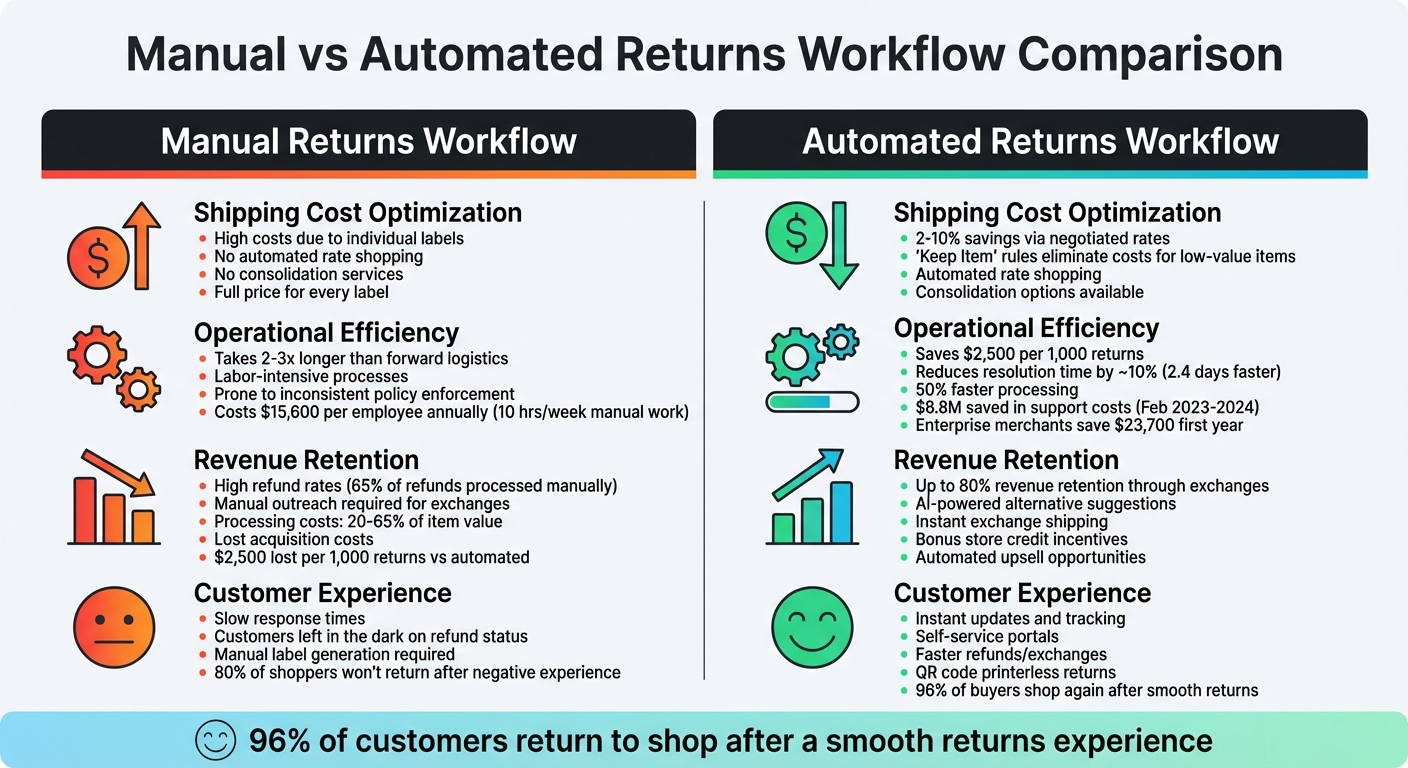
Manual vs Automated Returns Workflow Comparison
Let’s break down the differences between manual and automated workflows, focusing on their impact on costs, efficiency, and customer experience.
Manual workflows come with higher labor costs, slower processing times, and inconsistent application of policies. Without tools like automated rate shopping or access to discounted carrier rates, businesses end up paying full price for every shipping label. On top of that, manual coordination of returns often leads to delays, which frequently result in refunds instead of exchanges - hurting revenue retention.
Automated workflows, on the other hand, flip the script. Platforms like ForthRoute provide access to pre-negotiated carrier rates, cutting shipping costs by 2–10% per label. Features like automated "Keep Item" rules further reduce costs by eliminating shipping for low-value returns. Automation also speeds up resolution times by about 2.4 days (nearly 10%), while self-service portals handle tasks like label generation and status updates instantly, reducing the need for customer support.
| Criterion | Manual Returns Workflow | Automated Returns Workflow |
|---|---|---|
| Shipping Cost Optimization | High costs due to individual labels; no access to automated rate shopping or consolidation services | 2–10% savings via negotiated rates; "Keep Item" rules eliminate costs for low-value items; consolidation options available |
| Operational Efficiency | Labor-intensive; takes 2–3x longer than forward logistics; prone to inconsistent policy enforcement | Saves $2,500 per 1,000 returns; reduces resolution time by ~10%; automates 3PL and warehouse processing |
| Revenue Retention | High refund rates; manual outreach required to suggest exchanges; lost acquisition costs | Nudges customers toward exchanges (up to 80% retention); offers instant upsells and bonus credit incentives |
| Customer Experience | Slow response times; customers left in the dark regarding refund status; manual label generation required | Instant updates; self-service portals; faster refunds/exchanges; flexible drop-off options including QR codes |
Manual workflows are costly, inefficient, and leave customers waiting, while automation offers clear savings and faster processing. With 96% of buyers saying they’d shop again after a smooth returns experience, automation isn’t just a cost-saving tool - it’s a way to secure future revenue. These stark differences highlight how automation can transform operations and protect profits.
Conclusion
Automating returns can shift them from being a financial burden to a key part of protecting profits. Relying on manual processes for handling returns often leads to higher labor costs, slower turnaround times, and missed chances to save revenue. Automation not only eliminates these inefficiencies but also provides access to perks like volume-based shipping discounts and pre-negotiated carrier rates - advantages that manual methods just can't offer.
Platforms such as ForthRoute help cut hidden costs with features like "Keep Item" rules for low-value returns and automated rate comparisons. These tools reshape returns management, turning what was once a cost-heavy process into a strategic asset that protects margins and supports scalable growth.
A smooth and efficient returns process also strengthens customer loyalty. Self-service portals, quicker resolutions, and instant exchange options keep customers engaged, often encouraging them to opt for exchanges instead of refunds. For Shopify merchants managing returns at scale, adopting automation is a smart way to maintain profit margins while building stronger customer relationships.
Ready to see the difference? ForthRoute offers a 14-day free trial - no credit card needed - so you can experience firsthand how automation can boost your bottom line.
FAQs
How can automated returns help with volume-based shipping discounts?
When shipments hit certain thresholds - like a specific number of items or total weight - volume-based shipping discounts kick in. Tools like Forthroute make it easier for merchants to take advantage of these discounts during the return process. By consolidating multiple return items into one shipment and automatically generating discounted shipping labels, these tools apply the same volume-based pricing rules to returns. The result? Merchants keep their per-item shipping costs low while avoiding the hassle of manual processing, saving both time and effort.
What are the main advantages of automating returns management?
Automating returns transforms what used to be a tedious, error-prone task into a fast, efficient system. With a self-service portal and rule-based automation, return requests can be handled in just 90 seconds - cutting down processing time by over 95% compared to manual methods. This not only speeds up resolutions for customers but also lightens the load on your team.
Beyond saving time, automation reduces mistakes, trims labor costs, and can easily scale to manage large volumes of returns without needing extra staff. On average, businesses save about $2,500 for every 1,000 returns processed. Plus, features like instant exchanges, store credit options, and AI-driven product suggestions help retain more revenue while delivering a seamless, stress-free experience for customers.
How does automating returns enhance customer satisfaction and loyalty?
Automating returns makes the process quicker and easier for customers. Features like instant return initiation, real-time tracking, and simple access to shipping labels or exchange options remove much of the hassle, offering a more seamless experience.
When returns are handled smoothly, customers feel appreciated and respected, which strengthens their trust in your brand. This positive interaction not only encourages them to shop with you again but also helps build lasting loyalty - boosting your business's revenue in the long run.