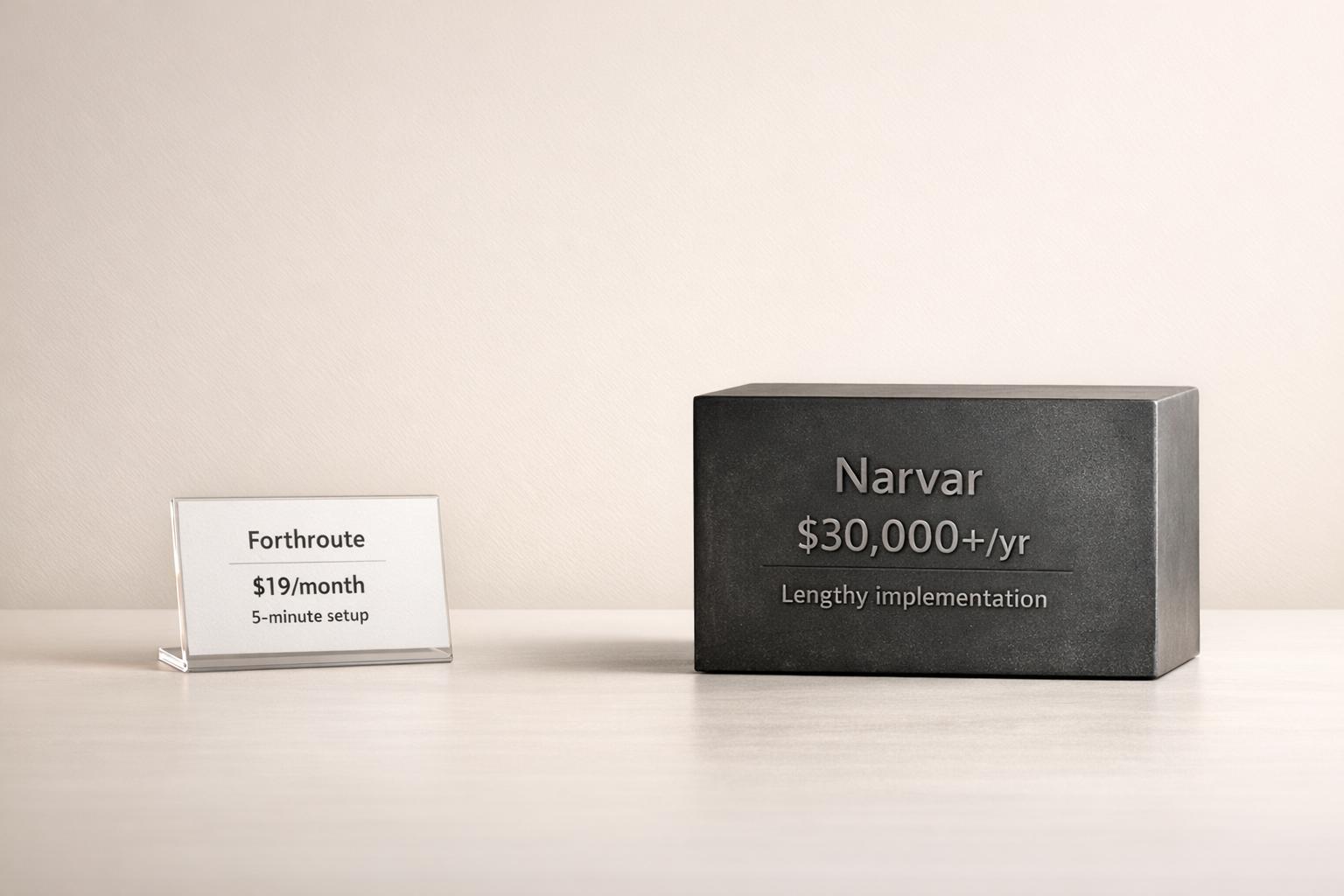
Managing returns effectively is critical for Shopify merchants in 2026. With return rates often exceeding 20–30% in industries like fashion and electronics, manual processes are no longer practical. Automated return management platforms not only simplify operations but also help retain revenue by encouraging exchanges and store credits over refunds. Here's a breakdown of the leading platforms:
- Forthroute: Flat pricing at $19/month + $1.50 per label. Unlimited returns, branded portals, and automation make it ideal for small to medium-sized stores.
- Loop Returns: Plans start at $59/month with advanced features like instant exchanges and fraud detection. Best for high-growth brands.
- AfterShip Returns: Affordable entry-level pricing at $11/month. Covers 20 returns with per-return fees for additional volume.
- Happy Returns: Offers over 10,000 drop-off locations in the U.S. Custom pricing suits large-scale businesses but may not be ideal for smaller stores.
- Narvar: Enterprise-focused with custom pricing starting around $30,000 annually. Supports international operations and advanced analytics.
- ReturnGO: Plans start at $23/month. Offers flexible return rules and AI-driven automation, suitable for growing Shopify merchants.
Key takeaway: Choose a platform that aligns with your return volume, budget, and need for automation. For smaller stores, Forthroute offers simplicity and affordability, while larger brands may benefit from Loop Returns or Narvar's advanced features.
Quick Comparison
| Platform | Starting Price | Key Features | Best For |
|---|---|---|---|
| Forthroute | $19/month | Unlimited returns, branded portals, automation | Small to medium-sized stores |
| Loop Returns | $59/month | Instant exchanges, fraud detection | High-growth brands |
| AfterShip | $11/month | Affordable, 20 returns included, per-return fee | Budget-conscious, low-volume stores |
| Happy Returns | Custom Pricing | 10,000+ drop-off locations, instant refunds | Large-scale U.S.-based businesses |
| Narvar | $30,000+/year | Enterprise analytics, global support | Enterprise retailers |
| ReturnGO | $23/month | AI-driven rules, multi-language support | Growing Shopify merchants |
Need a solution for your Shopify store? Start with Forthroute for just $19/month and simplify your returns process today.
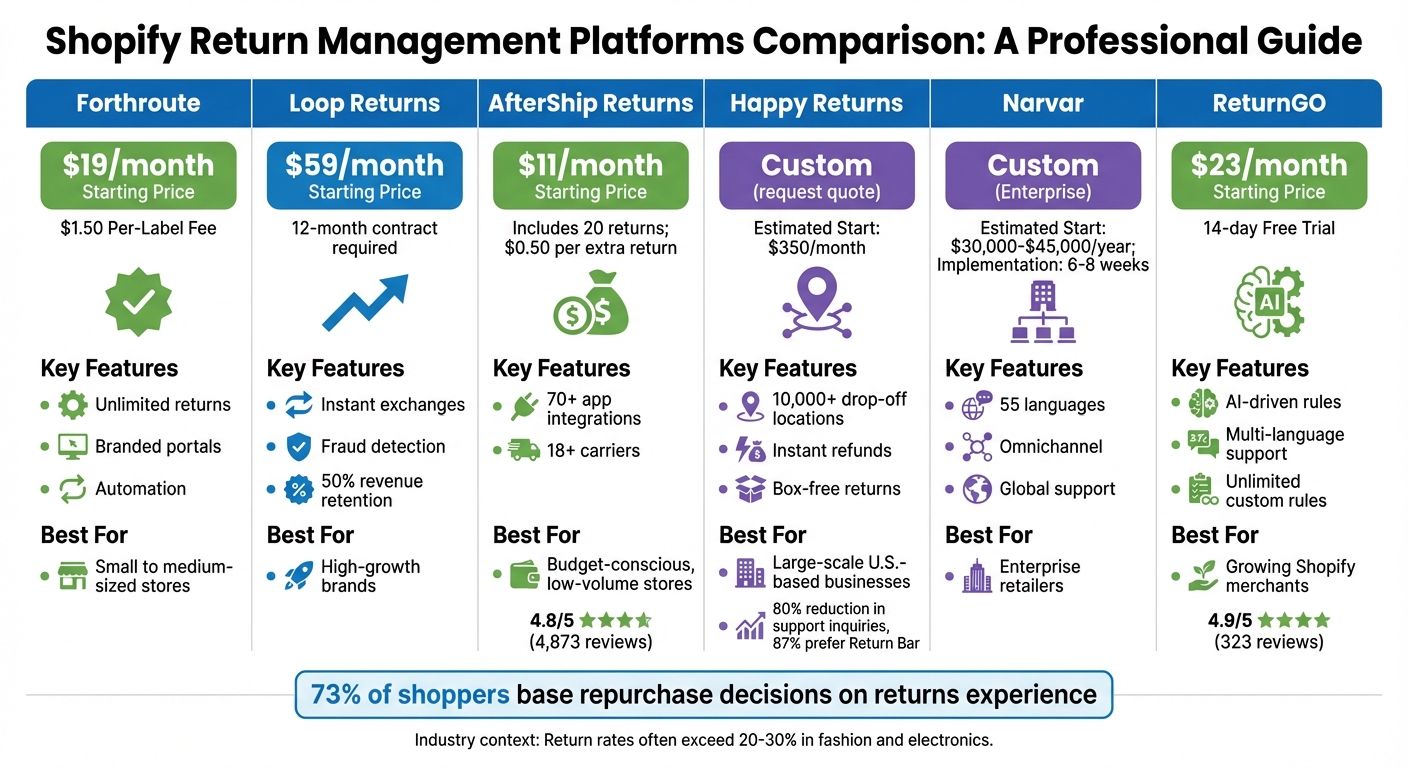
Return Management Platforms Pricing Comparison for Shopify 2026
1. Forthroute for Shopify
Pricing Structure
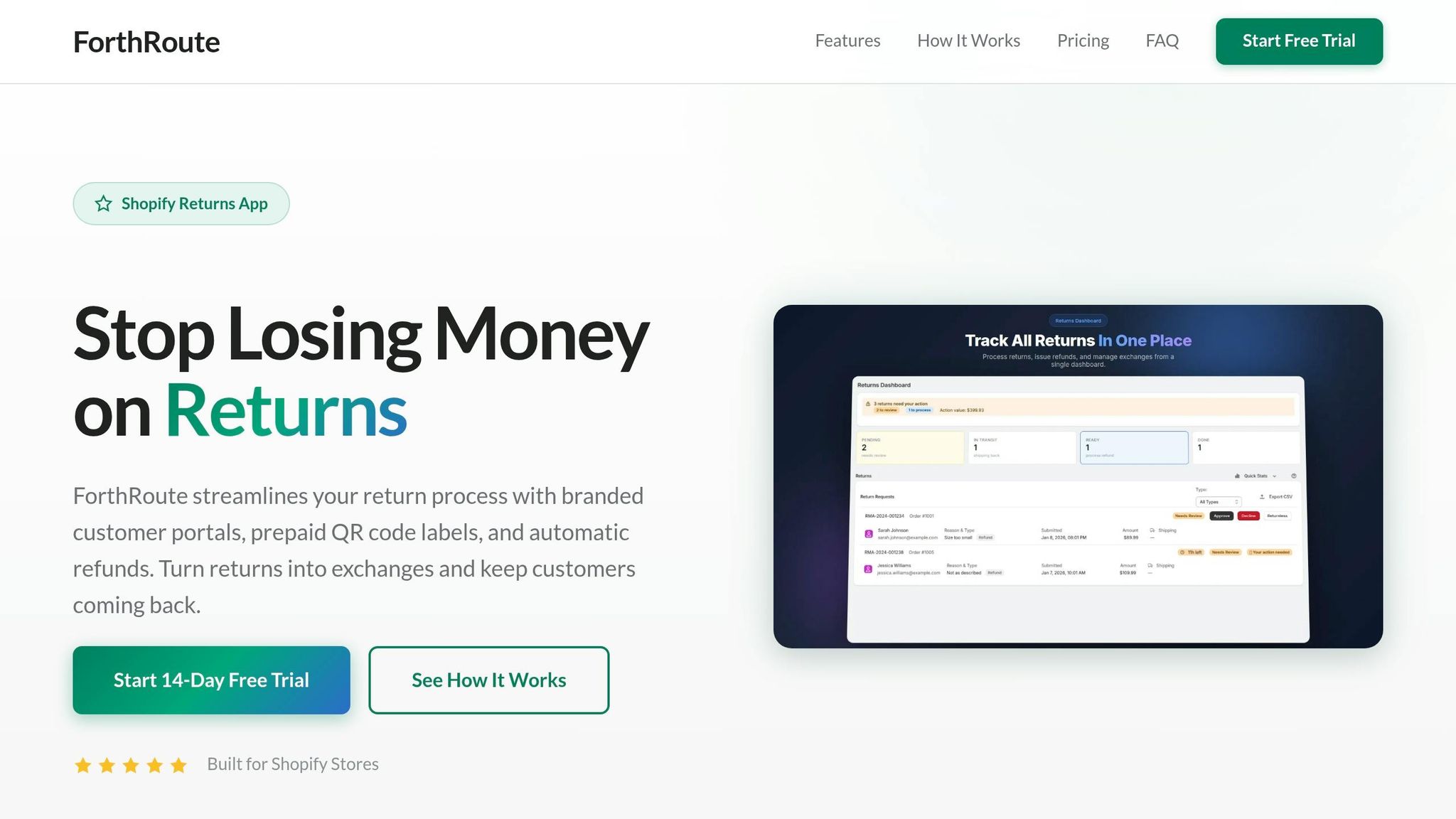
Forthroute keeps things simple with a flat $19/month subscription. This includes unlimited returns, a branded self-service portal, QR code labels, exchanges, store credit options, automated approval rules, and built-in analytics. Unlike tiered pricing models that fluctuate with return volume, this setup ensures your costs stay steady - even during busy seasons. The only extra charge is $1.50 per shipping label (plus the carrier rate), and you're only billed when the customer actually uses the label. Learn more about our integration.
Shopify Integration
Installing Forthroute is a breeze - just authorize it with one click from the Shopify App Store. It instantly syncs your order data, customer information, and inventory across all Shopify plans. For businesses with additional logistics needs, webhook API support integrates seamlessly with 3PL and warehouse management systems, keeping everything updated in real time as returns are received, inspected, and restocked. This deep integration sets the stage for a fully automated returns process.
Automation Features
Forthroute takes the hassle out of managing returns by automating the entire workflow. You set the rules once, and the system handles the rest. For example, you can auto-approve returns under $50 or reject items marked as Final Sale - no manual intervention needed. Once approved, prepaid shipping labels are generated automatically for carriers like USPS, UPS, and FedEx. It even supports printerless QR code returns, so customers can simply show a code on their phone at drop-off locations. This frictionless process not only saves time but also keeps returns running smoothly. Discover our return automation best practices.
Customer Return Portals
Forthroute offers a self-service portal that matches your store's branding, making returns easy for customers without involving your support team. Customers just enter their order number and email, select the items they want to return, and choose their preferred resolution - whether it's a refund, exchange, or store credit. The portal also nudges customers toward exchanges or store credit by offering smart suggestions. For instance, if a customer returns a shirt for sizing issues, the system might recommend the next size up, helping turn refunds into retained revenue. See our overview of return portal features.
Analytics and Scalability
Forthroute’s Return Analytics suite gives you valuable insights into your returns. It tracks return reasons, flags problematic SKUs, and monitors shipping costs per product. For example, if you notice a high return rate due to sizing issues, you can update product descriptions or adjust inventory accordingly. These insights don’t just help you manage costs - they also highlight opportunities to recover revenue lost through refunds. Whether you're handling 20 or 2,000 returns, Forthroute’s flat pricing ensures it scales with your business. Start optimizing your Shopify returns today for $19/month plus $1.50 per label, and take advantage of a 14-day free trial - no credit card required. Start your trial now.
sbb-itb-a3e286c
2. Loop Returns
Pricing Structure
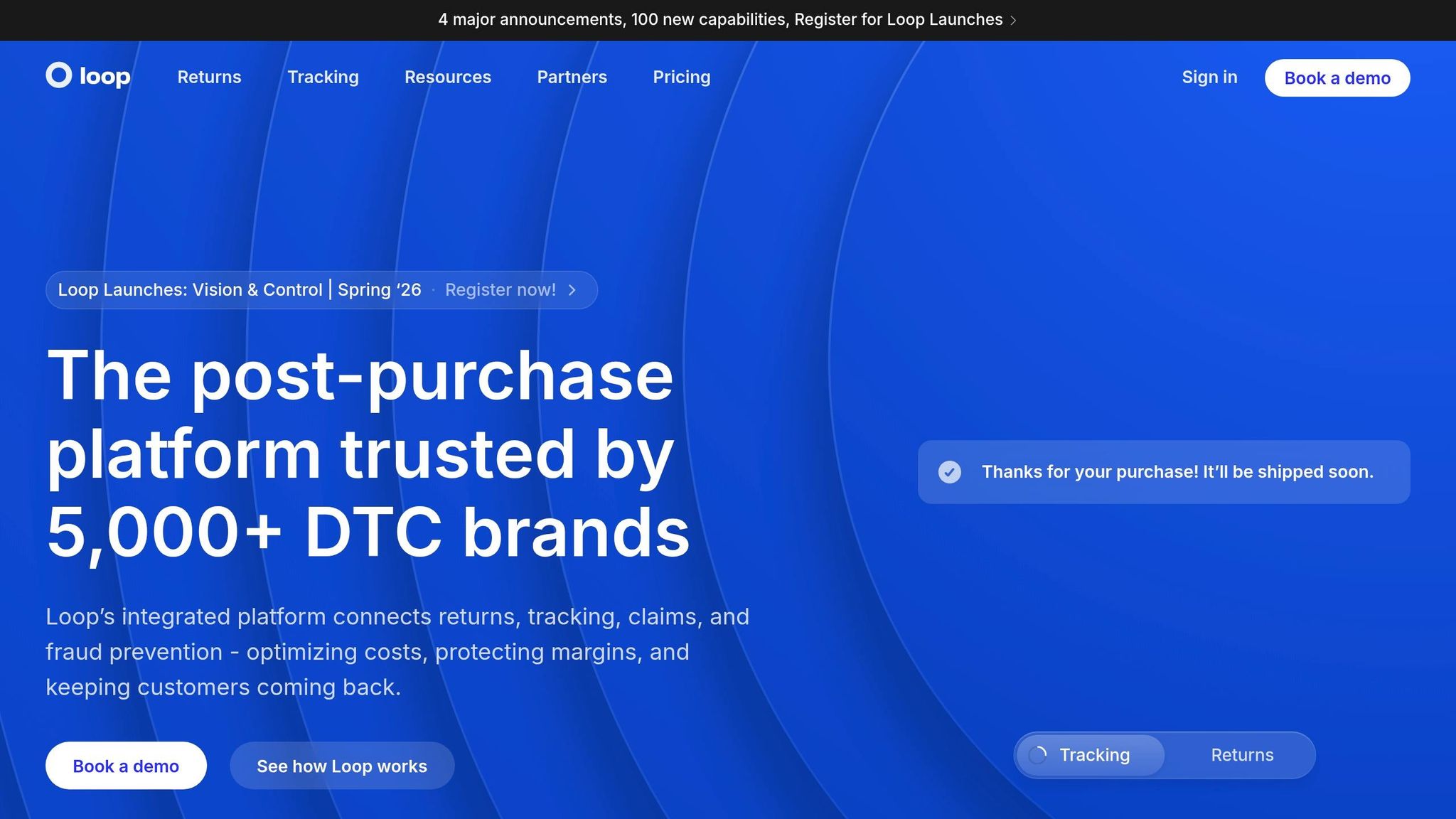
Loop Returns offers Shopify merchants a range of premium plans to streamline their return processes and improve customer retention. The Starter Plan is priced at $59/month, covering up to 1,000 returns annually, with one warehouse destination and basic automation included. The Essential Plan, priced between $155–$165/month, adds features like unlimited return policy customizations, support for two warehouse destinations, and custom brand URLs. For merchants needing more, the Advanced Plan costs $272–$375/month, offering unlimited warehouse destinations, the "Shop Now" feature, instant exchanges, and bonus credit incentives. Smaller merchants handling under 500 returns per year can opt for a usage-based plan starting at $29/month, with additional charges per return. Most plans require a 12-month contract, locking in the pricing for a year.
Shopify Integration
Loop Returns is designed to work seamlessly with Shopify, meeting the platform's highest standards for performance and design. It integrates natively with Shopify workflows and supports returns for both online and in-store purchases through Shopify POS. The platform also connects with Wonderment, a popular Shopify tracking app, to combine order tracking and return management in one system. Merchants can link Loop to Shopify development stores, allowing them to test return logic before launching. Additionally, Loop syncs orders and updates inventory, while coordinating warehouse actions through 3PL partners like ShipHero and Ryder.
Automation Features
Loop brings automation to the forefront, making return approvals easier with customizable rules tailored to specific business needs. Its "Loop Intelligence" feature helps detect fraud by using blocklists and custom rules. Instant exchanges are another highlight, enabling customers to swap products immediately without waiting for the original item to be returned. The "Shop Now" feature allows customers to use their refund credit to shop across the store's entire catalog, keeping revenue within the business.
Customer Return Portals
To enhance the customer experience, Loop Returns offers a self-service portal that aligns with your store's branding. This portal lets customers initiate returns without needing to contact support. Customers can choose between refunds, exchanges, or store credit, and the system even supports printerless QR code returns at select locations. The "Bonus Credit" feature adds an extra incentive, offering additional store credit - usually $5–$10 - if customers pick an exchange instead of a refund.
Analytics and Scalability
Loop provides merchants with detailed reporting on return trends, product performance, and revenue retention. While some users have asked for more in-depth data options, the platform remains a favorite among over 3,500 brands, including Princess Polly, Allbirds, and Marine Layer. Shopify merchants using Loop report a 30% drop in return rates and retain around 50% more revenue. With a 4.5/5 rating from 172 reviews on the Shopify App Store, users frequently commend its smooth integration, though some mention occasional bugs when viewing return requests within Shopify's native order view.
3. Aftership Returns
Pricing Structure
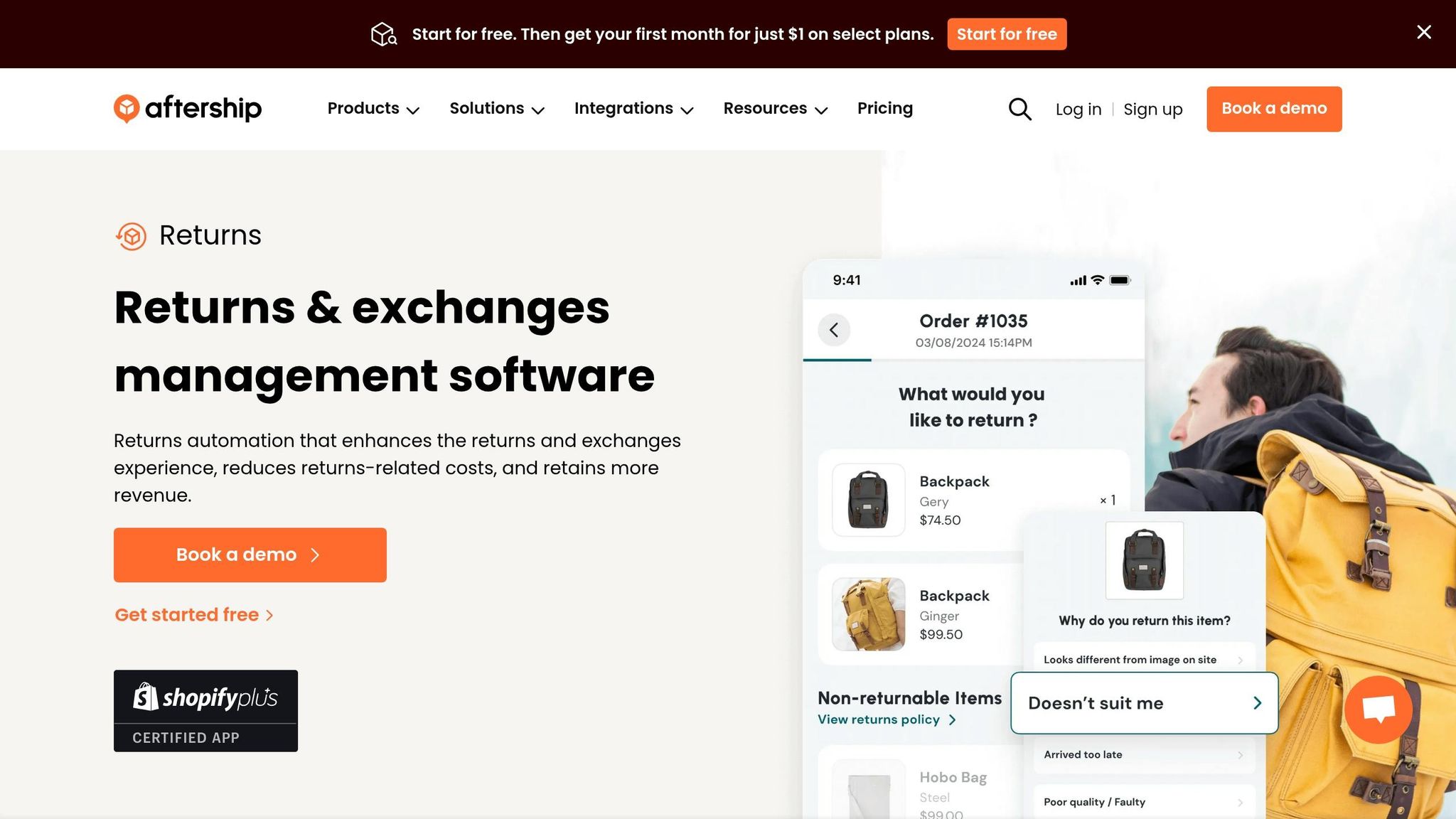
Aftership Returns provides Shopify merchants with a pricing model designed to balance affordability and automation. The Essentials plan starts at $11/month, covering 20 returns, with an additional $0.50 per extra return. The Pro Plan is priced at $59/month for 100 returns, also with a $0.50 fee for each extra return. For larger needs, the Premium Plan costs $239/month, covering 200 returns, with a $1.00 fee for extras. High-volume stores can explore Enterprise pricing, which offers custom features and advanced security options tailored to specific needs. As of March 2026, merchants can take advantage of a $1 trial for the first month across Essentials, Pro, and Premium plans.
For enhanced support, Silver support adds 20% of your subscription fee (minimum $200), while Gold support adds 30% (minimum $400), providing faster response times for businesses requiring premium service.
Shopify Integration
Aftership Returns integrates seamlessly with Shopify, syncing data across 70+ apps, including warehouse management, helpdesk, and marketing tools. It supports 18+ carriers and offers discounted USPS labels, making it a versatile option for merchants. The platform is ISO 27001 certified and GDPR compliant, ensuring robust data protection. With a 4.8/5 star rating from over 4,873 reviews on the Shopify App Store, it’s one of the highest-rated return management apps available.
Automation Features
The platform simplifies return management with rule-based workflows that automate approvals based on product type, return reason, and location. Prepaid return labels are generated through 18+ carriers, and smart routing helps reduce shipping costs. Fraud prevention tools are also built in to protect your revenue. Automated status updates via email, SMS, and Messenger keep customers informed, reducing the need for support intervention. Aftership highlights that 73% of shoppers say their return experience influences whether they’ll shop with a retailer again.
Customer Return Portals
A branded, self-service return portal allows customers to initiate returns or exchanges directly through your Shopify store. The portal supports 18 languages and integrates with over 1,100 carriers worldwide, extending its functionality for global operations.
Analytics and Scalability
Aftership Returns provides detailed analytics to help merchants understand return trends, refine product strategies, and manage inventory effectively. The platform is designed to scale, accommodating small stores with 20 returns per month and enterprise-level operations with custom volume requirements. While the entry-level pricing is attractive for startups, businesses should consider how per-return fees might impact costs as return volumes grow.
Next, we’ll take a closer look at Happy Returns to continue comparing Shopify return management platforms.
4. Happy Returns
Pricing Structure
Happy Returns, a subsidiary of PayPal, operates on a custom pricing model tailored to the needs of individual merchants. Retailers must request a personalized quote, which is determined by their specific logistics and order volume requirements. This flexibility caters to businesses with more intricate operations and higher transaction volumes.
For Shopify merchants, there’s an added perk: a free Return Shopping feature available through the Happy Returns Return & Exchange Portal. This tool encourages customers to use their refunds for new purchases directly within the portal. By treating the return and subsequent purchase as separate transactions, it simplifies financial reporting for businesses.
"Now, more than ever, shopper re-engagement and revenue retention are key priorities for merchants. It's not enough to make returns easy, merchants need to account for every dollar and bring shoppers back at every stage." - Sanaz Hajizadeh, Director of Product Management, Happy Returns
Shopify Integration
Happy Returns integrates smoothly with both standard Shopify and Shopify Plus accounts, leveraging API-based connections for seamless operation. A standout feature is its Return Bar network, which offers over 10,000 drop-off locations across the U.S., including partnerships with FedEx and Walgreens. These locations allow customers to return items without needing a box or printed label. Returns are initiated with QR codes that can even be saved to Apple Wallets for convenience.
The platform enjoys a high customer satisfaction score, with a 4.8/5 rating on G2 and Capterra. Users appreciate its eco-conscious approach and extensive return network. However, it’s worth noting that setting up Happy Returns can be more complex than Shopify-native apps, and its services are primarily focused on North America, which may limit its appeal for global sellers.
Automation Features
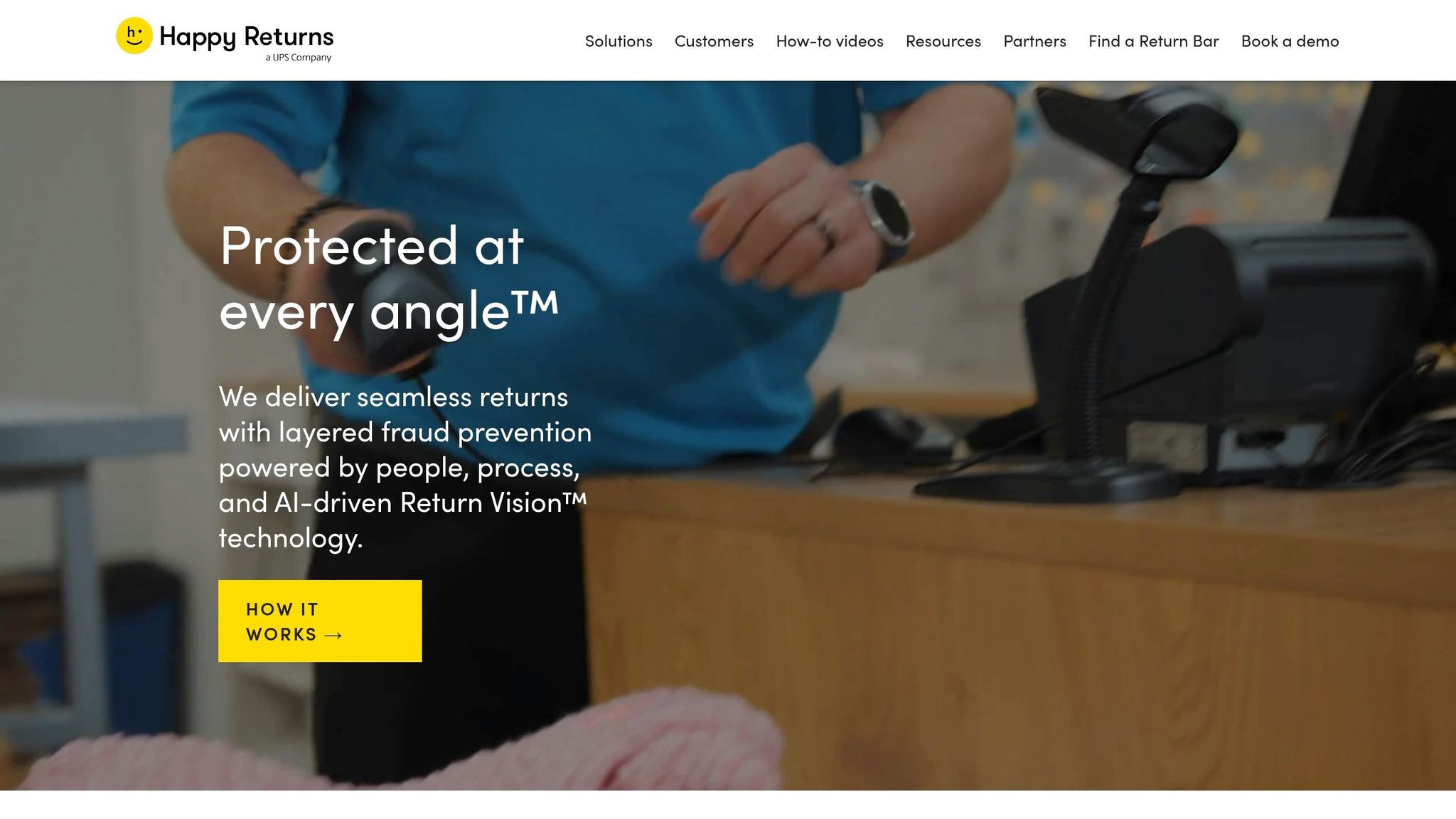
Happy Returns takes automation to another level with features designed to streamline the returns process. It employs AI-driven risk scoring and one-click exchanges to reduce fraud and speed up transactions. Its Return Vision technology identifies suspicious returns, delaying refunds until items are verified. For customers using Return Bar locations, refunds are processed instantly once items are checked in-person. Additionally, exchange suggestions are tailored based on the customer’s return reason and real-time inventory data.
These automation tools significantly reduce the operational burden on Shopify merchants. For example, Happy Returns reports an 80% drop in customer service inquiries related to returns. Furthermore, 87% of shoppers prefer using the automated Return Bar network. With a 93 Net Promoter Score (NPS), the platform is highly regarded by users, and 86% of shoppers are more likely to return to retailers offering immediate refunds at third-party locations. Consolidated returns also reach warehouses faster - cutting restocking times by 34%.
Case studies underscore these benefits. In 2024, Nogin saved nearly $1 million in its first year with Happy Returns by automating exchanges and reducing customer service costs by $500,000. Similarly, Peak Design achieved a zero detractor score for returns after adopting the automated portal and Return Bar network.
These automated workflows not only simplify operations but also feed into detailed analytics, crucial for scaling businesses.
Analytics and Scalability
Happy Returns is built for large-scale operations, making it an excellent choice for merchants in the U.S. with high order volumes and complex logistics. Its Return Bar network sets it apart from purely digital solutions by combining online portals with convenient in-person drop-offs. Additionally, the use of reusable totes for consolidated shipping from Return Bars to warehouses reduces cardboard waste, aligning with eco-friendly practices.
In June 2024, Happy Returns partnered with Loop, designating it as the preferred returns portal for Shopify brands. This collaboration combines Loop’s exchange-first workflows with Happy Returns’ box-free logistics.
"The optionality of Loop and the convenience of Return Bars is incredible. Together, they offer a more streamlined customer experience." - Audra Shipstad, Customer Experience Manager, Vitality
Next, we’ll take a closer look at Narvar to continue comparing return management platforms for Shopify.
5. Narvar
Pricing Structure
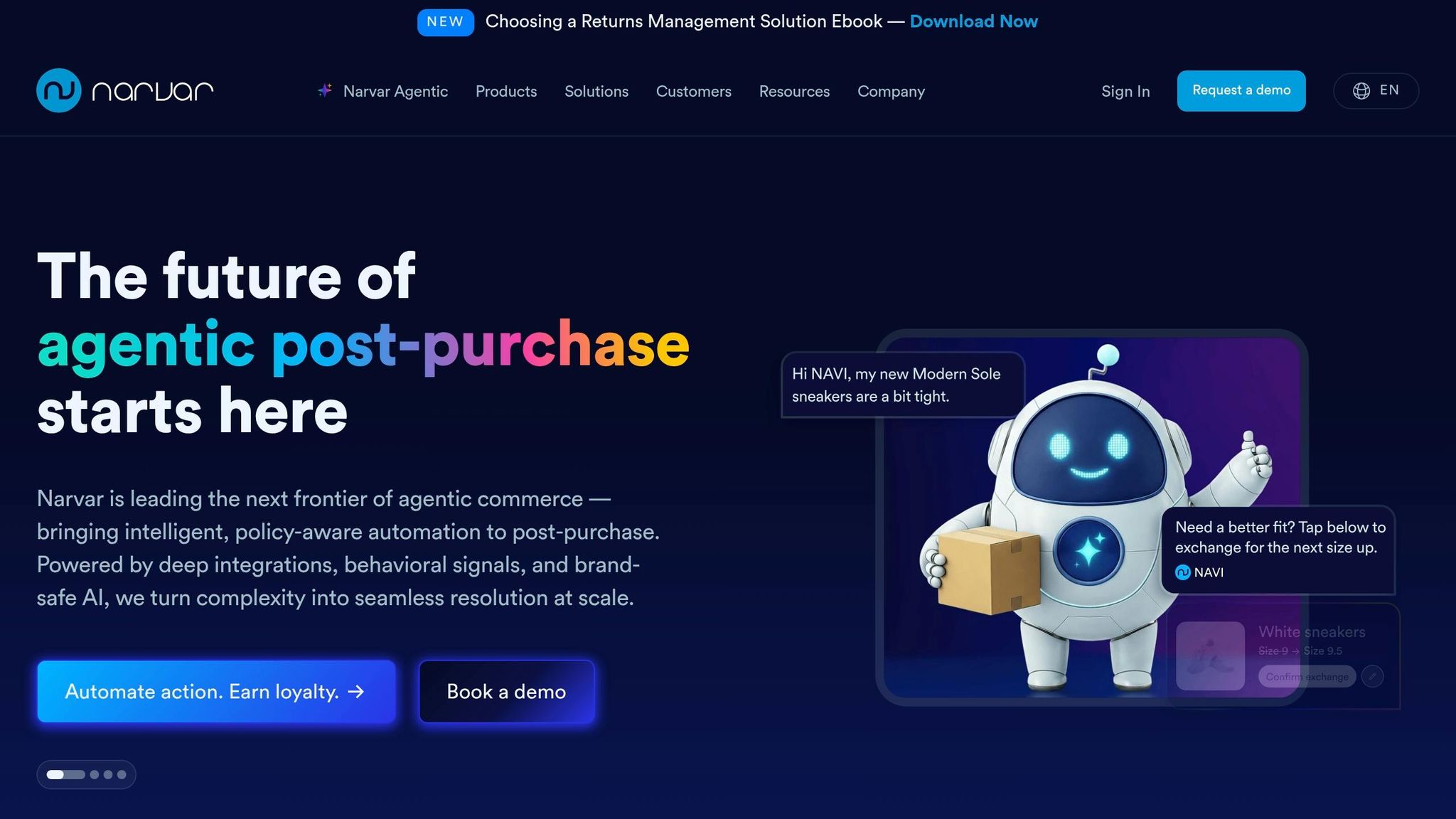
Narvar's pricing is customized based on factors like order volume, features, and geographical reach. This model is tailored for enterprise-level retailers such as Sephora and Levi's, rather than smaller Shopify stores.
Estimates suggest annual costs begin at $30,000–$45,000 for moderate order volumes with standard tracking features. The platform requires a substantial upfront investment, with implementation taking 6–8 weeks and demanding developer resources for API integrations, which are billed at $120–$250 per hour. Mid-sized retailers may face $15,000 to $50,000 in efficiency losses during this transition period. Additionally, merchants typically use their own carrier accounts, missing out on pre-negotiated shipping rates.
Shopify Integration
Narvar integrates seamlessly with Shopify, including Shopify Plus, through API connections that sync storefronts with ERP and WMS systems to ensure inventory accuracy. It has a 4.3/5 rating on the Shopify App Store (based on 19 reviews) and a 4.5-star rating on G2/Capterra. While the app is free to install, additional charges apply depending on usage and specific features.
The platform supports up to 55 languages in its return portal, making it suitable for international operations. It also enables omnichannel features like buy-online-return-in-store (BORIS) workflows, which are beneficial for retailers with physical locations. However, smaller businesses might find Narvar's complexity and extended deployment timeline excessive for their needs.
"The integration of Narvar has really helped the workload for our customer service team and created a simple self-serve process for customers." - King's Camo, Shopify Merchant
Narvar also connects with tools like Netsuite, Klaviyo, Gorgias, ShipHero, Recharge, and Tapcart. Looking ahead to 2026, Narvar plans to focus on "agentic AI", which will use autonomous systems for managing delivery promises, fraud detection, and proactive exception handling.
Automation Features
Narvar streamlines manual processes with customizable return rules. Merchants can automate approval or rejection criteria based on factors like order details, customer segments (e.g., VIPs), or product types such as final sale items. Dynamic routing capabilities generate return labels that direct packages to specific warehouses based on pre-set rules.
To retain revenue, Narvar prioritizes exchanges and store credits over refunds. Self-service portals allow customers to initiate returns, choose exchange options, and generate labels without needing support. Automated, branded email and SMS notifications keep customers informed about their return status and tracking updates. These features can reduce customer service workload by about 30%.
The platform offers access to over 200,000 drop-off locations, including Walgreens and the UPS Store. It also supports printerless and boxless returns via QR codes. Shopify stores can leverage Narvar's integration with Shopify Flow to create advanced workflows that trigger specific actions when a return is initiated.
"Narvar has been a reliable part of our post-purchase experience. The tracking pages are clean and on-brand, and the return flow is easy for customers to use and simple for our team to manage." - PB5star, Shopify Merchant
Analytics and Scalability
Designed for large-scale operations, Narvar provides detailed dashboards covering return reasons, inventory management, and operational efficiency. Its AI-driven insights help predict return trends and optimize routing. By 2026, Narvar aims to introduce "Confidence Engineering", transforming estimated delivery dates into dynamic decision-making tools that factor in carrier performance and fulfillment risks.
"By the end of 2026, estimated delivery dates (EDDs) will stop functioning as static facts and start operating as active decision engines." - Narvar Team
Narvar Shield focuses on fraud prevention and delivery protection. While the platform excels in post-purchase experiences and returns management, it does not currently support self-service warranty workflows.
With 85% of U.S. online shoppers unlikely to reorder after a poor delivery experience, Narvar's comprehensive post-purchase solutions are appealing for businesses handling high volumes. However, smaller Shopify merchants should weigh the platform's enterprise-level costs and lengthy implementation process against their specific needs and resources.
Next, we’ll take a closer look at ReturnGO to compare Shopify return management options further.
6. ReturnGO
Pricing Structure
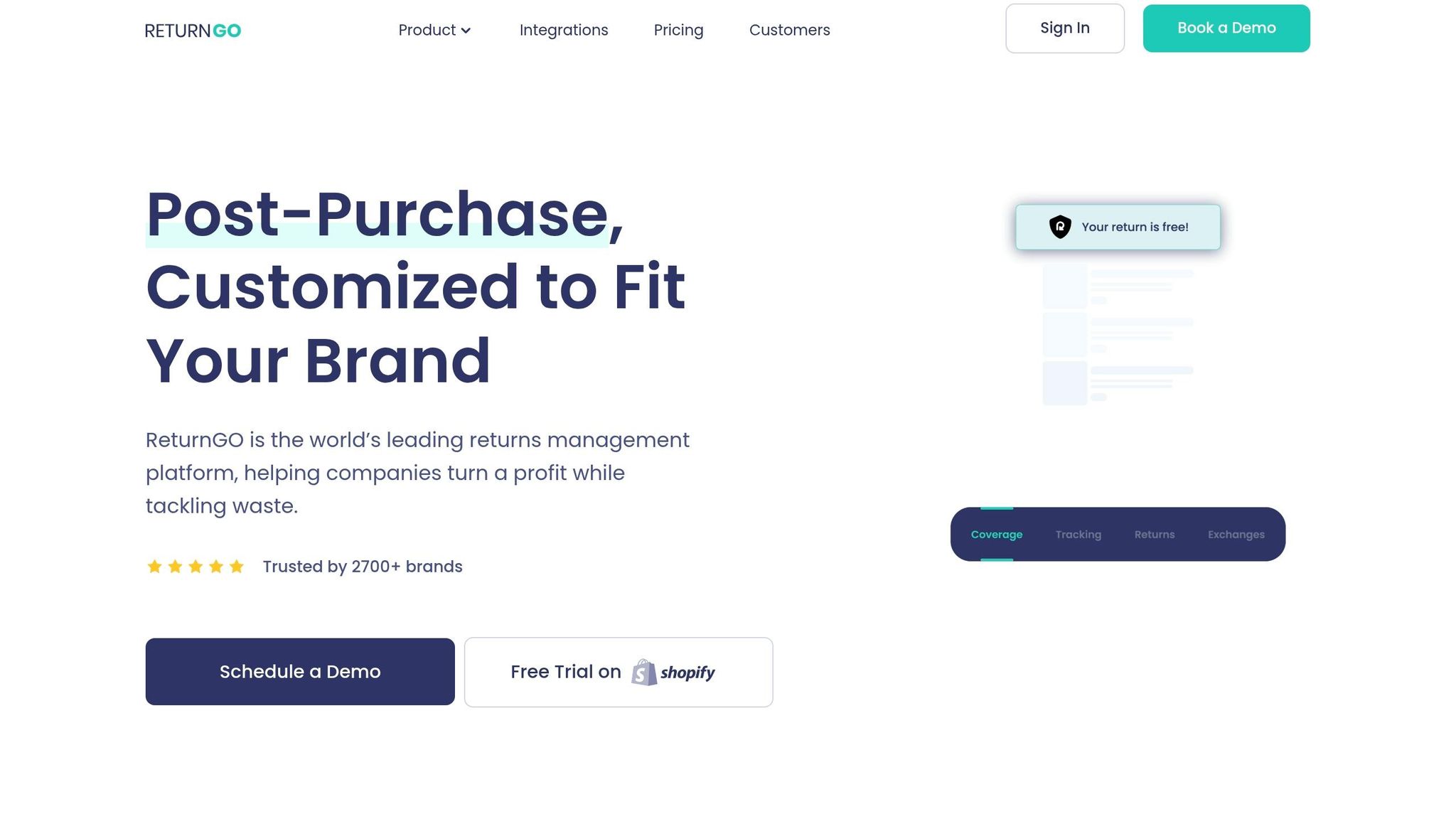
ReturnGO has four pricing tiers tailored for Shopify merchants at different growth levels. The Starter Plan starts at $23 per month, making it an affordable option for newer stores exploring return automation. For more advanced needs, the Premium Plan is $147 per month, while the Pro Plan costs $297 per month. Larger operations can opt for the Enterprise Plan, which offers custom pricing to suit high-volume requirements.
Every plan comes with a 14-day free trial, and there’s even a free version available for stores with low return volumes. This pricing approach allows merchants to access core automation features without a hefty initial investment.
Shopify Integration
As a native Shopify app, ReturnGO is easy to install and integrates seamlessly with Shopify’s system. It features an embedded, branded return portal that syncs in real time with Shopify.
The app has a 4.9 out of 5-star rating from 323 reviews on the Shopify App Store, with users frequently praising its smooth integration and reliable customer support. Key features include support for product and variant exchanges, gift returns, store credit, and order cancellations, all with instant inventory updates. Additionally, ReturnGO connects with a range of shipping carriers, 3PLs, ERPs, and helpdesks, ensuring compatibility with existing tools.
"ReturnGO is a native Shopify app with an easy install process, and integrates seamlessly with any shipping carrier, warehouse management system, helpdesk, and more." - mushdesk.com
Automation Features
ReturnGO leverages advanced automation to streamline return logistics. Its AI-driven decision trees allow merchants to create flexible return rules based on product categories or customer segments. Features like "auto-exchange", "auto-refund", "auto-approve", and "auto-credits" reduce the need for manual intervention in the RMA process.
Merchants can set unlimited custom rules to handle complex situations, such as gift returns, discounts, or geography-based eligibility. The system also generates pre-paid return shipping labels and sends real-time tracking updates for every shipment.
To help businesses retain revenue, ReturnGO focuses on one-click exchanges and instant exchange options. It even offers exchange bonuses to encourage customers to choose replacements over refunds. AI-powered suggestions further help merchants convert potential refunds into retained sales by recommending alternatives.
"ReturnGO offers more configurable rules and refund logic for teams that want tighter control." - Jens Ackermann, Content @ Claimlane
Customer Return Portals
ReturnGO’s self-service return portal is fully branded and integrated directly into the Shopify store, maintaining a visually consistent experience for customers. The portal supports multiple languages and currencies, making it a strong choice for international merchants. Customers can also upload images and videos to provide detailed context for their return requests, ensuring a smoother resolution process.
This attention to detail aligns with Forthroute’s dedication to providing efficient tools for Shopify merchants.
Analytics and Scalability
ReturnGO offers robust analytics to aid decision-making. Its real-time reporting dashboards track return reasons, costs, and trends, helping merchants spot patterns and refine their product offerings. With unlimited customizable rules, the platform supports scalable return operations.
While some users mention a learning curve due to the extensive customization options, the app still boasts a 9/10 rating from 363 reviews on Taranker, reflecting high user satisfaction. This balance of powerful analytics and automation ensures merchants can efficiently manage their return processes while scaling their operations.
5 Best Return Management Apps for Shopify
Platform Advantages and Disadvantages
Here's a breakdown of the strengths and trade-offs of some leading platforms, based on their features and pricing.
Loop Returns stands out for its exchange-focused workflows and AI-driven recommendations, which help merchants retain up to 50% of revenue that might otherwise be lost to refunds. By promoting strategic exchanges and store credits, it becomes a strong choice for brands looking to maximize revenue retention. However, its premium pricing - starting at $155 per month on annual contracts - positions it as an option best suited for high-growth, direct-to-consumer brands.
On the other hand, AfterShip Returns offers a more budget-friendly entry point at $11 per month. It boasts a network of over 1,100 carrier integrations and an easy setup process, earning it a stellar 4.8-star rating from 4,873 Shopify reviews. The downside? Its lower-tier plans come with strict volume caps, which could be a challenge for growing businesses.
For those prioritizing customization, ReturnGO provides advanced, rule-based return policies powered by AI decision trees. It even supports returns in multiple languages, making it versatile across regions. While its pricing is competitive, users often face a steep learning curve when working with its advanced automation tools.
Happy Returns takes a unique approach with its network of over 9,000 Return Bars across the U.S., enabling box-free, label-free in-person returns. This logistics model offers convenience but comes with higher costs - starting at $350 per month - and limited availability outside North America.
For enterprise-level retailers, Narvar offers robust omnichannel support, including buy-online-return-in-store options, and supports 55 languages. However, its custom pricing - ranging from $30,000 to over $250,000 annually - and long implementation times make it a better fit for large-scale operations.
The platform you choose depends on your store's size and priorities. Research shows that 73% of shoppers base their decision to repurchase on their returns experience. For small to medium-sized Shopify stores, platforms like AfterShip Returns and ReturnGO offer a solid mix of automation and affordability. In contrast, enterprise brands in sectors like fashion and electronics, where return rates often exceed 20–30%, may find Loop Returns' revenue retention features or Narvar's comprehensive ecosystem more beneficial.
"Returns are no longer just a cost center in eCommerce. They are a make-or-break factor for profitability, customer loyalty, and brand perception." - Joyeeta Ghosal, Return Prime
Conclusion
When it comes to managing returns for your Shopify store, the trick is to find a solution that matches your store's specific needs. This means balancing your return volume, budget, and the features that matter most to your business.
For small to medium-sized Shopify merchants handling fewer than 100 to 200 returns per month, platforms priced under $25 per month offer a practical way to automate the process. These tools focus on turning refunds into exchanges or store credit, helping businesses retain up to 50% of revenue that might otherwise be lost to refunds.
One standout option for Shopify merchants is Forthroute, which provides a simple, transparent pricing model at $19 per month, plus a per-label fee. This flat-rate structure - $19 monthly, carrier rates, and a $1.50 transaction fee per label - eliminates the unexpected costs often associated with volume-based pricing tiers. For growing stores, Forthroute offers key features like branded self-service portals, automatic approval rules, and workflows that prioritize exchanges, all at an affordable price.
If your store processes between 20 and 200 returns monthly and you’re focused on retaining revenue through exchanges, Forthroute’s automation tools are tailored to meet your needs. Take advantage of their trial period to explore the customer journey firsthand and uncover any hidden friction points that might not be obvious from pricing pages.
Want to turn returns into revenue? Start your 14-day free trial for just $19/month - no credit card required. Get started with Forthroute and see how branded portals and smart automation can transform your returns process.
FAQs
How do I estimate monthly returns cost on Shopify?
To figure out your monthly returns cost on Shopify, you'll need to factor in your return management platform's pricing and the number of returns your store handles. For smaller to medium-sized stores, ForthRoute offers a flat rate of $19/month, making it a budget-friendly option. Larger stores might consider platforms like Loop Returns, which start at $59/month. Add these platform fees to your average return volume and any extra per-label charges to get a clear picture of your total monthly expenses.
When should I switch from refunds to exchanges or store credit?
Consider shifting from offering refunds to providing exchanges or store credit if your goal is to strengthen customer loyalty, minimize revenue loss, and improve the overall return experience. Tools like Forthroute (priced at $19/month) can help Shopify merchants simplify and automate these processes. By integrating such AI-powered solutions, you can offer more flexible return options while keeping your bottom line intact.
What returns automations matter most for a small Shopify store?
For smaller Shopify stores, certain returns automations can make a big difference in saving time and keeping customers happy. Automated return labels are a must-have, as they make the return process straightforward for customers. Pair this with automated email notifications to keep customers updated every step of the way. On the backend, features like fraud detection and customizable workflows help safeguard your store and streamline operations. By focusing on tools that are easy to use and budget-friendly, small businesses can implement these automations without stretching their resources.